By using this site, you agree to the Privacy Policy and Terms of Use.
Accept
GMJ NewsGMJ NewsGMJ News
  • Latest News
  • Podcast & Media
  • Research Digest
    • New Studies
    • Georgian Research
    • Data & Numbers
  • Policy & Systems
    • Health Policy
    • Quality & Safety
    • Migration & Health
    • Global Health
  • Practice
    • Clinical Updates
    • Case Discussions
    • Pharmacy & Prescribing
  • Perspectives
    • Editorial
    • Explainers
    • Voices
    • Letters
  • GMJ Articles
    • Vol. 1 Issue 2 (2026)
    • Vol. 1 Issue 1 (2026)
    • Pre-Launch Articles (2025)
  • GMJ Briefs
  • Read the Journal →
Notification Show More
Font ResizerAa
GMJ NewsGMJ News
Font ResizerAa
  • Latest News
  • Podcast & Media
  • Research Digest
    • New Studies
    • Georgian Research
    • Data & Numbers
  • Policy & Systems
    • Health Policy
    • Quality & Safety
    • Migration & Health
    • Global Health
  • Practice
    • Clinical Updates
    • Case Discussions
    • Pharmacy & Prescribing
  • Perspectives
    • Editorial
    • Explainers
    • Voices
    • Letters
  • GMJ Articles
    • Vol. 1 Issue 2 (2026)
    • Vol. 1 Issue 1 (2026)
    • Pre-Launch Articles (2025)
  • GMJ Briefs
  • Read the Journal →
Follow US
GMJ News > Policy & Systems > Global Health > WHO Declares Ebola Outbreak in DRC and Uganda a Global Health Emergency
Global HealthPolicy & Systems

WHO Declares Ebola Outbreak in DRC and Uganda a Global Health Emergency

GMJ
Last updated: 05/25/2026 00:44
By
GMJ News Desk
Share
6 Min Read
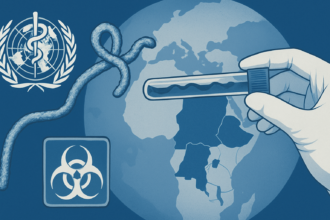
Map showing Ebola outbreak locations in Democratic Republic of Congo and Uganda with WHO emergency response indicators
WHO declares Ebola outbreak in DRC and Uganda a global health emergency as experts criticize proposed US travel restrictions. New vaccine development could take 9 months. — Photo: DΛVΞ GΛRCIΛ / Pexels
SHARE

The World Health Organization has declared the Ebola outbreak in the Democratic Republic of the Congo and Uganda a public health emergency of international concern, marking the most serious escalation of the epidemic caused by the Bundibugyo virus strain. Health experts are criticizing proposed US travel restrictions from affected regions as ineffective measures that could undermine global containment efforts.

Contents
      • Ebola Vaccine Development Timeline
  • WHO escalates response as outbreak spreads across borders
  • Vaccine development timeline creates treatment gap
  • Travel restrictions face scientific criticism
    • Key takeaways
  • Frequently asked questions
    • Why don’t existing Ebola vaccines work against this outbreak?
    • How effective are travel restrictions in containing Ebola outbreaks?
    • What makes this outbreak particularly challenging to control?
9 months
estimated time needed to develop and deploy vaccine for Bundibugyo strain

Ebola Vaccine Development Timeline

Time required for vaccine development by virus strain, months

6
Zaire strain
vaccine (existing)
9
Bundibugyo strain
vaccine (needed)
12-18
Novel strain
vaccine development

Source: World Health Organization, 2024 | Georgian Medical Journal News

WHO escalates response as outbreak spreads across borders

The World Health Organization announced the public health emergency designation following confirmation of cross-border transmission between the Democratic Republic of the Congo and Uganda. The outbreak involves the Bundibugyo ebolavirus, a strain distinct from the Zaire strain that caused the devastating 2014-2016 West African epidemic.

Submit Your Paper
GMJ_Submit_Banner

Unlike previous outbreaks, this epidemic presents unique challenges due to its occurrence in conflict-affected areas where rebel groups maintain control. The Centers for Disease Control and Prevention reports that accessing affected populations for contact tracing and medical care remains severely limited in these regions.

Public health officials are working to establish treatment centers while navigating security concerns that have already hampered response efforts. The global health community is mobilizing resources despite logistical obstacles in the affected areas.

Vaccine development timeline creates treatment gap

The current outbreak highlights a critical gap in pandemic preparedness, as existing Ebola vaccines were developed specifically for the Zaire strain and show limited effectiveness against Bundibugyo ebolavirus. According to the WHO’s emergency response team, developing and testing a new vaccine formulation could require up to nine months.

Pharmaceutical companies are racing to adapt existing vaccine platforms, but regulatory approval and mass production present additional hurdles. The absence of readily available vaccines forces health workers to rely primarily on supportive care and infection control measures.

Medical research institutions are exploring whether modified versions of existing vaccines might provide some cross-protection, though clinical data remains limited. The clinical response currently focuses on early case detection and isolation protocols.

Travel restrictions face scientific criticism

Proposed US travel restrictions targeting visitors from the Democratic Republic of the Congo, Uganda, and South Sudan have drawn sharp criticism from epidemiologists and global health experts. The evidence from previous outbreaks suggests that blanket travel bans often prove counterproductive and may discourage transparent reporting of cases.

Instead, public health authorities recommend enhanced screening measures at points of entry, combined with robust contact tracing systems. The approach focuses on identifying and monitoring travelers from affected areas rather than imposing complete restrictions that could isolate affected countries.

Travel restrictions during Ebola outbreaks can paradoxically increase transmission risk by driving people to use unofficial border crossings where health screening is impossible.

— Dr. Michael Ryan, WHO Health Emergencies Programme (WHO Emergency Response Guidelines, 2024)

Key takeaways

  • WHO declares Ebola outbreak in DRC and Uganda a public health emergency of international concern
  • Bundibugyo virus strain requires new vaccine development, estimated 9-month timeline
  • Proposed US travel bans criticized as ineffective by global health experts
  • Conflict zones complicate outbreak response and limit access to affected populations

Frequently asked questions

Why don’t existing Ebola vaccines work against this outbreak?

Current vaccines were developed specifically for the Zaire ebolavirus strain that caused the 2014-2016 West African epidemic. The Bundibugyo strain involved in this outbreak has different genetic characteristics that reduce vaccine effectiveness, requiring new formulations.

How effective are travel restrictions in containing Ebola outbreaks?

Scientific evidence suggests travel bans are largely ineffective and may worsen outbreaks by encouraging unofficial border crossings. Enhanced screening and contact tracing provide better results without isolating affected countries.

What makes this outbreak particularly challenging to control?

The outbreak is occurring in conflict-affected areas where armed groups control territory, making it difficult for health workers to reach affected populations. This limits contact tracing, treatment delivery, and vaccination campaigns when vaccines become available.

The international health community faces a complex challenge requiring coordinated diplomatic, security, and medical responses. Success will depend on balancing public health imperatives with geopolitical realities while avoiding measures that could inadvertently worsen the crisis through isolation and stigmatization of affected populations.

Source: Ebola: US ban on travellers from DRC, Uganda or South Sudan ‘not the solution’

TAGGED:DRCEbolaglobal health emergencyUgandaWHO
Share This Article
Facebook Copy Link Print
Leave a Comment Leave a Comment

Leave a Reply Cancel reply

Your email address will not be published. Required fields are marked *

Submit Your Paper →

Georgia's peer-reviewed open-access medical journal. No APC until January 2027.
Submit Manuscript →
US Travel Restrictions on Ebola-Exposed Regions Draw Human Rights Concerns

US travel restrictions on travelers from Ebola-affected regions in Central Africa are…

Healthcare Systems Must Prioritize Human Connection to Combat Employee Burnout Crisis

Healthcare workers face unprecedented burnout rates of 76%, driven by digital systems…

Air France Flight Diverts to Canada After Passenger From Ebola-Hit Congo Boards ‘In Error’

Air France flight from Paris to Detroit diverted to Montreal after passenger…

Submit Your Paper to GMJ

No APC until January 2027.
Submit Manuscript →

You Might Also Like

NAFDAC logo with pharmaceutical safety warning symbols and South African flag
Quality & Safety

NAFDAC Warns Nigerian Consumers After South African Antacid Recall Due to Contamination Risk

By
GMJ News Desk
Dr Víctor Elías Atallah Lajam and WHA79 leadership team at World Health Assembly Geneva 2026
Health Policy

World Health Assembly convenes in Geneva amid global health priorities

By
GMJ News Desk
Cruise ship in Antarctic waters with medical emergency response illustration
Global HealthPolicy & Systems

Andes Hantavirus Outbreak Infects 15 on Antarctic Cruise Ship

By
GMJ News Desk
CDC logo and mpox information materials highlighting political controversy over public health messaging
Health PolicyPolicy & Systems

CDC Mpox Information Page Becomes Target of Political Controversy Over Health Communication

By
GMJ News Desk
GMJ News > Policy & Systems > Global Health > WHO Declares Ebola Outbreak in DRC and Uganda a Global Health Emergency
Uncategorized

WHO Declares Ebola Outbreak in DRC and Uganda a Global Health Emergency

Last updated: 05/22/2026 02:40
By
Share
6 Min Read
SHARE

The World Health Organization has declared the Ebola outbreak in the Democratic Republic of the Congo and Uganda a public health emergency of international concern, marking the most serious escalation of the epidemic caused by the Bundibugyo virus strain. Health experts are criticizing proposed US travel restrictions from affected regions as ineffective measures that could undermine global containment efforts.

Contents
      • Ebola Vaccine Development Timeline
  • WHO escalates response as outbreak spreads across borders
  • Vaccine development timeline creates treatment gap
  • Travel restrictions face scientific criticism
    • Key takeaways
  • Frequently asked questions
    • Why don’t existing Ebola vaccines work against this outbreak?
    • How effective are travel restrictions in containing Ebola outbreaks?
    • What makes this outbreak particularly challenging to control?
9 months
estimated time needed to develop and deploy vaccine for Bundibugyo strain

Ebola Vaccine Development Timeline

Time required for vaccine development by virus strain, months

6
Zaire strain
vaccine (existing)
9
Bundibugyo strain
vaccine (needed)
12-18
Novel strain
vaccine development

Source: World Health Organization, 2024 | Georgian Medical Journal News

WHO escalates response as outbreak spreads across borders

The World Health Organization announced the public health emergency designation following confirmation of cross-border transmission between the Democratic Republic of the Congo and Uganda. The outbreak involves the Bundibugyo ebolavirus, a strain distinct from the Zaire strain that caused the devastating 2014-2016 West African epidemic.

Submit Your Paper
GMJ_Submit_Banner

Unlike previous outbreaks, this epidemic presents unique challenges due to its occurrence in conflict-affected areas where rebel groups maintain control. The Centers for Disease Control and Prevention reports that accessing affected populations for contact tracing and medical care remains severely limited in these regions.

Public health officials are working to establish treatment centers while navigating security concerns that have already hampered response efforts. The global health community is mobilizing resources despite logistical obstacles in the affected areas.

Vaccine development timeline creates treatment gap

The current outbreak highlights a critical gap in pandemic preparedness, as existing Ebola vaccines were developed specifically for the Zaire strain and show limited effectiveness against Bundibugyo ebolavirus. According to the WHO’s emergency response team, developing and testing a new vaccine formulation could require up to nine months.

Pharmaceutical companies are racing to adapt existing vaccine platforms, but regulatory approval and mass production present additional hurdles. The absence of readily available vaccines forces health workers to rely primarily on supportive care and infection control measures.

Medical research institutions are exploring whether modified versions of existing vaccines might provide some cross-protection, though clinical data remains limited. The clinical response currently focuses on early case detection and isolation protocols.

Travel restrictions face scientific criticism

Proposed US travel restrictions targeting visitors from the Democratic Republic of the Congo, Uganda, and South Sudan have drawn sharp criticism from epidemiologists and global health experts. The evidence from previous outbreaks suggests that blanket travel bans often prove counterproductive and may discourage transparent reporting of cases.

Instead, public health authorities recommend enhanced screening measures at points of entry, combined with robust contact tracing systems. The approach focuses on identifying and monitoring travelers from affected areas rather than imposing complete restrictions that could isolate affected countries.

Travel restrictions during Ebola outbreaks can paradoxically increase transmission risk by driving people to use unofficial border crossings where health screening is impossible.

— Dr. Michael Ryan, WHO Health Emergencies Programme (WHO Emergency Response Guidelines, 2024)

Key takeaways

  • WHO declares Ebola outbreak in DRC and Uganda a public health emergency of international concern
  • Bundibugyo virus strain requires new vaccine development, estimated 9-month timeline
  • Proposed US travel bans criticized as ineffective by global health experts
  • Conflict zones complicate outbreak response and limit access to affected populations

Frequently asked questions

Why don’t existing Ebola vaccines work against this outbreak?

Current vaccines were developed specifically for the Zaire ebolavirus strain that caused the 2014-2016 West African epidemic. The Bundibugyo strain involved in this outbreak has different genetic characteristics that reduce vaccine effectiveness, requiring new formulations.

How effective are travel restrictions in containing Ebola outbreaks?

Scientific evidence suggests travel bans are largely ineffective and may worsen outbreaks by encouraging unofficial border crossings. Enhanced screening and contact tracing provide better results without isolating affected countries.

What makes this outbreak particularly challenging to control?

The outbreak is occurring in conflict-affected areas where armed groups control territory, making it difficult for health workers to reach affected populations. This limits contact tracing, treatment delivery, and vaccination campaigns when vaccines become available.

The international health community faces a complex challenge requiring coordinated diplomatic, security, and medical responses. Success will depend on balancing public health imperatives with geopolitical realities while avoiding measures that could inadvertently worsen the crisis through isolation and stigmatization of affected populations.

Source: Ebola: US ban on travellers from DRC, Uganda or South Sudan ‘not the solution’

{“@context”:”https://schema.org”,”@type”:”NewsArticle”,”headline”:”WHO Declares Ebola Outbreak in DRC and Uganda a Global Health Emergency”,”description”:”WHO declares Ebola outbreak in DRC and Uganda global emergency. Bundibugyo strain requires new vaccine taking 9 months. Travel bans criticized as ineffective solution.”,”author”:{“@type”:”Organization”,”name”:”GMJ Editorial Team”},”publisher”:{“@type”:”Organization”,”name”:”GMJ News — Georgian Medical Journal”},”datePublished”:”2026-05-22″,”dateModified”:”2026-05-22″}

TAGGED:DRCEbolaglobal health emergencyUgandaWHO
Share This Article
Facebook Copy Link Print
Leave a Comment Leave a Comment

Leave a Reply Cancel reply

Your email address will not be published. Required fields are marked *

Submit Your Paper →

Georgia's peer-reviewed open-access medical journal. No APC until January 2027.
Submit Manuscript →
South Carolina Measles Outbreaks Linked to Childhood Undervaccination Clusters

New research reveals that 73% of measles cases in South Carolina occurred…

FDA Issues Class I Recall for VOCSN V+Pro Ventilators Over Critical Oxygen Leak Risk

FDA announces Class I recall of VOCSN V+Pro ventilators due to manufacturing…

UN Agencies Mobilize Emergency Response to New Ebola Outbreak in Eastern DRC

UN agencies deploy emergency medical supplies and surveillance teams within 72 hours…

Submit Your Paper to GMJ

No APC until January 2027.
Submit Manuscript →

You Might Also Like

WHO Emergency Committee meeting on Ebola Bundibugyo outbreak response
Global HealthPolicy & Systems

WHO Declares Ebola Bundibugyo Outbreak in DRC and Uganda a Public Health Emergency

By
GMJ News Desk
WHO health emergency response briefing room with epidemiologists reviewing outbreak data on screens
Global Health

WHO: Ebola outbreak in DRC and Uganda poses high regional risk but no global pandemic emergency

By
GMJ News Desk
WHO officials discussing Ebola outbreak response measures in Democratic Republic of Congo
Global HealthPolicy & Systems

WHO Raises Ebola Risk to ‘Very High’ in Democratic Republic of Congo

By
GMJ News Desk
Map of central Africa showing Ebola outbreak response zone with epidemiological data visualization
Global Health

Ebola outbreak in central Africa may be spreading faster than reported, warns WHO epidemiologist

By
GMJ News Desk
Facebook Twitter Youtube Instagram
Company
  • Privacy Policy
  • Contact US
  • GMJ Journal
  • Submit Manuscript
  • Editorial Team
  • Register at GMJ
  • Terms of Use

Sign Up For Free

Subscribe to our newsletter and don't miss out on our programs, webinars and trainings.

[mc4wp_form]

Join Community
Made by ThemeRuby using the Foxiz theme. Powered by WordPress
© 2026 Georgian Medical Journal (GMJ). Published by the Public Health Institute of Georgia (PHIG). All rights reserved.
Welcome Back!

Sign in to your account

Username or Email Address
Password

Lost your password?

Not a member? Sign Up