


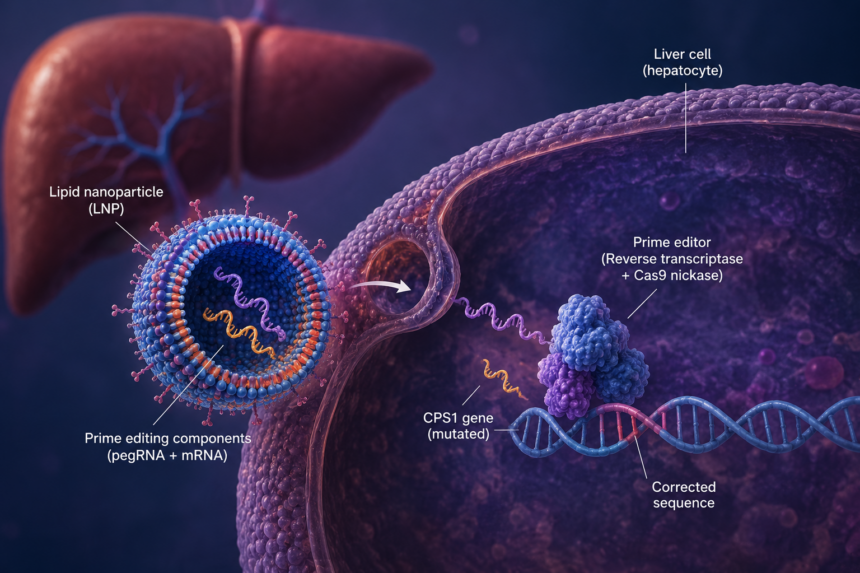
Researchers have demonstrated that an RNA-based gene-editing approach can reverse the symptoms of citrullinemia type I, a rare genetic liver disease, in a living mouse model. The study, published in Science Translational Medicine (Volume 18, Issue 849, May 2026), represents the first successful in vivo application of lipid nanoparticle (LNP)-delivered prime editing to correct a monogenic metabolic disorder.
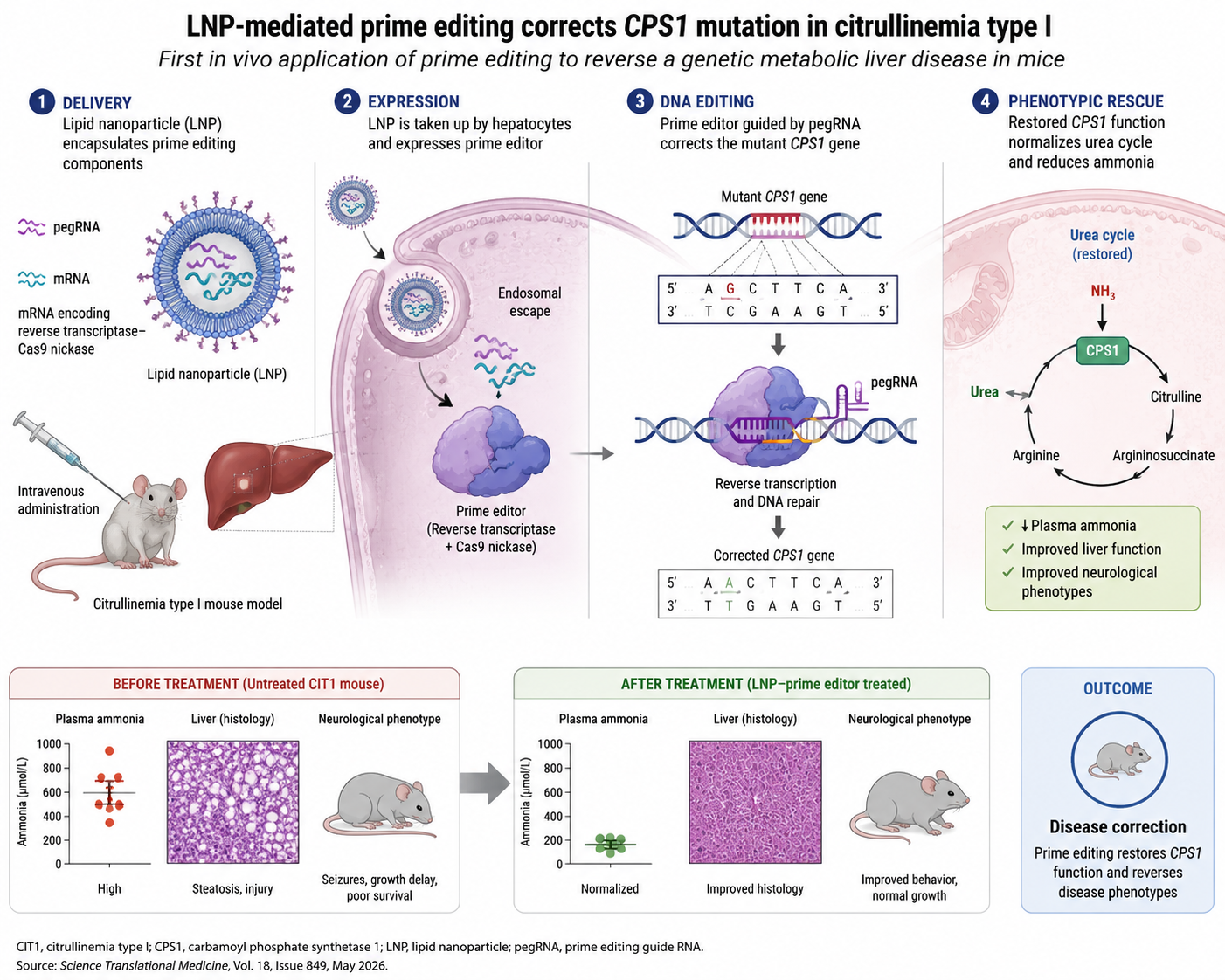
Prime Editing Technology Pathway: From Delivery to Disease Correction
| Stage | Component | Mechanism | Outcome |
|---|---|---|---|
| 1. Delivery | Lipid nanoparticles (LNPs) | Encapsulate RNA components | Transport to liver cells |
| 2. Expression | Prime editing machinery | Reverse transcriptase + Cas9 nickase | Functional enzyme produced |
| 3. DNA editing | PegRNA (pegRNA scaffold) | Guides correction of CPS1 gene | Mutated sequence repaired |
| 4. Phenotypic rescue | Citrulline metabolism restored | Ammonia detoxification functional | Disease symptoms reversed |
Source: Science Translational Medicine, May 2026
new research
Why Citrullinemia Type I Matters
Citrullinemia type I is a severe monogenic disorder caused by mutations in the carbamoyl phosphate synthetase 1 (CPS1) gene, which encodes a critical enzyme in the urea cycle. This metabolic pathway is essential for removing excess ammonia from the body, and when CPS1 is non-functional, ammonia accumulates to toxic levels, causing neurological damage and liver dysfunction. The disorder typically manifests in infancy or early childhood with seizures, developmental delays, and hepatomegaly, making it a life-threatening condition with limited treatment options beyond dietary protein restriction and nitrogen-scavenging medications.
Current therapeutic approaches offer incomplete disease correction. Dietary management requires strict protein restriction, and medications such as sodium benzoate and sodium phenylbutyrate can only partially mitigate ammonia toxicity by providing alternative pathways for nitrogen disposal. PubMed records indicate that even with optimal medical management, patients face persistent neurological complications and reduced quality of life. Gene therapy offers a potential path to stable, permanent correction by restoring functional CPS1 enzyme production within hepatocytes.
How Prime Editing Works
Prime editing is a newer generation of CRISPR-based gene-editing technology that differs fundamentally from conventional CRISPR-Cas9 systems. Rather than creating a double-strand break that relies on cellular repair machinery, prime editing uses a fusion protein combining a Cas9 nickase (which cuts only one DNA strand) with a reverse transcriptase enzyme. The system is guided by a pegRNA (prime editing guide RNA) that carries both the targeting sequence and the desired corrected DNA sequence, allowing the reverse transcriptase to synthesize the new genetic code directly into the DNA helix.
According to Science Translational Medicine (May 2026), the critical innovation in this study was packaging the prime editing machinery—pegRNA and mRNA encoding the reverse transcriptase–Cas9 fusion protein—into lipid nanoparticles (LNPs). LNPs are synthetic spheres composed of ionizable lipids, structural lipids, cholesterol, and polyethylene glycol that can cross biological membranes and deliver RNA cargo to target cells. The LNP formulation allowed systemic administration and preferential accumulation in the liver, the primary site of CPS1 expression.
Disease Correction in Living Mice
In the mouse model of citrullinemia type I, researchers administered a single intravenous dose of LNP-delivered prime editing components targeting the CPS1 mutation. Following treatment, the team observed restoration of functional CPS1 enzyme production in hepatocytes and normalization of ammonia metabolism. Plasma ammonia levels, which were elevated in untreated disease models, returned toward physiological ranges, and key neurological and hepatic phenotypes improved significantly.
This represents the first successful in vivo application of LNP-mediated prime editing to correct a monogenic metabolic liver disorder, demonstrating both technical feasibility and therapeutic efficacy in correcting disease phenotypes at the molecular and systemic levels.
— Science Translational Medicine research team (Science Translational Medicine, May 2026)
The durability of the correction and the potential for long-term safety remain important questions for future research. Because prime editing does not produce off-target DNA breaks at the same frequency as conventional CRISPR systems, it may carry a lower risk of genotoxicity, though comprehensive safety monitoring will be essential as the technology advances toward clinical trials. The study builds on earlier research in Nature Medicine and other peer-reviewed journals establishing the foundations of prime editing as a therapeutic modality.
Pathway to Human Translation
The successful demonstration in mice does not immediately translate to approved human therapies, but it establishes critical proof-of-concept needed for regulatory agency review. The U.S. Food and Drug Administration (FDA) has previously approved LNP-based therapies, including European Medicines Agency (EMA)-authorized mRNA vaccines, providing regulatory precedent for the safety and manufacturing standards required for LNP-delivered gene therapeutics. Researchers will need to conduct toxicology studies, optimize dosing, and evaluate immune responses before advancing to clinical trials in human patients.
For patients and families affected by citrullinemia type I, this research offers hope for a curative intervention rather than lifelong symptomatic management. Related gene therapy approaches are under investigation for other metabolic disorders, and the success of LNP-delivered prime editing may accelerate development of similar therapies for other monogenic hepatic diseases. Simultaneously, researchers in the field remain focused on improving editing efficiency, minimizing off-target effects, and understanding long-term immunogenicity—all critical factors for safe translation to human patients.
Key takeaways
- Lipid nanoparticle-delivered prime editing successfully corrected citrullinemia type I phenotypes in a living mouse model, marking the first in vivo demonstration of this approach for a metabolic liver disorder.
- Prime editing uses a Cas9 nickase fused to reverse transcriptase to synthesize corrected DNA directly, offering potentially lower off-target risk compared to conventional CRISPR-Cas9 systems.
- The LNP platform has established regulatory precedent through approved mRNA vaccines, though preclinical toxicology and immunogenicity studies remain necessary before human trials can begin.
- Current treatments for citrullinemia type I rely on dietary restriction and nitrogen-scavenging medications; a durable gene therapy could transform patient outcomes and quality of life.
Frequently asked questions
What is prime editing and how does it differ from CRISPR-Cas9?
Prime editing uses a Cas9 nickase fused to reverse transcriptase to edit DNA by cutting only one DNA strand and directly synthesizing the corrected sequence, rather than creating a double-strand break that relies on cellular repair. This approach, according to Science Translational Medicine (May 2026), results in fewer off-target DNA breaks and potentially lower genotoxic risk.
Why use lipid nanoparticles to deliver gene-editing machinery?
Lipid nanoparticles (LNPs) are synthetic spheres that can cross biological membranes and protect RNA from degradation during transport through the bloodstream. The LNP formulation allows systemic administration with preferential liver accumulation, enabling delivery of both pegRNA and mRNA encoding the prime editing enzymes to hepatocytes where they are needed.
When might this therapy become available to human patients?
While this preclinical success is significant, regulatory approval requires toxicology studies, immunogenicity assessment, and clinical trials. The FDA has approved LNP-based vaccines, providing regulatory precedent, but patient recruitment and trial conduct typically require several years before a new gene therapy reaches the clinic.
The successful reversal of citrullinemia type I phenotypes using LNP-mediated prime editing represents a milestone in translational gene therapy. While regulatory and manufacturing challenges remain before human trials can commence, this research demonstrates that in vivo genetic correction of monogenic metabolic disorders is technically achievable and biologically effective. For families living with rare genetic diseases, advances in prime editing and related therapeutic platforms offer renewed optimism that durable cures—rather than lifelong symptom management—may soon become clinical reality.