By using this site, you agree to the Privacy Policy and Terms of Use.
Accept
GMJ NewsGMJ NewsGMJ News
  • Latest News
    • GMJ Briefs
  • Podcast & Media
    • Podcast Episodes
    • GMJ Audio
    • GMJ Videos
  • Research Digest
    • New Studies
    • Georgian Research
    • Data & Numbers
  • Policy & Systems
    • Health Policy
    • Quality & Safety
    • Migration & Health
    • Global Health
  • Practice
    • Clinical Updates
    • Case Discussions
    • Pharmacy & Prescribing
    • Ingredients A-Z
  • Perspectives
    • Editorial
    • Explainers
    • Voices
    • Letters
  • GMJ Articles
    • Vol. 1 Issue 2 (2026)
    • Vol. 1 Issue 1 (2026)
    • Pre-Launch Articles (2025)
  • Read the Journal →
  • About GMJ News
Notification Show More
Font ResizerAa
GMJ NewsGMJ News
Font ResizerAa
  • Latest News
    • GMJ Briefs
  • Podcast & Media
    • Podcast Episodes
    • GMJ Audio
    • GMJ Videos
  • Research Digest
    • New Studies
    • Georgian Research
    • Data & Numbers
  • Policy & Systems
    • Health Policy
    • Quality & Safety
    • Migration & Health
    • Global Health
  • Practice
    • Clinical Updates
    • Case Discussions
    • Pharmacy & Prescribing
    • Ingredients A-Z
  • Perspectives
    • Editorial
    • Explainers
    • Voices
    • Letters
  • GMJ Articles
    • Vol. 1 Issue 2 (2026)
    • Vol. 1 Issue 1 (2026)
    • Pre-Launch Articles (2025)
  • Read the Journal →
  • About GMJ News
Follow US
GMJ News > GMJ Briefs > Strength Training Reverses Brain Aging at the Neural Level, New Trial Reveals

Strength Training Reverses Brain Aging at the Neural Level, New Trial Reveals

GMJ
Last updated: 30/07/2026 11:30
By
Prof. Giorgi Pkhakadze
Share
1 Min Read
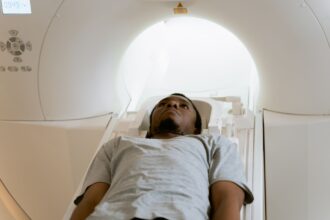
Illustration of strength training exercise with brain neural networks overlay
A randomized controlled trial in GeroScience shows that 2–3 weekly sessions of structured resistance training significantly reduce biological brain age as measured by fMRI-derived brain clocks. Effects distributed across multiple neural networks with no change in non-exercise controls. — Photo by Yan Krukau on Pexels (Pexels License)
SHARE
1 min read|142 words

A randomized controlled trial published in GeroScience provides robust evidence that resistance training fundamentally alters brain aging trajectories. Adults who completed 2–3 structured weekly sessions with progressive, moderate-to-heavy loads demonstrated measurable reductions in biological brain age over 1–2 years, with functional connectivity patterns shifting toward a younger neural signature.

The findings are particularly significant because benefits were not confined to isolated brain regions. Instead, functional improvements distributed across multiple neural networks, suggesting that resistance exercise triggers systemic neural remodeling rather than localized adaptation. The non-exercise control group showed no significant change, establishing causality between the training protocol and observed brain protection.

Mechanistic pathways may include increased cerebral perfusion, enhanced neurotrophic signaling, and reduced systemic inflammation—all established contributors to healthy brain aging. These results support resistance training as a practical, evidence-based strategy for cognitive and neurological protection.

Read the full article on GMJ Newsroom.

Submit Your Paper
GMJ_Submit_Banner

Was this article helpful?

GMJ Brief · Announcement

📰 Read the full article: Resistance Training 2–3 Times Weekly Reduces Brain Age, Randomized Trial Shows →

Share This Article
Facebook LinkedIn Bluesky Copy Link Print
GMJ
ByProf. Giorgi Pkhakadze
Follow:
Prof. Giorgi Pkhakadze, MD, MPH, PhD, is Editor-in-Chief of the Georgian Medical Journal and Chair of the Public Health Institute of Georgia (PHIG). He is Professor and Head of the Department of Social and Behavioural Sciences at David Tvildiani Medical University, and Secretary/Treasurer of the UEMS Section of Public Health. ORCID: 0000-0001-7609-4515.

Submit Your Paper →

Georgia's peer-reviewed open-access medical journal. No APC until January 2027.
Submit Manuscript →
How Medical Practice Transforms When Evidence Shifts: The Case for Continuous Clinical Learning

Medical practice must continuously adapt as evidence evolves, yet the transition from…

Why Nutrients Work Better Together: How Coordinated Inputs Reshape Brain Synapses

New neuroscience research reveals that synapses respond more robustly to coordinated nutrient…

L-Theanine Improves Task Accuracy Without Expected Brain Wave Changes, Research Shows

L-theanine marketing claims about alpha brain wave enhancement lack experimental support in…

Submit Your Paper to GMJ

No APC until January 2027.
Submit Manuscript →

You Might Also Like

UN Aviation Agency Issues Safety Alert as Ebola Spreads in DRC and Uganda

By
Prof. Giorgi Pkhakadze
27/05/2026
Updated 2025-2030 Food Pyramid showing emphasis on fruits, vegetables, proteins, and healthy fats

Every Five Years: How U.S. Dietary Guidelines Evolve with Evidence

By
Prof. Giorgi Pkhakadze
02/08/2026
Healthcare provider counseling diverse family about autism support services

Three Critical Barriers to Autism Care in South Asian Families—and How Providers Can Help

By
Prof. Giorgi Pkhakadze
02/08/2026
Medical illustration showing stem cell-derived heart patch being placed on damaged cardiac tissue

Stem Cell Heart Patches Offer New Treatment Path for Millions with Advanced Heart Failure

By
Prof. Giorgi Pkhakadze
04/06/2026
Facebook Twitter Youtube Instagram
Company
  • Privacy Policy
  • Contact US
  • GMJ Journal
  • Submit Manuscript
  • Editorial Team
  • Register at GMJ
  • Terms of Use

Subscribe to GMJ News — Click here

Join Community
© 2026 Georgian Medical Journal (GMJ). Published by the Public Health Institute of Georgia (PHIG). All rights reserved.
Welcome Back!

Sign in to your account

Username or Email Address
Password

Lost your password?

Not a member? Sign Up