World Health Organization · 2025 · 17 pages
Global surveillance framework for detecting, investigating and reporting human H5 avian influenza infections for public-health professionals and clinicians.
- Issuer
- World Health Organization
- Edition
- 2025
- Audience
- Public health authorities, clinicians, National IHR Focal Points, National Influenza Centres, epidemiologists, animal health authorities
- Evidence
- Expert consensus based on previous zoonotic influenza surveillance experience and current H5 epidemiology
- Reviewed
- 16 Oct 2026 · GMJ
What this guideline says
GMJ summary
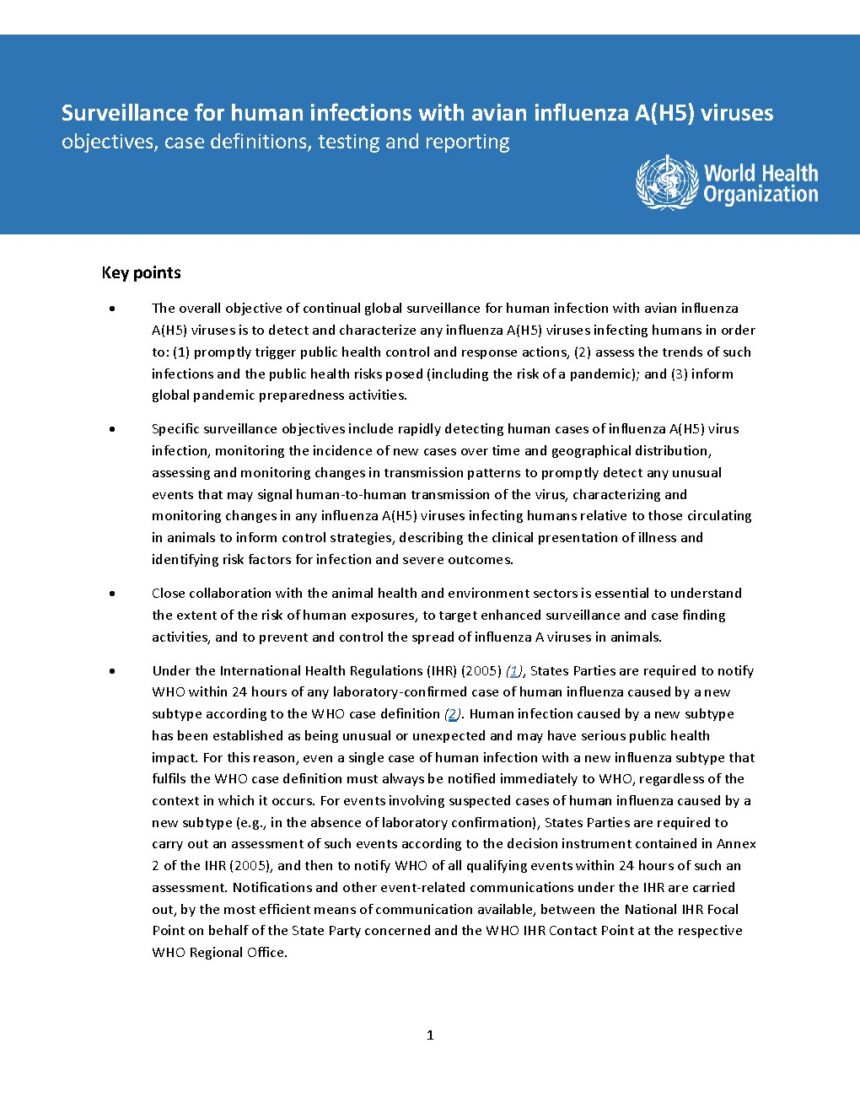
This WHO guidance establishes a comprehensive framework for global surveillance of human infections with avian influenza A(H5) viruses. The document addresses the unprecedented H5N1 epizootic affecting wild birds, poultry and mammals, and outlines objectives for early detection, risk assessment and pandemic preparedness through coordinated One Health surveillance.
The guidance provides standardized case definitions (suspected and confirmed), testing protocols and reporting requirements under the International Health Regulations (2005). A suspected case requires unexplained acute respiratory illness with fever >38°C or respiratory symptoms or conjunctivitis, plus exposure to infected animals, contaminated environments or confirmed cases within 14 days. Confirmation requires PCR, virus isolation or serology with specific criteria including ≥4-fold neutralizing antibody rise to ≥1:40 titre.
Countries must notify WHO within 24 hours of any laboratory-confirmed case of human influenza caused by a new subtype. The document emphasizes collaboration between human, animal and environmental health sectors, with specific enhanced surveillance requirements for countries experiencing H5 outbreaks in animals, including monitoring of occupationally exposed workers and systematic investigation of all confirmed cases and their contacts.
Key points
For clinicians — doses and thresholds as stated in the guideline
- Suspected case: unexplained acute respiratory illness with fever >38°C or cough/dyspnoea or conjunctivitis, plus exposure to infected animals/environments/cases within 14 days prior to symptom onset
- Confirmed case requires PCR, virus isolation, or paired sera with ≥4-fold neutralizing antibody rise to ≥1:40 titre (acute specimen within 7 days of onset, convalescent ≥21 days post-onset)
- Single convalescent serum (≥21 days post-onset) with neutralizing titre ≥1:40 plus positive HI ≥1:40 or ELISA, and epidemiological link to confirmed case, meets confirmation criteria
- Test all patients with severe unexplained acute respiratory illness who lived in or travelled to H5-affected areas, had animal/market exposure, or contact with sick individuals with such exposures in the 14 days prior to onset
- Test health care workers developing acute respiratory illness or conjunctivitis after caring for patients with severe unexplained acute respiratory illness
- In H5-affected countries, test outpatients with acute respiratory infection/ILI/conjunctivitis who had exposure to infected or presumed infected animals in the 14 days prior to illness onset
- Notify WHO within 24 hours of any laboratory-confirmed case of human influenza caused by a new subtype under IHR (2005); even a single case requires immediate notification
- All influenza A-positive specimens unable to be subtyped must be sent immediately to National Influenza Centre, then to WHO Collaborating Centre for detailed characterization
Case definitions for surveillance of human A(H5) infection
Table extracted from the guideline
| Case classification | Clinical criteria | Exposure criteria (within 14 days prior to onset) | Laboratory criteria |
|---|---|---|---|
| Suspected case | Unexplained acute respiratory illness with fever (>38°C) OR cough, shortness of breath or difficulty breathing OR conjunctivitis | • Close contact (within 1 metre) with suspected/confirmed H5 case, OR • Exposure in H5-affected area: close contact with live/sick/dead infected animals or animal products, consumption/handling of raw meat or unpasteurized milk, exposure to contaminated surfaces/water, visiting live animal market/farm/zoo, OR • Handling samples suspected of containing H5 virus |
Not applicable |
| Confirmed case (Option 1) | Any | Any | Positive PCR, virus isolation, or paired sera with ≥4-fold neutralizing antibody rise to ≥1:40 titre (acute <7 days onset; convalescent ≥21 days post-onset) |
| Confirmed case (Option 2) | Any | Epidemiological link to laboratory-confirmed human case | Single convalescent serum (≥21 days) with: • Neutralizing antibody titre ≥1:40, AND • HI titre ≥1:40 or positive ELISA/binding assay |
Source: World Health Organization, Surveillance for human infections with avian influenza A(H5) viruses: objectives, case definitions, testing and reporting. Reproduced in summary form.
From the guideline
Verbatim
“Even a single case of human infection with a new influenza subtype that fulfils the WHO case definition must always be notified immediately to WHO, regardless of the context in which it occurs.”
Editor’s perspective
Why this matters for Georgia and the region
Prof. Giorgi Pkhakadze, MD, MPH, PhD
Editor-in-Chief, Georgian Medical Journal · Chair, Public Health Institute of Georgia · WHO consultant, health and migration
As someone who has supported Georgia's IHR implementation since 2008, I recognize that this H5 guidance arrives at a critical moment when avian influenza surveillance in the Caucasus requires urgent strengthening. Georgia's National Influenza Centre at the Lugar Center has excellent PCR capacity, but the weakest link remains event-based surveillance in rural areas where most poultry exposure occurs—we need community health workers trained to recognize and report respiratory illness clusters among people with animal contact, exactly as outlined in this document. The requirement for 24-hour WHO notification of even a single confirmed case underscores the pandemic potential; our National IHR Focal Point must rehearse these reporting pathways now, not when a case appears. The most challenging recommendation for Georgia will be systematic monitoring of all occupationally exposed groups during animal outbreaks—this demands close operational collaboration between the National Food Agency and NCDC that frankly does not yet function smoothly in the field, and without it we risk missing the early human cases that signal adaptation.
ORCID 0000-0001-7609-4515 · Perspective written for the GMJ Guidelines Library, 16 Oct 2026
Applicability
Georgia and the South Caucasus
Georgia’s position at the crossroads of migratory bird flyways between Europe, Asia and Africa places the country at elevated risk for introduction of H5 viruses through wild bird populations. The national influenza surveillance programme must ensure that sentinel SARI/ILI sites, National Influenza Centre laboratory capacity and event-based surveillance systems can rapidly detect human H5 infections, particularly among poultry workers, veterinarians and rural populations with backyard flocks. Georgia’s IHR National Focal Point must establish clear protocols for 24-hour notification to WHO Regional Office for Europe, ensure that respiratory specimens from severe unexplained illness are tested for influenza subtyping, and strengthen collaboration between the National Food Agency (animal health), National Centre for Disease Control and Public Health and environmental authorities to implement the One Health approach outlined in this guidance. Cross-border coordination with Armenia, Azerbaijan and Turkey is essential given regional poultry trade and shared migratory routes.
Questions this guideline answers
Quick answers
What temperature threshold defines fever in the suspected H5 case definition?
Fever is defined as >38°C. However, the clinical spectrum is broad and can include mild symptoms without fever, so clinical judgement and epidemiological reasoning should guide testing decisions, particularly in patients with relevant animal exposures.
How quickly must I notify authorities of a suspected or confirmed H5 case?
For laboratory-confirmed cases of human influenza caused by a new subtype (including H5), States Parties must notify WHO within 24 hours under IHR (2005). For suspected cases without laboratory confirmation, an assessment using the IHR Annex 2 decision instrument is required, followed by notification of qualifying events within 24 hours.
What samples should I collect from a patient with suspected H5 infection?
Collect respiratory specimens (nasopharyngeal swab, oropharyngeal swab, nasal wash, nasopharyngeal aspirate, endotracheal aspirate or bronchoalveolar lavage for lower respiratory tract). In cases presenting with conjunctivitis, also collect conjunctival specimens. For serological confirmation, collect acute serum within 7 days of symptom onset and convalescent serum ≥21 days (ideally 21–28 days) after onset.
Which occupational groups should be monitored for H5 exposure in affected areas?
Monitor individuals who work in poultry or livestock industries, fur farms or zoos (farmers, veterinarians), visit animal farms in the course of work (animal and public health responders), transport or sell live poultry/animals/carcasses, participate in slaughter/culling/depopulation/disposal of animals or decontamination of premises, and those with non-occupational exposure to infected or potentially infected animals.
Related on GMJ
Interconnected resources
Dictionary of Public Health
GMJ News coverage
Quality & accreditation
Other guidelines on this topic
- Consolidated guidance on tuberculosis data generation and use: Module 3 – National tuberculosis prevalence surveys
- Routine health information system and health facility data for neglected tropical diseases: general guidance for national programme managers and data clerks
- Routine health information system and health facility data for neglected tropical diseases: Buruli ulcer
- Anthrax: implementation guidance for clinicians
- Routine health information system and health facility data for neglected tropical diseases: Schistosomiasis
- Issuer
- World Health Organization
- Type
- Guidance (normative)
- Edition
- 2025
- Status
- Current
- Published
- 2025-04-11
- Languages
- English
- Scope
- Global
- Audience
- Public health authorities, clinicians, National IHR Focal Points, National Influenza Centres, epidemiologists, animal health authorities
- Pages
- 17
- Licence
- CC BY-NC-SA 3.0 IGO
- Evidence
- Expert consensus based on previous zoonotic influenza surveillance experience and current H5 epidemiology
- Record history
- Created 16 Oct 2026 · updated 16 Oct 2026 · next check Apr 2027
World Health Organization. Surveillance for human infections with avian influenza A(H5) viruses: objectives, case definitions, testing and reporting. Geneva: World Health Organization; 2025. https://doi.org/10.2471/B09337GMJ Guidelines Library records are original summaries written by the GMJ editorial team from the issuer’s published document and reviewed by a physician. They do not replace the full guideline. The document is the copyright of its issuer and is linked, not hosted. Spotted an error or a newer edition? Tell the Guidelines Desk.
Was this article helpful?