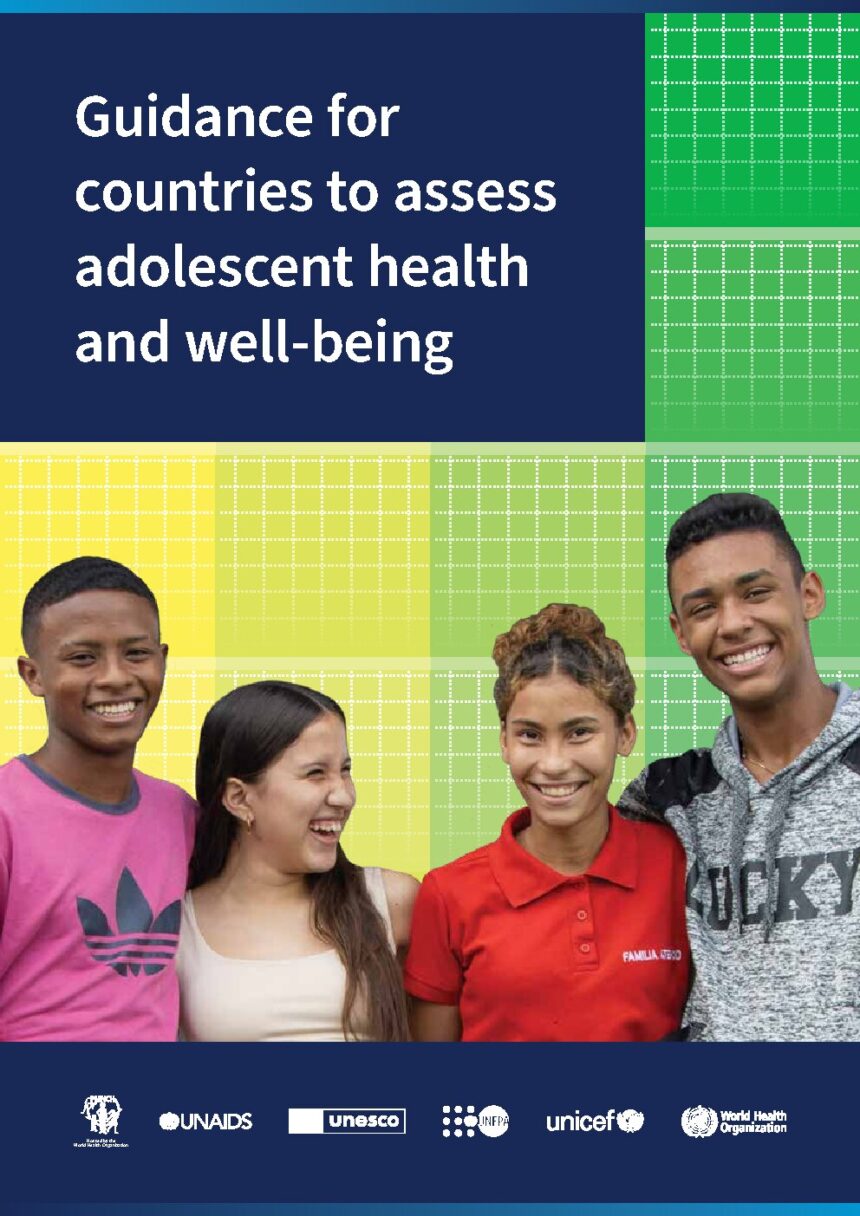
World Health Organization · 1st edition, 2025 · 50 pages
Country-level tool to compile, visualize, and use multisectoral data on the health and well-being of adolescents aged 10–19 years.
- Issuer
- World Health Organization
- Edition
- 1st edition, 2025
- Audience
- Government (health, education, social protection, youth affairs ministries), national statistics offices, NGOs, academic institutions, adolescents and youth representatives, UN agencies, donors
- Evidence
- Expert consensus through multistakeholder process including Expert Consultative Group (28 experts across disciplines and regions with early-career professionals), modified Delphi prioritization, global youth survey (1.5 million responses), youth consultations, and country assessments in Colombia, India, and South Africa
- Reviewed
- 16 Oct 2026 · GMJ
What this guideline says
GMJ summary
This WHO guidance, developed with PMNCH and United Nations partners, provides governments and stakeholders a systematic approach to strengthening the evidence base for adolescent health and well-being. It offers an Excel-based data tool with two components: (1) mapping and compiling individual-level data on adolescent well-being across five domains (good health and nutrition; connectedness and positive values; safety and supportive environment; learning and employability; agency and resilience), building on the 47 GAMA-recommended indicators; and (2) assessing government actions through six policy and systems indicators and six process indicators covering intersectoral collaboration, national planning, communication strategies, data review, decision-making, and dissemination.
The guidance aligns with the Adolescent Well-being Framework (AWF) and the Global Accelerated Action for the Health of Adolescents (AA-HA!), emphasizing a multisectoral, participatory approach with meaningful adolescent and youth engagement throughout. It prioritizes use of existing data while identifying gaps, supports both national and subnational implementation, and links data compilation directly to needs assessment, landscape analysis, priority-setting, and advocacy as outlined in AA-HA!.
Countries are encouraged to establish multisectoral teams, inventory available data sources (surveys, HMIS, EMIS, CRVS), compile the GAMA indicators, map additional well-being data across 28 prioritized concepts (focusing on subjective, positive experiences), assess government actions, and translate findings into strategic plans, programmes, and advocacy to improve the lives of the world’s 1.3 billion adolescents.
Key points
For clinicians — doses and thresholds as stated in the guideline
- Use the 47 GAMA-recommended indicators as the starting point: 41 individual-level indicators covering mortality, nutrition (anaemia, overweight/obesity, thinness, fruit/vegetable consumption), substance use, sexual health (birth rate, contraceptive/condom use, HPV coverage, HIV/STI), mental health (suicide attempt, depression/anxiety symptoms, care-seeking, life satisfaction), physical activity, bullying, violence, school completion, and foundational learning; plus 6 policy/systems indicators.
- Map additional data across 28 prioritized well-being concepts spanning all five AWF domains, focusing on subjective, positive experiences (e.g. having a trusted person, positive family/peer relationships, sense of safety, belonging at school, self-efficacy, hope, purpose) to complement the more objective GAMA indicators.
- Inventory all relevant data sources across sectors: population-based household and school surveys (DHS, MICS, GSHS, HBSC, PISA, PIRLS, SSES, TIMSS), administrative systems (HMIS, EMIS, social protection systems, labour market information), and CRVS.
- Assess six government process indicators: (1) intersectoral collaboration covering all five AWF domains with regular meetings; (2) national action plan with resources, time-bound targets, aligned with national priorities; (3) communication strategy using multiple channels, implemented nationwide; (4) data review with disaggregated, representative data from adolescents across all domains; (5) data for decision-making with multisector review at least annually; (6) data dissemination to adolescents and communities within 3 months, using multiple channels.
- Ensure meaningful adolescent and youth engagement (MAYE) throughout: clearly defined and supported roles in the multisectoral team, intersectoral processes, communication strategies, data review, decision-making, and dissemination; inclusive participation across genders, ages, abilities, and geographies; and institutionalized capacity strengthening.
- Disaggregate all data by age, sex, educational status, geographical location, and context-relevant dimensions (e.g. refugee status, disability, ethnicity) to identify disparities and inform equity-focused programming.
- Link data compilation directly to AA-HA! implementation: use assembled data to conduct needs assessment (status of adolescents across five domains), landscape analysis (extent to which problems are addressed in policies/programmes), prioritization, and strategic planning, with annual stakeholder meetings to review findings and every 3–5 years for strategic plan updates.
- Where data gaps exist, first explore adapting existing data sources (adding questions, adjusting sampling, modifying frequency) before initiating new data collection; consider using local studies, qualitative data, or global modelled estimates to fill gaps until nationally representative data are available.
Government process indicators and assessment criteria
Table extracted from the guideline
| Indicator | Minimally addressed | Partially addressed | Fully addressed |
|---|---|---|---|
| 1. Intersectoral collaboration | 2 ministries, meeting planned <1/year, engagement plan developed, adolescents of all genders | 3 ministries, 1+ meeting/year, participation in ≥1 activity, adolescents of different genders and geographies | 4+ ministries, 1+ meeting/year, clearly defined roles in all activities, greater diversity of adolescents, institutionalized training |
| 2. National plan of action | Plan costed (not allocated), core indicators established, reviewed for alignment | Resources allocated (partial), baseline and targets established, fully aligned with priorities | Resources allocated (complete), monitoring underway, fully aligned with periodic review mechanism |
| 3. Communication strategy | 1–2 ministries, 1 channel, strategy planned, engagement plan, adolescents of all genders | 3 ministries, 2 channels, subnational implementation, participation in ≥1 activity, different geographies | 4+ ministries, 3+ channels (all major languages), nationwide, defined roles in all activities, greater diversity, institutionalized training |
| 4. Data review | 1–2 ministries, data on 1–2 AWF domains, >half of adolescent age group | 3+ ministries, 3–4 domains, >half age group, audit by 3+ ministries | 3+ ministries, all 5 domains, ages 10–19, shared future data collection plans |
| 5. Data for decision-making | Review by 1 ministry, review planned, actions planned/decisions made | Multiple ministries, 1 review conducted, ≥1 action implemented | Multiple ministries and stakeholders, reviews ≥1/year, several actions implemented, defined roles, greater diversity, institutionalized training |
| 6. Data dissemination | Key stakeholders identified, materials developed, 1 channel, within 6 months | Presentations for different audiences, 2 channels, within 3 months, participation in ≥1 activity | Audience-specific products disseminated, 3+ channels, adolescent-targeted products at launch, defined roles, greater diversity, institutionalized training |
Source: World Health Organization, Guidance for countries to assess adolescent health and well-being. Reproduced in summary form.
From the guideline
Verbatim
“Adolescence is a critical period of growth and change. The world's 1.3 billion adolescents hold immense potential, and yet, from a global health perspective, they are one of the most overlooked population groups.”
Editor’s perspective
Why this matters for Georgia and the region
Prof. Giorgi Pkhakadze, MD, MPH, PhD
Editor-in-Chief, Georgian Medical Journal · Chair, Public Health Institute of Georgia · WHO consultant, health and migration
As Chair of the Public Health Institute of Georgia and a WHO consultant who has worked on health systems strengthening across our region, I see this guidance as essential infrastructure for adolescent health in the South Caucasus. Georgia has made commendable progress in maternal and child health—our UHC programme since 2013, early introduction of rotavirus vaccine, and the hepatitis C elimination programme are examples—but we lack a comprehensive, intersectoral picture of adolescent well-being. Our health information system captures some clinical data, our education statistics track school completion, but we have no systematic mechanism to bring these together with data on mental health, violence, positive relationships, or sense of belonging that this guidance prioritizes. The recommendation I would stress to Georgian colleagues is the call for meaningful adolescent engagement from the outset, not as consultation but as co-design with clearly defined roles—this aligns with our experience in community-based primary care reform where beneficiary involvement proved critical. The realistic implementation caveat is that establishing the recommended multisectoral coordination (health, education, labour, youth affairs) with annual data review will require high-level political commitment and dedicated resources; in our context, embedding this within existing mechanisms like the Interagency Coordination Council for Healthcare may be more feasible than creating new structures, but genuine intersectoral collaboration remains a persistent challenge in Georgian governance.
ORCID 0000-0001-7609-4515 · Perspective written for the GMJ Guidelines Library, 16 Oct 2026
Applicability
Georgia and the South Caucasus
For Georgia and the South Caucasus, this guidance offers a structured approach to strengthen adolescent health systems across multiple sectors. Georgia has established foundations in maternal and child health (UHC programme since 2013, rotavirus vaccine 2013, hepatitis C elimination 2015) but adolescent-specific data remain fragmented across health, education, and social protection systems. National programmes would need to inventory existing data from school health surveys, the integrated health information system, education statistics, and any youth surveys; map these against the GAMA indicators and AWF domains to identify gaps (particularly in mental health, positive well-being indicators, and out-of-school adolescents); establish an intersectoral coordinating mechanism involving the Ministries of Health, Education, Labour and Social Affairs, and youth-serving NGOs; and ensure meaningful engagement of adolescents themselves—including from minority communities, rural areas, and internally displaced populations—in data interpretation and priority-setting. The guidance’s flexibility allows adaptation to Georgia’s decentralized governance structures and can support development of a comprehensive adolescent health strategy aligned with SDG targets and UHC expansion.
Questions this guideline answers
Quick answers
What are the 47 GAMA-recommended indicators this guidance builds on?
Forty-one individual-level indicators spanning mortality (all-cause and cause-specific), injury hospitalization, health service use, substance use (alcohol, tobacco, e-cigarettes, cannabis, heavy episodic drinking), nutrition (anaemia, overweight/obesity, thinness, fruit/vegetable and sugar-sweetened beverage consumption, physical activity), sexual health (birth rate, first sex by age 15, contraceptive/condom use, demand for family planning satisfied, skilled birth attendance, HPV vaccine coverage, HIV prevalence, STI incidence, pre-menarche menstruation awareness, sexual/reproductive health decision-making), mental health (suicide attempt, depression/anxiety symptoms and care-seeking, life satisfaction, self-assessed overall/physical/mental health, sleep, having someone to talk to, positive family relationships), safety (poverty, food insecurity, bullying, physical violence, contact sexual violence, sexual violence by age 18), education (school completion, foundational learning skills, not in education/employment/training), and population proportion; plus 6 policy/systems indicators (national adolescent health programme, service delivery standards, user fee exemptions, legal restrictions for access, comprehensive school health services, schools offering HIV/sexuality education).
How does this guidance differ from simply using the GAMA indicators?
This guidance uses the 47 GAMA indicators as a starting point but extends the evidence base in three ways: (1) it adds systematic mapping of data across 28 prioritized well-being concepts (like having a trusted person, sense of belonging, hope, self-efficacy) that focus on positive, subjective experiences often missing from health-focused indicators; (2) it includes assessment of six additional government process indicators covering intersectoral collaboration, national planning, communication strategies, and data use—going beyond the six GAMA policy/systems indicators; and (3) it provides an Excel-based data tool and structured implementation process (establish team, assemble data, review/interpret, plan collection, translate to action) explicitly linked to the AA-HA! needs assessment and landscape analysis.
What does 'meaningful adolescent and youth engagement' require in implementing this guidance?
Following the MAYE principles, adolescents and youth (ages 10–24) must have clearly defined and supported roles from the outset, not token participation. This means: membership in the multisectoral team with sustained involvement; active participation in data interpretation, priority-setting, and identifying actions (not just data collection); inclusive representation across genders, ages (including younger adolescents 10–14), education levels, abilities, and geographies, considering vulnerabilities relevant to the country (e.g. refugee status, disability, rural/urban, ethnic minorities); safe spaces and partners experienced in youth engagement; capacity strengthening through institutionalized, regularly scheduled training/mentoring on how to engage in intersectoral processes, interpret data, and advocate; and demonstrated influence on decision-making, not merely consultation.
Our country has limited survey data on adolescents—how can we start using this guidance?
Start by inventorying all available sources across sectors, including: routine administrative data (HMIS for health service use, EMIS for school completion/attendance, CRVS for mortality), any existing school-based health surveys or youth surveys (even if old or subnational), data from NGO-led studies or university research (even if not nationally representative), and sectors beyond health (labour market data on youth unemployment, social protection data on poverty, justice data on youth crime). Map these against the GAMA indicators and prioritized concepts to systematically identify which domains are covered and which are gaps. Use whatever data exist to conduct a preliminary needs assessment and landscape analysis following AA-HA!, clearly documenting data limitations (coverage, representativeness, recency). This exercise itself will build the case for future data collection and can inform strategic planning about which gaps are most urgent to fill, whether by adding questions to planned surveys (like DHS, MICS, or school surveys) or advocating for dedicated adolescent data collection in the next budget cycle.
Related on GMJ
Interconnected resources
Dictionary of Public Health
GMJ News coverage
Quality & accreditation
Other guidelines on this topic
- WHO guidelines for the treatment of patients with cystic echinococcosis
- Consolidated guidance on tuberculosis data generation and use: Module 4: Surveys of costs faced by households affected by tuberculosis
- Routine health information system and health facility data for neglected tropical diseases: general guidance for national programme managers and data clerks
- Routine health information system and health facility and community data for neglected tropical diseases: last-mile logistics information system for medicines and health products
- Routine health information system and health facility data for neglected tropical diseases: Buruli ulcer
- Issuer
- World Health Organization
- Type
- Guidance (normative)
- Edition
- 1st edition, 2025
- Status
- Current
- Published
- 2025-05-13
- Languages
- English (French and other UN languages expected)
- Scope
- Global; adaptable at national and subnational levels
- Audience
- Government (health, education, social protection, youth affairs ministries), national statistics offices, NGOs, academic institutions, adolescents and youth representatives, UN agencies, donors
- Pages
- 50
- Licence
- CC BY-NC-SA 3.0 IGO
- ISBN
- 978-92-4-010784-7
- Evidence
- Expert consensus through multistakeholder process including Expert Consultative Group (28 experts across disciplines and regions with early-career professionals), modified Delphi prioritization, global youth survey (1.5 million responses), youth consultations, and country assessments in Colombia, India, and South Africa
- Record history
- Created 16 Oct 2026 · updated 16 Oct 2026 · next check Apr 2027
World Health Organization. Guidance for countries to assess adolescent health and well-being. Geneva: World Health Organization; 2025. Licence: CC BY-NC-SA 3.0 IGO.GMJ Guidelines Library records are original summaries written by the GMJ editorial team from the issuer’s published document and reviewed by a physician. They do not replace the full guideline. The document is the copyright of its issuer and is linked, not hosted. Spotted an error or a newer edition? Tell the Guidelines Desk.
Was this article helpful?