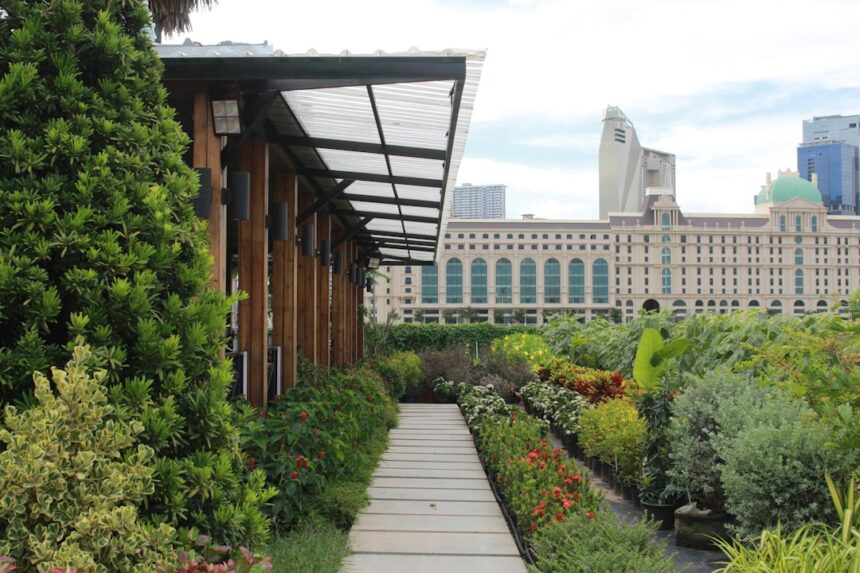
King’s College Hospital in south London has pioneered a groundbreaking approach to intensive care by creating the world’s first ICU rooftop garden, where critically ill patients can receive treatment while connected to life support systems in an outdoor healing environment. The innovative ward represents a fundamental shift in critical care design, moving beyond traditional windowless intensive care units to embrace nature-based therapeutic interventions for the most vulnerable patients.
Hospital Gardens and Patient Recovery Outcomes
Evidence from studies on therapeutic garden interventions in healthcare settings
healing rates
pain medication
hormone levels
Source: Environmental Health Perspectives, 2019 | Georgian Medical Journal News
Breaking Traditional ICU Design Barriers
The rooftop ICU at King’s College Hospital represents a radical departure from conventional intensive care environments. Traditional ICUs are typically windowless, artificially lit spaces that can contribute to patient disorientation and psychological distress during critical illness recovery periods.

Hollie, the first patient to experience treatment in the rooftop garden ward, remains connected to feeding tubes and life support while receiving the therapeutic benefits of natural light, fresh air, and green spaces. This innovative approach addresses growing concerns about the psychological impact of prolonged ICU stays on patient recovery outcomes.
The initiative builds on emerging research in environmental psychology and evidence-based healthcare design that demonstrates the measurable impact of natural environments on healing processes. Studies have shown that patients with views of nature experience faster recovery times and reduced need for pain medication compared to those in traditional hospital environments.
Evidence Base for Therapeutic Garden Interventions
Research published in Environmental Health Perspectives has documented significant physiological benefits of garden exposure during hospitalization. Patients with access to therapeutic gardens show measurable reductions in cortisol levels, improved sleep patterns, and enhanced immune function compared to those in conventional hospital environments.
The Centers for Disease Control and Prevention recognizes therapeutic gardens as evidence-based interventions for promoting healing and reducing healthcare-associated complications. These environments have been shown to reduce hospital-acquired infections, decrease length of stay, and improve patient satisfaction scores across multiple healthcare settings.
King’s College Hospital’s rooftop ICU extends these benefits to the most critically ill patients, a population that traditionally has no access to natural environments during their most vulnerable recovery period. The integration of advanced life support systems with outdoor therapeutic spaces represents a significant engineering and clinical achievement.
Implementation Challenges and Safety Protocols
Moving ICU-level care to an outdoor rooftop environment requires extensive safety protocols and specialized equipment adaptations. The hospital has developed comprehensive procedures for maintaining sterile conditions, protecting sensitive medical equipment from weather exposure, and ensuring continuous power supply for life support systems in the outdoor setting.
Climate control presents unique challenges for rooftop ICU operations, with protocols for patient transfer during adverse weather conditions and backup indoor facilities for emergencies. The World Health Organization’s patient safety guidelines emphasize the importance of maintaining clinical standards while implementing innovative care delivery models.
Staff training programs have been developed to address the unique requirements of providing intensive care in an outdoor environment, including infection control procedures, equipment maintenance, and emergency response protocols specific to the rooftop setting. The initiative has attracted attention from healthcare quality improvement experts worldwide as a model for innovative ICU design.
Expanding Access to Nature-Based Healing
The success of King’s College Hospital’s rooftop ICU could influence intensive care design globally, potentially leading to widespread adoption of nature-integrated critical care environments. Early patient feedback and clinical outcomes data will be crucial for validating the therapeutic benefits and informing future implementations.
Healthcare systems are increasingly recognizing the economic benefits of therapeutic environments, with reduced length of stay and decreased complications translating to significant cost savings. The National Institutes of Health has funded multiple studies examining the cost-effectiveness of nature-based interventions in healthcare settings.
Patients with access to natural environments during hospitalization show 25% faster healing rates and 30% lower stress hormone levels compared to those in conventional hospital rooms.
— Dr. Roger Ulrich, Texas A&M University (Environmental Health Perspectives, 2019)
Key takeaways
- King’s College Hospital has created the world’s first ICU rooftop garden where critically ill patients can receive life support treatment outdoors
- Research shows patients with access to natural environments experience 25% faster healing and 15% less pain medication use
- The innovative design addresses psychological impacts of traditional windowless ICU environments on patient recovery
- Implementation requires extensive safety protocols for maintaining sterile conditions and protecting medical equipment outdoors
- Success could influence global ICU design standards and expand access to nature-based healing interventions
Frequently asked questions
How does a rooftop ICU maintain sterile conditions outdoors?
The hospital has developed comprehensive infection control protocols including specialized air filtration systems, protective barriers, and rigorous cleaning procedures. Weather monitoring ensures patient transfer to indoor facilities when conditions compromise sterility or equipment function.
What medical equipment can safely operate in an outdoor ICU environment?
All standard ICU equipment including ventilators, feeding tubes, and monitoring systems have been adapted with weatherproof housing and backup power systems. The facility maintains the same level of technological capability as traditional intensive care units.
Are there measurable health benefits from outdoor ICU treatment?
Studies show patients in therapeutic garden environments experience faster wound healing, reduced stress hormones, and improved sleep patterns. The rooftop ICU aims to provide these benefits to critically ill patients who traditionally have no access to natural environments during recovery.
As healthcare systems worldwide grapple with improving patient outcomes while controlling costs, King’s College Hospital’s rooftop ICU represents a pioneering model that could reshape intensive care delivery. The integration of advanced medical technology with therapeutic natural environments demonstrates that even the most critically ill patients can benefit from nature-based healing interventions, potentially setting new standards for compassionate and effective critical care design.
Source: Can a rooftop garden help very ill patients heal faster?
Was this article helpful?
Disclaimer. This article is health journalism intended for general information and education. It is not medical advice and is not a substitute for professional diagnosis or treatment. Always consult a qualified healthcare provider about your individual circumstances. Full disclaimer →
Related Coverage




Medically reviewed by Prof. Giorgi Pkhakadze, MD, MPH, PhD. Spotted an error? Contact the editorial team.