By using this site, you agree to the Privacy Policy and Terms of Use.
Accept
GMJ NewsGMJ NewsGMJ News
  • Latest News
    • GMJ Briefs
  • Podcast & Media
    • Podcast Episodes
    • GMJ Audio
    • GMJ Videos
  • Research Digest
    • New Studies
    • Georgian Research
    • Data & Numbers
  • Policy & Systems
    • Health Policy
    • Quality & Safety
    • Migration & Health
    • Global Health
  • Practice
    • Clinical Updates
    • Case Discussions
    • Pharmacy & Prescribing
    • Ingredients A-Z
  • Perspectives
    • Editorial
    • Explainers
    • Voices
    • Letters
  • GMJ Articles
    • Vol. 1 Issue 2 (2026)
    • Vol. 1 Issue 1 (2026)
    • Pre-Launch Articles (2025)
  • Read the Journal →
  • About GMJ News
Notification Show More
Font ResizerAa
GMJ NewsGMJ News
Font ResizerAa
  • Latest News
    • GMJ Briefs
  • Podcast & Media
    • Podcast Episodes
    • GMJ Audio
    • GMJ Videos
  • Research Digest
    • New Studies
    • Georgian Research
    • Data & Numbers
  • Policy & Systems
    • Health Policy
    • Quality & Safety
    • Migration & Health
    • Global Health
  • Practice
    • Clinical Updates
    • Case Discussions
    • Pharmacy & Prescribing
    • Ingredients A-Z
  • Perspectives
    • Editorial
    • Explainers
    • Voices
    • Letters
  • GMJ Articles
    • Vol. 1 Issue 2 (2026)
    • Vol. 1 Issue 1 (2026)
    • Pre-Launch Articles (2025)
  • Read the Journal →
  • About GMJ News
Follow US
GMJ News > GMJ Briefs > Progressive Gut Microbiome Changes Detected in Pre-Symptomatic Parkinson’s Disease

Progressive Gut Microbiome Changes Detected in Pre-Symptomatic Parkinson’s Disease

GMJ
Last updated: 28/06/2026 09:17
By
Prof. Giorgi Pkhakadze
Share
1 Min Read
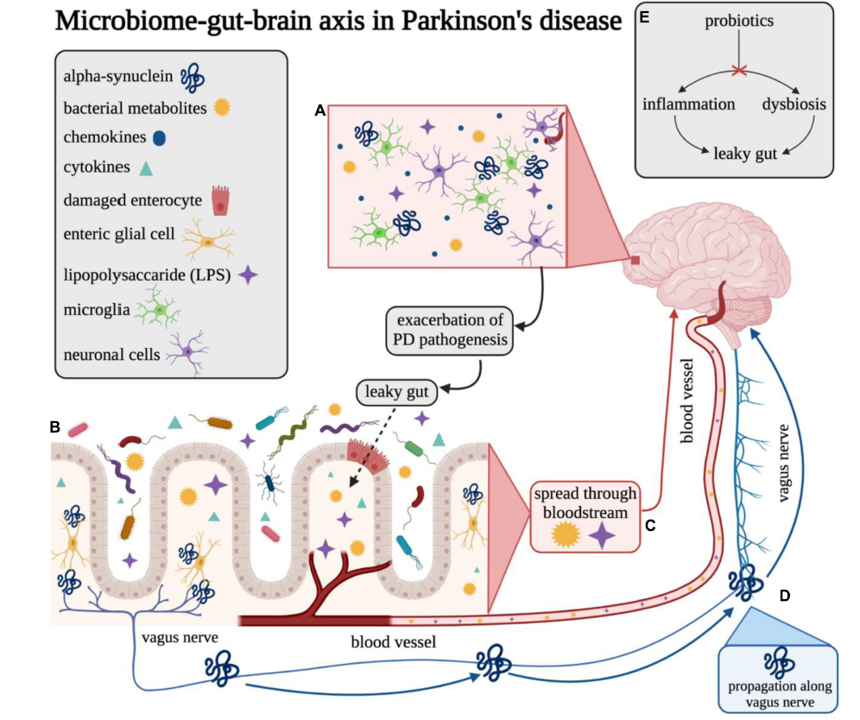
Scientific illustration of gut microbiome bacteria and brain connection for Parkinson's disease research
New research published in Nature Medicine reveals that gut microbiome analysis could identify Parkinson's disease risk years before symptoms appear. The study found progressive microbiome changes across healthy, at-risk, and symptomatic individuals, with healthy diet showing protective effects. — "Overview of the gut–brain axis in Parkinson’s disease" by Emily M. Klann, Upuli Dissanayake, Anjela Gurrala, Matthew Farrer, Aparna Wagle Shukla, Adolfo Ramirez-Zamora, Volker Mai, and Vinata Vedam-Mai is licensed under CC BY 4.0. To view a copy of this license, visit https://creativecommons.org/licenses/by/4.0/. (CC BY 4.0)
SHARE
1 min read|127 words

New research from Nature Medicine identifies coherent gut microbiome alterations occurring progressively across three distinct populations: healthy controls, individuals with genetic Parkinson’s risk, and symptomatic patients. This structured pattern of microbial change provides measurable markers for disease trajectory that could enable early risk identification.

The detection of these microbiome changes years before motor symptoms emerge offers a critical window for intervention. Rather than waiting for neurological symptoms to appear, clinicians could potentially use microbiome profiling as a non-invasive screening tool to identify high-risk individuals who might benefit from preventive treatments. This data-driven approach represents a paradigm shift in neurodegenerative disease management, leveraging our growing understanding of the intestinal microbiome’s role in neurological health to enable earlier, more effective intervention strategies.

Read the full article on GMJ Newsroom.

Was this article helpful?

GMJ Brief · Key Finding

📰 Read the full article: Gut microbiome screening could predict Parkinson’s disease risk years before symptoms emerge →

Share This Article
Facebook LinkedIn Bluesky Copy Link Print
GMJ
ByProf. Giorgi Pkhakadze
Follow:
Prof. Giorgi Pkhakadze, MD, MPH, PhD, is Editor-in-Chief of the Georgian Medical Journal and Chair of the Public Health Institute of Georgia (PHIG). He is Professor and Head of the Department of Social and Behavioural Sciences at David Tvildiani Medical University, and Secretary/Treasurer of the UEMS Section of Public Health. ORCID: 0000-0001-7609-4515.

Submit Your Paper →

Georgia's peer-reviewed open-access medical journal. No APC until January 2027.
Submit Manuscript →
UK Health Security Agency Publishes New Hantavirus Transmission Parameters for Public Health Response

UK Health Security Agency releases comprehensive guidance on hantavirus human-to-human transmission parameters.…

FDA Approves Sanofi’s Teplizumab for Children with Stage 3 Type 1 Diabetes

FDA approves Sanofi's teplizumab for children with stage 3 type 1 diabetes,…

Grandparents Emerge as Key Mental Health Support as Youth Crisis Deepens

New analysis reveals grandparents play crucial role in youth mental health support…

Submit Your Paper to GMJ

No APC until January 2027.
Submit Manuscript →

You Might Also Like

Medical students and residents in diverse healthcare training environment

Data Alert: The Widening Gap Between Medical School Diversity and Physician Workforce Representation

By
Prof. Giorgi Pkhakadze
15/06/2026
Medical illustration showing prostate cancer treatment targeting multiple pathways

Novel Three-Drug Combination Reshapes Advanced Prostate Cancer Treatment Landscape

By
Prof. Giorgi Pkhakadze
15/06/2026
Map showing geographic distribution of measles cases and vaccination coverage in South Carolina

Geographic Disparities in Vaccination Rates Drive Measles Clustering Across South Carolina

By
Prof. Giorgi Pkhakadze
31/05/2026
Scientific diagram showing neutrophil vitamin C concentration and immune cell function

Redefining Vitamin C’s Role: Regeneration Over Stimulation in Immune Defense

By
Prof. Giorgi Pkhakadze
03/06/2026
Facebook Twitter Youtube Instagram
Company
  • Privacy Policy
  • Contact US
  • GMJ Journal
  • Submit Manuscript
  • Editorial Team
  • Register at GMJ
  • Terms of Use

Subscribe to GMJ News — Click here

Join Community
© 2026 Georgian Medical Journal (GMJ). Published by the Public Health Institute of Georgia (PHIG). All rights reserved.
Welcome Back!

Sign in to your account

Username or Email Address
Password

Lost your password?

Not a member? Sign Up