World Health Organization · 1st edition, 2025 · 61 pages
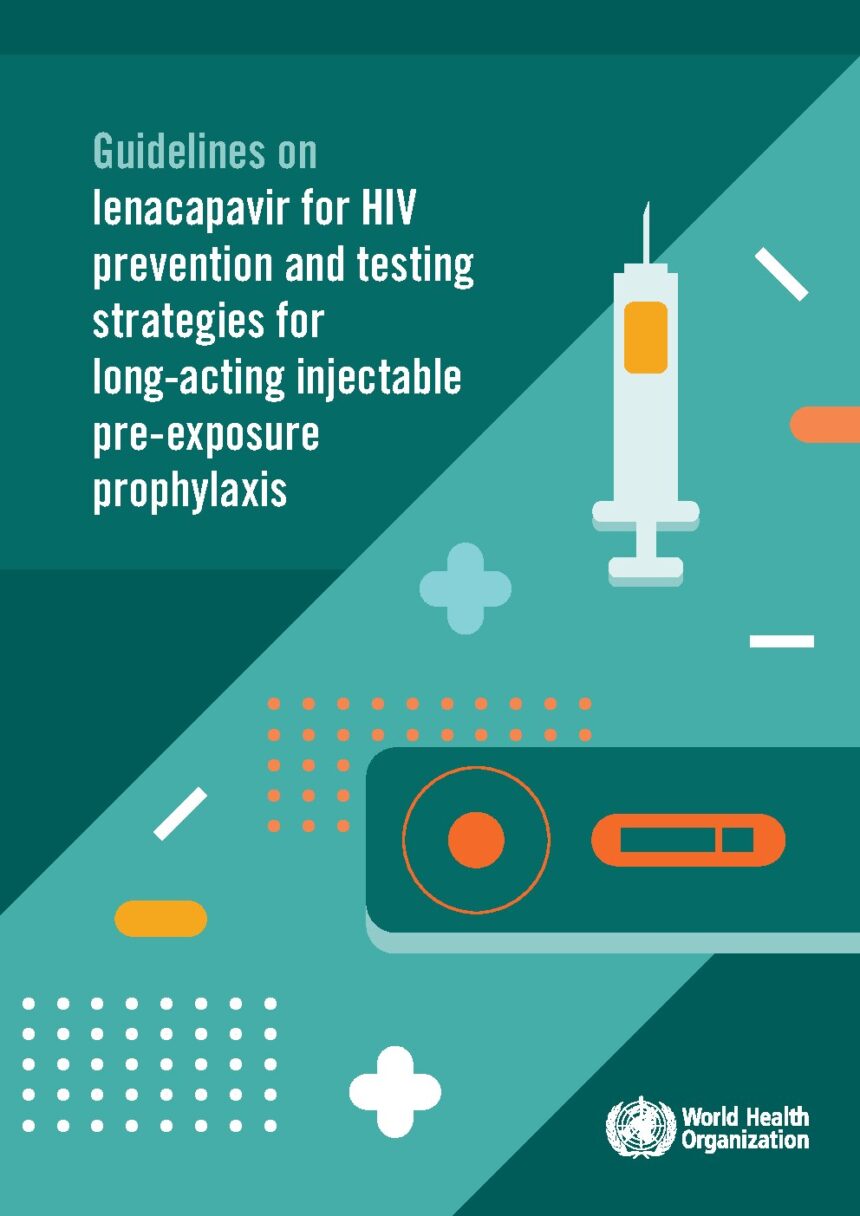
Guidance on offering twice-yearly lenacapavir and simplified HIV testing for long-acting PrEP implementation
- Issuer
- World Health Organization
- Edition
- 1st edition, 2025
- Audience
- National and subnational HIV programme managers, policy-makers, PrEP providers, public health professionals
- Evidence
- GRADE-rated recommendations based on systematic reviews, randomized controlled trials and mathematical modelling
- Reviewed
- 14 Oct 2026 · GMJ
What this guideline says
GMJ summary
These WHO guidelines introduce lenacapavir (LEN), a twice-yearly subcutaneous injection, as an additional HIV pre-exposure prophylaxis (PrEP) option alongside oral PrEP, cabotegravir and the dapivirine vaginal ring. Based on the PURPOSE 1 and PURPOSE 2 trials involving 8,660 participants, LEN demonstrated 89–100% efficacy in preventing HIV acquisition compared with daily oral PrEP, with no breakthrough infections among cisgender women and only two among men who have sex with men and transgender women.
The guidelines also recommend using rapid diagnostic tests (RDTs) rather than nucleic acid testing (NAT) for initiating and continuing long-acting injectable PrEP. This approach reduces costs (US$ 0.17–4.00 for RDTs versus US$ 8.80–85.10 for NAT), enables same-day service delivery and eliminates infrastructure barriers, while maintaining adequate safety surveillance for the rare breakthrough infections and drug resistance.
Implementation should prioritize product choice, differentiated service delivery including task-sharing and community-based provision, and robust monitoring of pregnancy outcomes, adverse events and drug resistance. The six-monthly dosing schedule may improve equity by reducing clinic visit requirements, though centralized delivery models could inadvertently limit access without community-based alternatives.
Key points
For clinicians — doses and thresholds as stated in the guideline
- Lenacapavir dosing: 600 mg oral loading dose (2 × 300 mg tablets) on days 1 and 2, plus 927 mg subcutaneous injection (2 × 1.5 mL) on day 1, then 927 mg subcutaneous every 26 weeks (window: 24–28 weeks)
- Follow-up injections after 28 weeks require oral reloading (600 mg over 2 days); no oral reloading needed if within the 24–28 week window
- LEN showed 100% efficacy in PURPOSE 1 (cisgender women) and 96% efficacy in PURPOSE 2 (men who have sex with men, transgender women) versus background incidence
- Injection site reactions occurred in 68.8% (PURPOSE 1) and 83.2% (PURPOSE 2) but were generally mild, decreased over time, and led to few discontinuations
- HIV testing for long-acting PrEP: use RDTs at initiation and continuation; NAT not required or recommended for routine PrEP delivery
- Individuals with inconclusive HIV results while on LEN should retest in 14 days; if still inconclusive, consider HIV-negative and continue PrEP
- No dose adjustment needed in pregnancy or for renal impairment (creatinine clearance ≥15 mL/min); pharmacokinetic tail persists 12 months after last injection
- Cost-effectiveness threshold in South Africa: US$ 106–225 per person per year; much lower (US$ 10–42) in lower-prevalence settings like western Kenya and Zimbabwe
Summary table of drug–drug interactions with lenacapavir used as PrEP
Table extracted from the guideline
| Drug class | Interaction and management |
|---|---|
| Antibiotics for TB (rifabutin, rifampicin, rifapentine) | Potential interaction requiring dose adjustment. Induction of CYP3A4 can substantially reduce LEN concentrations, risking loss of prevention efficacy. |
| Anticonvulsants (carbamazepine, phenobarbital, phenytoin) | Potential interaction requiring dose adjustment. Induction of CYP3A4 can substantially reduce LEN concentrations, risking loss of prevention efficacy. |
| Ketamine | Potential interaction that may persist after LEN discontinuation. Ketamine concentrations may increase due to CYP3A4 inhibition, increasing side-effects. |
| Erectile dysfunction drugs (avanafil, sildenafil, tadalafil, vardenafil) | Potential interaction that may persist after LEN discontinuation. Drug concentrations may increase due to CYP3A4 inhibition. |
| Gender-affirming hormones (estradiol, testosterone, etc.) | No dose adjustment required. LEN is a moderate CYP3A4 inhibitor but does not require dose adjustment. |
| Hormonal contraceptives (ethinylestradiol, levonorgestrel, etc.) | No dose adjustment required. LEN is a moderate CYP3A4 inhibitor but does not require dose adjustment. |
Source: World Health Organization, Guidelines on lenacapavir for HIV prevention and testing strategies for long-acting injectable pre-exposure prophylaxis. Reproduced in summary form.
What changed in this edition
Versus the previous edition
- First-time recommendation of lenacapavir as an HIV prevention option (new product, 2025)
- New recommendation to use RDTs rather than NAT for long-acting injectable PrEP initiation and continuation
- Expands HIV prevention product choice beyond oral PrEP (2015), dapivirine vaginal ring (2021) and cabotegravir (2022)
From the guideline
Verbatim
“Long-acting injectable lenacapavir should be offered as an additional prevention choice for people at risk of HIV, as part of combination prevention approaches.”
Editor’s perspective
Why this matters for Georgia and the region
Prof. Giorgi Pkhakadze, MD, MPH, PhD
Editor-in-Chief, Georgian Medical Journal · Chair, Public Health Institute of Georgia · WHO consultant, health and migration
As WHO consultant and chair of Georgia's Public Health Institute, I see lenacapavir's twice-yearly dosing as particularly relevant for our region, where daily oral PrEP uptake remains low among key populations facing criminalization and stigma. The strong recommendation to use rapid diagnostic tests rather than nucleic acid testing aligns perfectly with our existing infrastructure and the realities of resource-limited settings across the South Caucasus and Eastern Europe. I would stress to Georgian colleagues that cost-effectiveness modelling suggests thresholds of US$ 10–42 per person per year in lower-prevalence settings—far below current pricing—so national programmes must engage in rigorous price negotiations and prioritize delivery to highest-risk populations, particularly men who have sex with men and people who inject drugs. The critical implementation caveat is that these guidelines are based on controlled trial settings with no real-world programmatic experience yet; countries must build robust pharmacovigilance for pregnancy outcomes and drug resistance monitoring while avoiding delays in making this highly effective prevention option available to those who need it most.
ORCID 0000-0001-7609-4515 · Perspective written for the GMJ Guidelines Library, 14 Oct 2026
Applicability
Georgia and the South Caucasus
For Georgia and Eastern Europe, where HIV epidemics are concentrated among key populations (men who have sex with men, people who inject drugs, sex workers), lenacapavir offers a twice-yearly option that may improve uptake and persistence compared with daily oral PrEP. National programmes will need to assess cost-effectiveness thresholds in lower-prevalence settings (modelling suggests US$ 10–42 per person per year in comparable contexts), negotiate generic pricing, and develop differentiated delivery models that reach criminalized and stigmatized populations. The recommendation to use RDTs aligns with existing testing infrastructure in the region and avoids the need for expensive NAT capacity. Implementation planning should address legal and social barriers (criminalization, discrimination), ensure community-led service design, integrate with harm reduction programmes for people who inject drugs, and establish robust pharmacovigilance for pregnancy outcomes and drug resistance, given limited real-world data beyond the PURPOSE trials.
Questions this guideline answers
Quick answers
What is the dosing schedule for lenacapavir as PrEP?
Oral loading dose of 600 mg (two 300 mg tablets) on each of days 1 and 2, starting on the day of the first subcutaneous injection. The injection is 927 mg (2 × 1.5 mL) subcutaneously every 26 weeks. Follow-up injections can be given 24–28 weeks after the previous injection without oral reloading; beyond 28 weeks requires repeating the oral loading dose.
Can lenacapavir be used during pregnancy and breastfeeding?
Yes. PURPOSE 1 included 193 pregnancies with no increase in adverse pregnancy or birth outcomes compared with oral PrEP. No dose adjustment is needed during pregnancy. Pharmacokinetic data suggest standard dosing remains effective. Programmes should monitor pregnancy and infant outcomes through surveillance systems or ARV pregnancy registries.
What HIV testing strategy should be used for lenacapavir PrEP?
Use rapid diagnostic tests (RDTs) for initiation, continuation and discontinuation of lenacapavir. NAT is not required or recommended for routine PrEP delivery. RDTs cost US$ 0.17–4.00 versus US$ 8.80–85.10 for NAT, enable same-day service, and do not require laboratory infrastructure. If an individual has an inconclusive result, retest in 14 days; if still inconclusive, consider HIV-negative and continue PrEP.
What happens if someone misses their lenacapavir injection appointment?
If the individual returns within 28 weeks of the last injection (24–28 week window), give the injection without oral reloading. If returning after 28 weeks, they need to repeat the oral loading dose (600 mg over 2 days) with the injection. During delays, counsel on using other HIV prevention methods. Lenacapavir has a pharmacokinetic tail lasting up to 12 months but falls below protective levels after 6 months, so continued prevention is essential during any gap.
Related on GMJ
Interconnected resources
Dictionary of Public Health
GMJ News coverage
- HIV infection triggers CD4+ T cells to transform into CD8+ cells, Science study revealsJun 2026
- Bispecific Antibody 10E8.4/iMab Shows Promise in First Human Trial for HIV Prevention and TreatmentSep 2026
- Discrimination linked to early HIV prevention dropout among sex workers in ZambiaMay 2026
- Gonorrhea burden in sub-Saharan Africa remains stubbornly high: new meta-analysis reveals 3.2% general population prevalenceSep 2026
Quality & accreditation
Other guidelines on this topic
- Recommendations on the delivery of health services for the prevention and care of sexually transmitted infections
- Guideline on HIV service delivery: integration of diabetes, hypertension and mental health services, and adherence support interventions
- Consolidated guidelines on tuberculosis. Module 6: tuberculosis and comorbidities, 2nd ed.
- Medical eligibility criteria for contraceptive use, 6th edition
- Guideline on fortification of edible oils and fats with vitamins A and D for public health
- Issuer
- World Health Organization
- Type
- Guideline
- Edition
- 1st edition, 2025
- Status
- Current
- Published
- 2025-07-13
- Languages
- English
- Scope
- Global
- Audience
- National and subnational HIV programme managers, policy-makers, PrEP providers, public health professionals
- Pages
- 61
- Licence
- CC BY-NC-SA 3.0 IGO
- ISBN
- 978-92-4-011160-8
- Evidence
- GRADE-rated recommendations based on systematic reviews, randomized controlled trials and mathematical modelling
- Next review
- As evidence emerges (prioritizing HIVST for long-acting PrEP and real-world implementation data)
- Record history
- Created 14 Oct 2026 · updated 14 Oct 2026 · next check Apr 2027
Guidelines on lenacapavir for HIV prevention and testing strategies for long-acting injectable pre-exposure prophylaxis. Geneva: World Health Organization; 2025. Licence: CC BY-NC-SA 3.0 IGO.GMJ Guidelines Library records are original summaries written by the GMJ editorial team from the issuer’s published document and reviewed by a physician. They do not replace the full guideline. The document is the copyright of its issuer and is linked, not hosted. Spotted an error or a newer edition? Tell the Guidelines Desk.
Was this article helpful?