World Health Organization · 1st edition, 2025 · 68 pages
WHO guidance on decentralization, integration, task sharing and digital health interventions to improve access to STI services for clinicians and programme managers.
- Issuer
- World Health Organization
- Edition
- 1st edition, 2025
- Audience
- STI programme managers, primary care clinicians, nurses, midwives, community health workers, HIV/SRH service providers, public health professionals, policy-makers
- Evidence
- GRADE-assessed recommendations based on systematic reviews and meta-analyses; all four recommendations conditional with low certainty of evidence
- Reviewed
- 14 Oct 2026 · GMJ
What this guideline says
GMJ summary
This 2025 WHO guideline provides four evidence-based recommendations to improve the delivery of sexually transmitted infection (STI) services. With an estimated 374 million new cases of curable STIs annually (2020 data) and 8 million syphilis cases in 2022, the guideline supports the 2030 global health sector strategy target of a 90% reduction in gonorrhoea and syphilis and elimination of congenital syphilis.
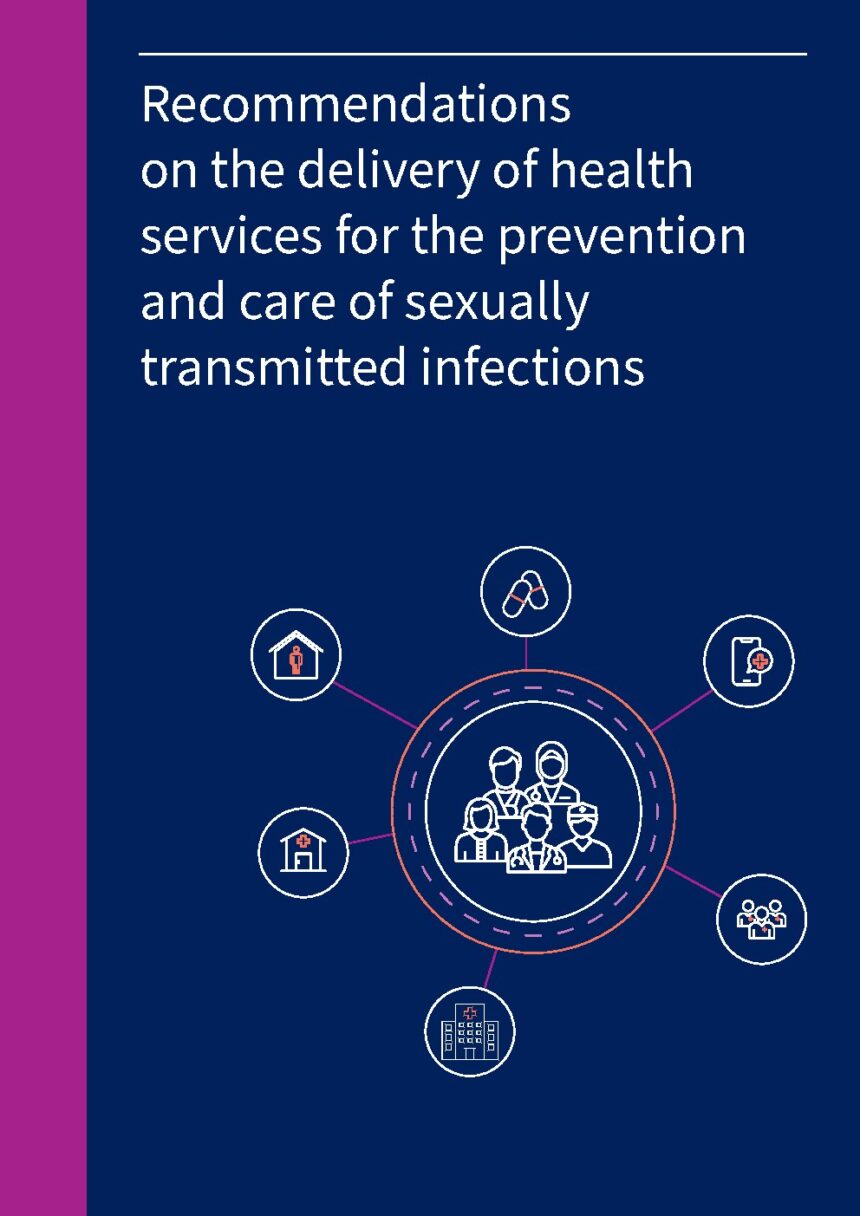
The guideline promotes a people-centred approach through four conditional recommendations: decentralizing services to peripheral and community facilities; integrating STI services into primary care, HIV, maternal health and sexual/reproductive health platforms; task sharing with trained health practitioners and community health workers; and using digital health interventions to complement in-person care. All recommendations emphasize that services must be quality-assured, confidential, non-stigmatizing and accessible.
The recommendations are based on GRADE-assessed evidence (low certainty) drawn from systematic reviews of STI, HIV and hepatitis C services. They complement existing WHO guidance on STI testing, treatment and self-care interventions, and will be incorporated into forthcoming consolidated STI guidelines.
Key points
For clinicians — doses and thresholds as stated in the guideline
- Decentralize STI services to primary care, peripheral or community-based facilities and outreach services to bring care closer to people's homes (conditional recommendation, low-certainty evidence)
- Integrate STI screening, diagnosis and treatment into primary health care, HIV services, maternal health care, contraceptive/family planning services and other sexual/reproductive health platforms where relevant and feasible (conditional recommendation, low-certainty evidence)
- Enable trained health practitioners (nurses, midwives, pharmacists) and community health workers to provide STI services with quality assurance, standardized training, supervision and mentoring (conditional recommendation, low-certainty evidence)
- Use digital health interventions (telemedicine, mobile apps, online consultations, digital reminders) to complement in-person STI care, ensuring data security and confidentiality (conditional recommendation, low-certainty evidence)
- All STI services should adhere to the five Cs: consent, confidentiality, counselling, correct test results and connection to prevention, care and treatment
- Priority populations include men who have sex with men, sex workers, trans and gender-diverse people, people who inject drugs, pregnant women and sexually active adolescents
- Self-collection of samples for Neisseria gonorrhoeae and Chlamydia trachomatis should be made available (strong recommendation, moderate-certainty evidence); syphilis self-testing may be offered (conditional recommendation, low-certainty evidence)
- Provide same-day treatment of STIs confirmed by molecular assay, rapid point-of-care test or based on syndromic management to interrupt transmission
Summary of the new recommendations on STI service delivery
Table extracted from the guideline
| Recommendation | Strength and certainty of evidence |
|---|---|
| WHO suggests the decentralization of services to improve access to prevention, screening, diagnosis and management of sexually transmitted infections. (Decentralization means quality-assured STI services provided beyond centralized facilities to meet people's needs, e.g. in primary care, peripheral or community-based facilities, through outreach services or self-care interventions, with referral to other STI services. Addition should complement not replace centralized services.) | Conditional recommendation, low certainty in evidence of effects (new 2024) |
| WHO suggests the integration of services for prevention, screening, diagnosis and management of sexually transmitted infections into other health services, where relevant and feasible. (Integration should be prioritized in primary health care, HIV services, maternal health care, contraceptive/family planning services and other sexual/reproductive health services.) | Conditional recommendation, low certainty in evidence of effects (new 2024) |
| WHO suggests that trained health practitioners can provide sexually transmitted infection services, and that community health workers can assist with service provision. (Quality assurance mechanisms, regular standardized training, supportive supervision and mentoring systems should be in place to ensure quality-assured services.) | Conditional recommendation, low certainty in evidence of effects (new 2024) |
| WHO suggests using digital health interventions to complement in-person health care services for sexually transmitted infections. (Ensuring data security and confidentiality is essential when providing digital health interventions.) | Conditional recommendation, low certainty in evidence of effects (new 2024) |
Source: World Health Organization, Recommendations on the delivery of health services for the prevention and care of sexually transmitted infections. Reproduced in summary form.
What changed in this edition
Versus the previous edition
- First WHO guideline on STI service delivery approaches; all four recommendations are new in 2024
- Complements existing WHO recommendations on STI testing, treatment and self-care but addresses for the first time how services should be organized and delivered
- Will be incorporated into forthcoming WHO consolidated guidelines on STI prevention and care
From the guideline
Verbatim
“Health systems should be structured and strengthened to deliver quality-assured, accessible, equitable and people-centred services for the prevention, screening, diagnosis and management of sexually transmitted infections.”
Editor’s perspective
Why this matters for Georgia and the region
Prof. Giorgi Pkhakadze, MD, MPH, PhD
Editor-in-Chief, Georgian Medical Journal · Chair, Public Health Institute of Georgia · WHO consultant, health and migration
As Chair of Georgia's Public Health Institute, I see these WHO recommendations as directly applicable to our national STI response. Georgia has successfully decentralized and integrated services for hepatitis C elimination since 2015 and HIV care under our universal health coverage programme—the same principles can now extend to STI services, particularly for gonorrhoea, chlamydia and syphilis. I would stress to Georgian clinicians the conditional recommendation to integrate asymptomatic STI screening for key populations (men who have sex with men, sex workers) and pregnant women into existing HIV, harm reduction and antenatal platforms where prevalence justifies it. The realistic caveat is that all four recommendations carry low certainty of evidence and are conditional, meaning successful implementation depends on ensuring quality through training peripheral health workers, maintaining laboratory capacity for point-of-care testing or rapid specimen transport, and establishing robust referral systems to specialized care when needed—infrastructure investments that require careful resource planning in our context.
ORCID 0000-0001-7609-4515 · Perspective written for the GMJ Guidelines Library, 14 Oct 2026
Applicability
Georgia and the South Caucasus
For Georgia and the South Caucasus, these recommendations offer a framework to expand STI services beyond specialized urban clinics. The integration of STI screening into existing primary health care, maternal care and the national HIV programme could leverage Georgia’s universal health coverage system. Decentralization to community health centres would be particularly relevant for reaching key populations (men who have sex with men, sex workers) who face stigma in specialized facilities. Task sharing with trained nurses and community health workers aligns with Georgia’s primary care strengthening efforts. Digital health interventions could build on existing telemedicine infrastructure developed during COVID-19. National programmes should assess local STI prevalence data, existing laboratory capacity for point-of-care testing, and resources for training peripheral health workers before selecting which service delivery interventions to prioritize. Ensuring non-stigmatizing, confidential services will require attention to cultural context and health worker attitudes in the region.
Questions this guideline answers
Quick answers
What does decentralization of STI services mean in practice?
Decentralization means providing quality-assured STI services beyond centralized hospital facilities—in primary care clinics, peripheral health facilities, community-based venues, through outreach services or self-care interventions. Services should complement, not replace, specialized centres. Examples include offering syphilis testing at antenatal clinics, chlamydia screening at family planning centres, or providing point-of-care tests and same-day treatment at community health posts.
Which health services should STI care be integrated with?
Integration should be prioritized in primary health care, HIV services (including HIV pre-exposure prophylaxis programmes), maternal health care and antenatal services, contraceptive/family planning services, and other sexual/reproductive health platforms. For example, pregnant women should be screened for syphilis, chlamydia and gonorrhoea during antenatal care; men who have sex with men should receive STI screening as part of HIV prevention services.
Can community health workers provide STI services?
Yes, with appropriate training, supervision and quality assurance. Community health workers can assist with health education and promotion, testing and screening, medication delivery, follow-up, peer support, treatment adherence, referral, and psychosocial support. However, they require regular standardized training, supportive supervision and mentoring systems. Pharmacists can also provide STI services including screening, treatment and partner treatment with proper training.
What is the evidence for self-collection and self-testing for STIs?
Self-collection of samples for Neisseria gonorrhoeae and Chlamydia trachomatis has a strong recommendation with moderate-certainty evidence—individuals can collect their own urine, blood or swabs for laboratory testing. Self-collection for syphilis and Trichomonas vaginalis has a conditional recommendation with low-certainty evidence. Syphilis self-testing (rapid test interpreted by the individual) has a conditional recommendation with low-certainty evidence. All self-care approaches require linkage to confirmatory testing and treatment within the formal health system.
Related on GMJ
Interconnected resources
Dictionary of Public Health
GMJ News coverage
- Gonorrhea burden in sub-Saharan Africa remains stubbornly high: new meta-analysis reveals 3.2% general population prevalenceSep 2026
- Congenital Syphilis Surging in U.S.: A Physician's Urgent Call for ActionJul 2026
- Syphilis Among Gay and Bisexual Men Falls to Decade Low in EnglandJun 2026
- UK Launches First National Gonorrhoea Vaccination Programme Using 4CMenB VaccineJun 2026
Quality & accreditation
Other guidelines on this topic
- Recommendations on the management of sickle-cell disease during pregnancy, childbirth and the interpregnancy period
- Guidelines on lenacapavir for HIV prevention and testing strategies for long-acting injectable pre-exposure prophylaxis
- Abortion care guideline, 2nd edition
- Guideline on HIV service delivery: integration of diabetes, hypertension and mental health services, and adherence support interventions
- Scaling up postpregnancy family planning: practical guide
- Issuer
- World Health Organization
- Type
- Guideline
- Edition
- 1st edition, 2025
- Status
- Current
- Published
- 2025-07-14
- Languages
- English
- Scope
- Global; applicable to low-, middle- and high-income countries
- Audience
- STI programme managers, primary care clinicians, nurses, midwives, community health workers, HIV/SRH service providers, public health professionals, policy-makers
- Pages
- 68
- Licence
- CC BY-NC-SA 3.0 IGO
- ISBN
- 978-92-4-011311-4
- Evidence
- GRADE-assessed recommendations based on systematic reviews and meta-analyses; all four recommendations conditional with low certainty of evidence
- Next review
- Not specified; electronic follow-up survey of end-users planned one year after dissemination; mechanisms for monitoring new evidence established
- Record history
- Created 14 Oct 2026 · updated 14 Oct 2026 · next check Apr 2027
World Health Organization. Recommendations on the delivery of health services for the prevention and care of sexually transmitted infections. Geneva: World Health Organization; 2025. Licence: CC BY-NC-SA 3.0 IGO.GMJ Guidelines Library records are original summaries written by the GMJ editorial team from the issuer’s published document and reviewed by a physician. They do not replace the full guideline. The document is the copyright of its issuer and is linked, not hosted. Spotted an error or a newer edition? Tell the Guidelines Desk.
Was this article helpful?