World Health Organization · Revised edition, 2023 · 38 pages
Comprehensive guidance for public health and animal health sectors on prevention, surveillance, and response to zoonotic influenza outbreaks.
- Issuer
- World Health Organization
- Edition
- Revised edition, 2023
- Audience
- WHO country offices, national health ministries, veterinary services, clinicians, public health professionals, emergency response teams
- Evidence
- Expert consensus from WHO, FAO, WOAH with references to existing guidelines and technical documents
- Reviewed
- 15 Oct 2026 · GMJ
What this guideline says
GMJ summary
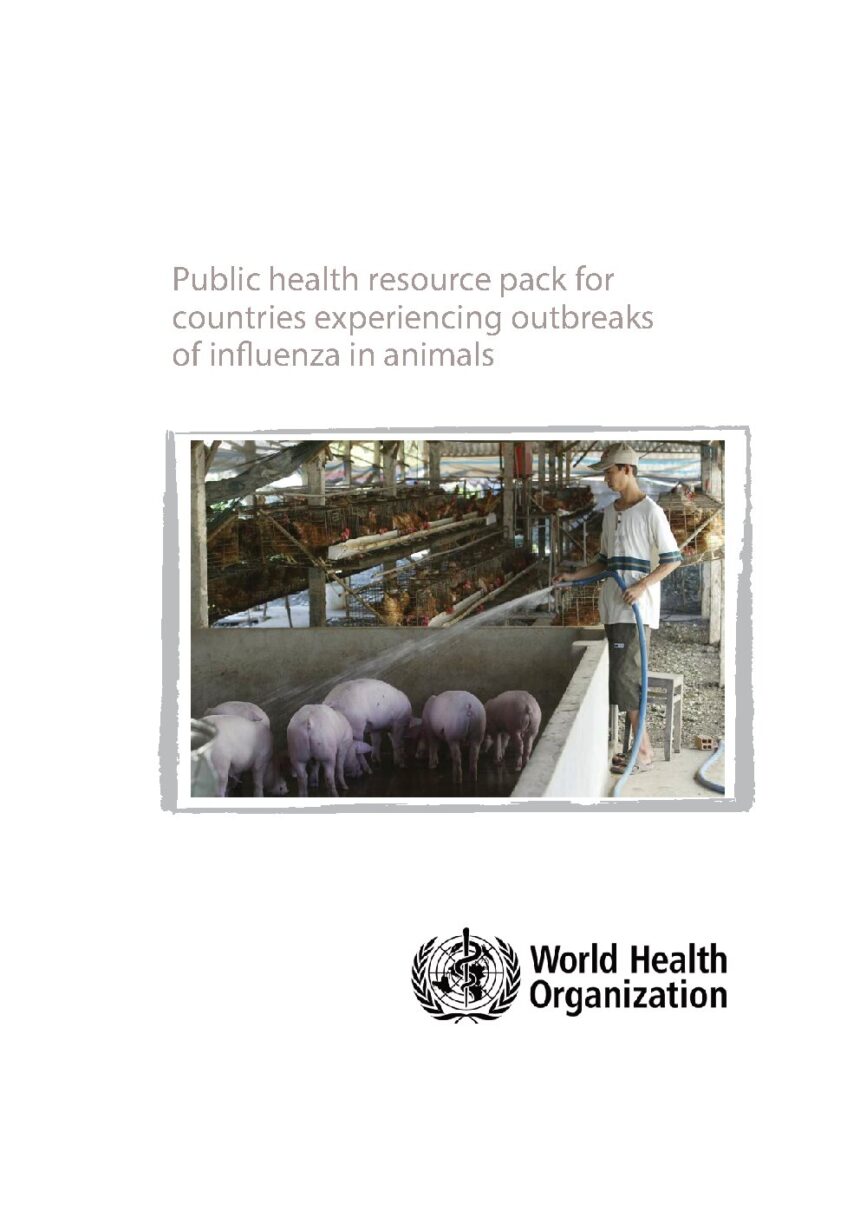
This resource pack collates WHO, FAO, and WOAH recommendations for countries experiencing outbreaks of animal influenza (avian, swine, and other zoonotic influenza viruses) or suspected human infections. It covers 11 key areas: understanding animal influenza, the role of animal health sectors, risk communication, reducing human exposure through basic and poultry-culling-specific measures, food safety, water and environmental management, surveillance and case investigation, diagnostic sample collection, clinical management, and human vaccination.
The pack emphasizes a One Health approach requiring coordination between public health, animal health, and environmental sectors. Human infections with animal influenza viruses are rare but must be investigated thoroughly to assess person-to-person transmission potential, provide appropriate treatment, and implement control measures. Key preventive measures include minimizing contact with potentially infected animals, practising proper hand hygiene, using personal protective equipment for high-risk activities, thoroughly cooking poultry products, and monitoring exposed individuals for 7 days minimum post-exposure.
Clinical management includes early isolation, droplet and airborne precautions, oseltamivir treatment initiated as soon as possible for confirmed or suspected cases, and mandatory reporting to WHO under IHR (2005). The resource pack is designed for iterative updating as new evidence emerges and serves as a practical operational tool for WHO country offices and national health institutions.
Key points
For clinicians — doses and thresholds as stated in the guideline
- Monitor all individuals exposed to animal influenza viruses or contacts of confirmed human cases for 7 days minimum following last exposure
- Treat laboratory-confirmed or suspected zoonotic influenza patients with oseltamivir as soon as possible; do not delay for test results if infection suspected
- Cook all poultry meat to 70 °C (158 °F) internal temperature in all parts with no pink meat remaining; egg yolks should not be runny
- Personnel involved in poultry culling must use waterproof protective clothing, FFP2/N95 respirators or higher, eye protection, heavy-duty gloves, and rubber boots
- Implement standard, droplet, and airborne precautions (N95/FFP2/FFP3) for suspected cases; use airborne precautions when performing aerosol-generating procedures
- Report all laboratory-confirmed zoonotic influenza cases to WHO under International Health Regulations (2005) through the IHR national focal point
- Do not use corticosteroids routinely; consider only in septic shock with suspected adrenal insufficiency or SARS-CoV-2 co-infection with hypoxemia
- Collect upper respiratory tract specimens (nasopharyngeal and oropharyngeal swabs) and lower respiratory tract specimens (bronchoalveolar lavage or tracheal aspirate if intubated) plus acute and convalescent serum samples
What changed in this edition
Versus the previous edition
- 2022: Scope broadened from only avian influenza (particularly H5N1) to address risks from all animal influenza viruses including swine influenza
- 2022: Links to existing resources updated and new resources added
- 2023: Further updates to reflect current scientific understanding and operational guidance
From the guideline
Verbatim
“Human infections with animal influenza viruses must be investigated and monitored closely. A thorough epidemiological investigation and immediate public health actions should include assessing exposure to animals and travel history, contact tracing and the early identification of any unusual respiratory events that could signal person-to-person transmission of the virus.”
Editor’s perspective
Why this matters for Georgia and the region
Prof. Giorgi Pkhakadze, MD, MPH, PhD
Editor-in-Chief, Georgian Medical Journal · Chair, Public Health Institute of Georgia · WHO consultant, health and migration
As Chair of Georgia's Public Health Institute and someone who has worked on zoonotic disease preparedness in the region, I find this resource pack particularly relevant given recent HPAI H5N1 detections in wild birds across the Caucasus and the prevalence of backyard poultry farming in rural Georgia. The guidance on establishing coordination mechanisms between our Ministry of Health and veterinary services is essential – historically these sectors have operated in silos. I would stress to Georgian clinicians the need to maintain high clinical suspicion and immediately initiate oseltamivir when zoonotic influenza is suspected, rather than waiting for laboratory confirmation, as delays reduce treatment effectiveness. The realistic challenge for implementation will be ensuring adequate stocks of personal protective equipment and oseltamivir in regional facilities, training primary care physicians in case recognition given that most are unfamiliar with zoonotic influenza presentations, and establishing the rapid laboratory diagnostic capacity required for timely confirmation and virus characterization outside Tbilisi.
ORCID 0000-0001-7609-4515 · Perspective written for the GMJ Guidelines Library, 15 Oct 2026
Applicability
Georgia and the South Caucasus
Georgia and the South Caucasus region face ongoing risks from highly pathogenic avian influenza (HPAI) H5N1 outbreaks in wild birds and poultry, with detections reported across Eurasia. The region’s position on migratory bird flyways, traditional live bird markets, backyard poultry keeping, and home slaughtering practices create multiple exposure pathways. National programmes would need to strengthen coordination between the Ministry of Health, Ministry of Agriculture (veterinary services), and environmental agencies; establish enhanced surveillance at the human-animal interface particularly among poultry workers, market vendors, and veterinarians; ensure laboratory capacity for timely diagnosis including virus subtyping; stockpile oseltamivir and personal protective equipment; develop risk communication strategies addressing cultural practices around poultry handling and consumption; and implement biosecurity measures in live bird markets. Georgia’s existing IHR capacities and WHO collaboration provide a foundation, but sustained investment in One Health infrastructure and cross-sectoral coordination mechanisms remains essential.
Questions this guideline answers
Quick answers
Can I get avian influenza from eating properly cooked chicken or eggs?
No. Influenza viruses are destroyed by heat. Cook poultry to 70 °C internal temperature with no pink meat remaining, and ensure egg yolks are not runny. Proper cooking makes poultry products safe to consume.
How long should exposed individuals be monitored after contact with infected birds?
All individuals exposed to potentially infected animals should monitor their health during the exposure period plus a minimum of 7 days afterward. Those exposed should be registered with local health authorities for close monitoring to facilitate early detection and timely treatment.
What personal protective equipment is needed for culling infected poultry?
Waterproof protective clothing covering the entire head, body and extremities; FFP2/N95 respirators or higher; eye protection; heavy-duty rubber work gloves; and rubber or polyurethane boots or impermeable foot covers. PPE must be correctly removed immediately after the task and disposed of safely.
Should people at risk receive seasonal influenza vaccination?
Yes, seasonal influenza vaccination can be considered for groups with high exposure risk to reduce the probability of co-infection with both animal and human influenza viruses, which could lead to viral reassortment. However, seasonal vaccines provide no protection against animal influenza viruses themselves.
Related on GMJ
Interconnected resources
Dictionary of Public Health
GMJ News coverage
Quality & accreditation
Other guidelines on this topic
- Guidelines on meningitis diagnosis, treatment and care
- Consolidated guidelines on tuberculosis: Module 4: Treatment and care
- Clinical management and infection prevention and control for mpox: living guideline, May 2025
- Digital adaptation kit for birth defects surveillance: operational requirements for implementing WHO recommendations in digital systems
- Strategic actions for infection prevention and control and water, sanitation and hygiene during mpox outbreak response
- Issuer
- World Health Organization
- Type
- Guideline
- Edition
- Revised edition, 2023
- Replaces
- Summary of Key Information Practical to Countries Experiencing Outbreaks of A(H5N1) and Other Subtypes of Avian Influenza, 2015-2016
- Status
- Current
- Published
- 2023-08-11
- Languages
- English
- Scope
- Global, applicable to all countries experiencing or at risk of animal influenza outbreaks
- Audience
- WHO country offices, national health ministries, veterinary services, clinicians, public health professionals, emergency response teams
- Pages
- 38
- Licence
- CC BY-NC-SA 3.0 IGO
- ISBN
- 978-92-4-007688-4
- Evidence
- Expert consensus from WHO, FAO, WOAH with references to existing guidelines and technical documents
- Next review
- Not specified; living resource updated as new information becomes available
- Record history
- Created 15 Oct 2026 · updated 15 Oct 2026 · next check Apr 2027
World Health Organization. Public health resource pack for countries experiencing outbreaks of influenza in animals. Geneva: World Health Organization; 2023. Licence: CC BY-NC-SA 3.0 IGO.GMJ Guidelines Library records are original summaries written by the GMJ editorial team from the issuer’s published document and reviewed by a physician. They do not replace the full guideline. The document is the copyright of its issuer and is linked, not hosted. Spotted an error or a newer edition? Tell the Guidelines Desk.
Was this article helpful?