World Health Organization · 1st edition, 2025 · 136 pages
Global standards for deploying diagnostic surge capacity in health emergencies, for laboratory specialists and emergency coordinators.
- Issuer
- World Health Organization
- Edition
- 1st edition, 2025
- Audience
- Laboratory specialists, GOARN partners, emergency coordinators, ministries of health, WHO country offices, EMT partners
- Evidence
- Expert consensus developed through multi-phase scoping review, interregional field exercises (2023–2024), and three-phase technical review
- Reviewed
- 16 Oct 2026 · GMJ
What this guideline says
GMJ summary
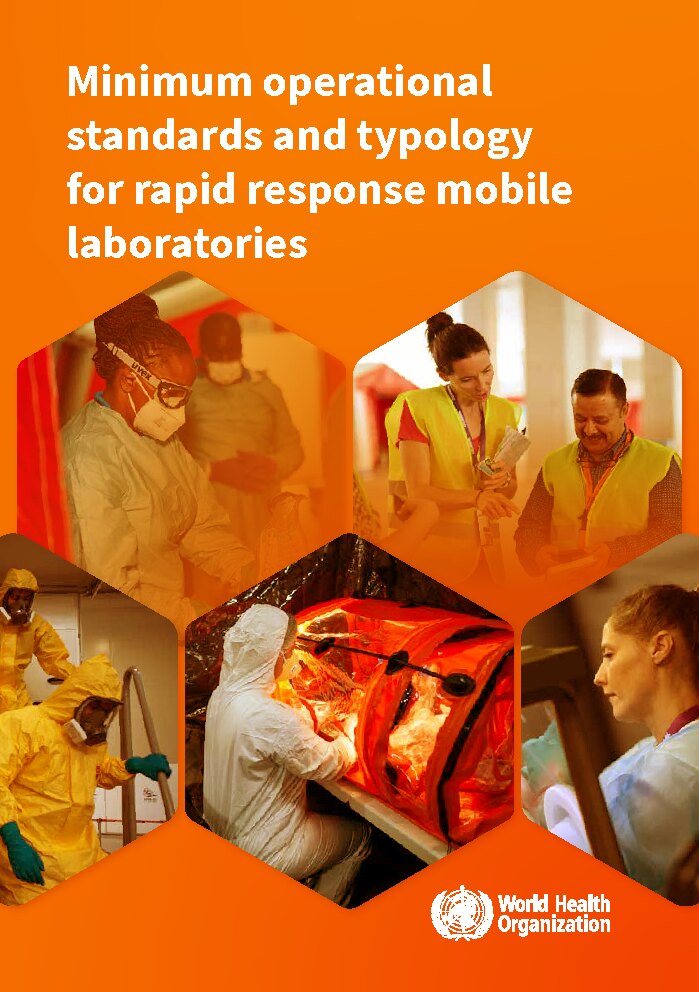
This 136-page WHO document establishes the first global Minimum Operational Standards and Typology (MOST) for rapid response mobile laboratories (RRMLs) deployed during health emergencies. Developed through a rigorous multi-phase process involving GOARN partner institutions and field-tested through interregional exercises in 2023–2024, the standards define 26 minimum requirements across five workstreams: operational coordination and interoperability, operational support and logistics, biosafety and biosecurity, quality management systems, and knowledge and information management.
The document introduces a five-type infrastructure classification (Type I–V, from highly compact to full-scale) and categorizes diagnostic capabilities across infectious diseases, noninfectious diseases, animal testing, and environmental testing, with special designation for high-containment laboratories. The standards emphasize two critical capacities: self-sufficiency (ability to operate independently for defined periods) and interoperability (ability to integrate with other response entities through standardized biosafety interfaces, data systems, and exit strategies including technology transfer).
RRMLs must demonstrate minimum, moderate, or high levels of both self-sufficiency and interoperability across deployment, operational, and personnel functions before deployment. The standards apply to both national and international RRMLs responding to disease outbreaks, natural disasters, humanitarian crises, and mass gatherings, ensuring predictable, quality, and safe diagnostic services while supporting—not replacing—national laboratory systems.
Key points
For clinicians — doses and thresholds as stated in the guideline
- RRMLs must maintain initial supply of laboratory reagents and supplies sufficient for minimum 2 weeks of self-sufficient operation (OSL 8.7)
- All RRML staff require documented competency assessments regularly during inter-mission phase and deployment-specific training before each mission (QMS 18.2, 18.3)
- Biosafety and biosecurity risk assessment must be conducted before each mission and updated whenever procedures, equipment, or personnel change (B&B 12.1)
- Laboratory information management system (LIMS) must be configured with flexible architecture based on commonly used formats to enable rapid data exchange (KIM 24.2)
- Exit strategy including technology transfer, sample handover protocols, and capacity-building must be agreed with national authorities during mission assignment, not at conclusion (OCI 1.5)
- RRMLs are categorized into five infrastructure types (I–V) and four diagnostic capability domains: infectious disease, noninfectious disease, animal testing, environmental testing, with asterisk (*) denoting high-containment capacity
- Self-sufficiency and interoperability must be demonstrated at minimum, moderate, or high levels across three functions: deployment (transport/customs), operational (core diagnostic functions), and personnel (living/security support)
- All biological material and data collected during response operations are owned by national authorities; use beyond response requires informed patient consent and ethics approval (OCI 7.3)
Key requirements throughout the deployment cycle for operational coordination and interoperability standards
Table extracted from the guideline
| Standard | Mission assignment | Mission specification | Mission execution | End of mission | Inter-mission | Related key requirements |
|---|---|---|---|---|---|---|
| 1.1 RRML profile | x | x | x | x | x | |
| 1.2 Scope of support defined | x | OCI 1.1, 1.4 | ||||
| 1.3 Deployment arrangements | x | x | OCI 1.4 | |||
| 1.4 Agreement with authorities | x | x | x | x | OCI 1.1, 1.4 | |
| 1.5 Exit strategy | x | x | x | x | OCI 1.1, 1.4 | |
| 4.4 RRML decommissioning | x | x | OCI 1.4, 4.3; OSL 11.1 | |||
| 5.2 Sample transport mechanism | x | x | OCI 5.1; B&B 11.5; QMS 22.1 | |||
| 8.7 Supply management ≥2 weeks | x | x | x | OSL 8.2 |
Source: World Health Organization, Minimum operational standards and typology for rapid response mobile laboratories. Reproduced in summary form.
From the guideline
Verbatim
“All biological material and data collected are owned by the national authorities.”
Editor’s perspective
Why this matters for Georgia and the region
Prof. Giorgi Pkhakadze, MD, MPH, PhD
Editor-in-Chief, Georgian Medical Journal · Chair, Public Health Institute of Georgia · WHO consultant, health and migration
As someone who has worked with WHO on health emergency preparedness in the South Caucasus, I recognize these MOST as a critical step toward professionalizing what has often been ad hoc deployment of mobile diagnostic capacity during outbreaks. For Georgia, the most immediately actionable recommendation is the requirement for pre-deployment risk assessments and exit strategies that include technology transfer (OCI 1.5, OSL 11)—this aligns with our national policy since 2015 of building sovereign capacity rather than prolonged dependency on external assets. The two-week minimum supply buffer (OSL 8.7) and requirement for interoperable LIMS (KIM 24.2) are realistic thresholds that the National Centre for Disease Control can implement with current budget allocations. However, one implementation challenge is apparent: the standards assume a level of customs facilitation and cross-border transport efficiency that does not always exist in our region, particularly for Category A infectious substances (UN2814) requiring special permits; national programmes will need bilateral agreements in place before crises occur, not negotiated during mission assignment. The document's typology also provides a useful framework for countries considering investment in mobile laboratory infrastructure—Georgia's current capacity would likely be classified as Type II with moderate self-sufficiency, and the gap analysis against 'high' self-sufficiency offers a clear roadmap for the next phase of capacity development tied to our commitments under the International Health Regulations.
ORCID 0000-0001-7609-4515 · Perspective written for the GMJ Guidelines Library, 16 Oct 2026
Applicability
Georgia and the South Caucasus
For Georgia and the South Caucasus, these standards are directly applicable to strengthening regional outbreak response capacity, particularly given Georgia’s role as a WHO collaborating centre for epidemic preparedness and response in Eastern Europe. The National Centre for Disease Control and Public Health in Tbilisi operates mobile laboratory capacity for outbreak investigation; these MOST provide a framework for ensuring that capacity meets international benchmarks for self-sufficiency and interoperability. The emphasis on exit strategies with technology transfer aligns with Georgia’s documented commitment to building sustainable national systems rather than dependency on external surge capacity. National programmes should assess current mobile laboratory assets against the five infrastructure types and determine realistic self-sufficiency levels (minimum, moderate, or high) based on available funding for 2-week minimum supply buffers, staff rotation capacity, and ability to maintain LIMS interoperability with the national surveillance system. The requirement for pre-agreed data custodianship protocols is particularly relevant given ongoing international research collaborations in the region; Georgian ethics committees and the Ministry of Health would need to establish streamlined approval pathways for dual-use (response and research) specimen protocols that comply with Nagoya Protocol requirements.
Questions this guideline answers
Quick answers
What is the minimum supply buffer an RRML must maintain to be deployment-ready?
The RRML must maintain an initial supply of laboratory reagents and other goods enabling self-sufficient operation for a minimum of 2 weeks (OSL 8.7). This is the baseline threshold; longer missions require established resupply mechanisms agreed with coordination bodies during mission specification.
How are RRMLs categorized and what do the designations mean?
RRMLs are categorized by infrastructure type (I–V, from compact units transportable commercially to full-scale container laboratories) and diagnostic capability (ID=infectious disease, NID=noninfectious disease, AT=animal testing, ET=environmental testing). An asterisk (*) indicates high-containment capability for handling pathogens causing high mortality without available vaccines. For example, 'Type II, ID-AT*' means a box-based RRML for human and animal infectious disease diagnostics with high-containment capacity.
What is the difference between self-sufficiency and interoperability for RRMLs?
Self-sufficiency is the ability to operate independently for a defined period without external support, spanning deployment logistics (transport/customs), operations (maintaining core diagnostic functions), and personnel support (accommodation/security). Interoperability is the ability to integrate with other response entities through standardized biosafety interfaces, compatible data systems (LIMS), and coordinated exit strategies including technology transfer. Both operate on a spectrum (minimum, moderate, high) and must be demonstrated before an RRML is deployed.
Who owns the samples and data collected by an RRML during emergency deployment?
All biological material and data collected during response operations are owned by the national authorities of the deployment country (OCI 7.4). Any use of samples or data beyond the immediate response—for example, for research or publication—requires informed patient consent, approval from local ethics committees, and a memorandum of understanding with national authorities. Genome data sharing must comply with the Nagoya Protocol on access and benefit-sharing.
Related on GMJ
Interconnected resources
Dictionary of Public Health
GMJ News coverage
Quality & accreditation
- ASF Laboratory — Standard 1 — Governance & Document Control
- ASF Laboratory — Standard 6 — Pre-Examination: Specimen Pathway
- ASF Laboratory — Standard 7 — Examination: Process & Safety
- ASF Laboratory — Standard 8 — Post-Examination: Reporting & Critical Values
- ASF Hospital — Standard 5 — Safety & Emergency Preparedness
- ASF Hospital — Standard 11 — Critical Care
- ASF Medical Transport — Standard 6 — Emergency Response During Transport
Other guidelines on this topic
- Consolidated guidance for strengthening national routine surveillance systems: updated HIV case definitions, advanced HIV disease indicators and surveillance checklist
- Surveillance for human infections with avian influenza A(H5) viruses: objectives, case definitions, testing and reporting
- Consolidated guidance on tuberculosis data generation and use: Module 3 – National tuberculosis prevalence surveys
- Routine health information system and health facility data for neglected tropical diseases: general guidance for national programme managers and data clerks
- Routine health information system and health facility data for neglected tropical diseases: Buruli ulcer
- Issuer
- World Health Organization
- Type
- Standards
- Edition
- 1st edition, 2025
- Status
- Current
- Published
- 2025-05-09
- Languages
- English
- Scope
- Global, all emergency contexts
- Audience
- Laboratory specialists, GOARN partners, emergency coordinators, ministries of health, WHO country offices, EMT partners
- Pages
- 136
- Licence
- CC BY-NC-SA 3.0 IGO
- ISBN
- 978-92-4-010711-3
- Evidence
- Expert consensus developed through multi-phase scoping review, interregional field exercises (2023–2024), and three-phase technical review
- Record history
- Created 16 Oct 2026 · updated 16 Oct 2026 · next check Apr 2027
World Health Organization. Minimum operational standards and typology for rapid response mobile laboratories. Geneva: World Health Organization; 2025. Licence: CC BY-NC-SA 3.0 IGO.GMJ Guidelines Library records are original summaries written by the GMJ editorial team from the issuer’s published document and reviewed by a physician. They do not replace the full guideline. The document is the copyright of its issuer and is linked, not hosted. Spotted an error or a newer edition? Tell the Guidelines Desk.
Was this article helpful?