World Health Organization · 1st edition, 2025 · 48 pages
A three-level monitoring framework (internal, external, and national) to assess and improve adherence to the Ten Steps to Successful Breastfeeding in maternity care facilities.
- Issuer
- World Health Organization
- Edition
- 1st edition, 2025
- Audience
- Quality improvement teams in maternity facilities; regional/administrative oversight bodies; ministry of health policy-makers and programme managers
- Evidence
- Expert consensus with integration of established BFHI standards and monitoring best practices
- Reviewed
- 18 Oct 2026 · GMJ
What this guideline says
GMJ summary
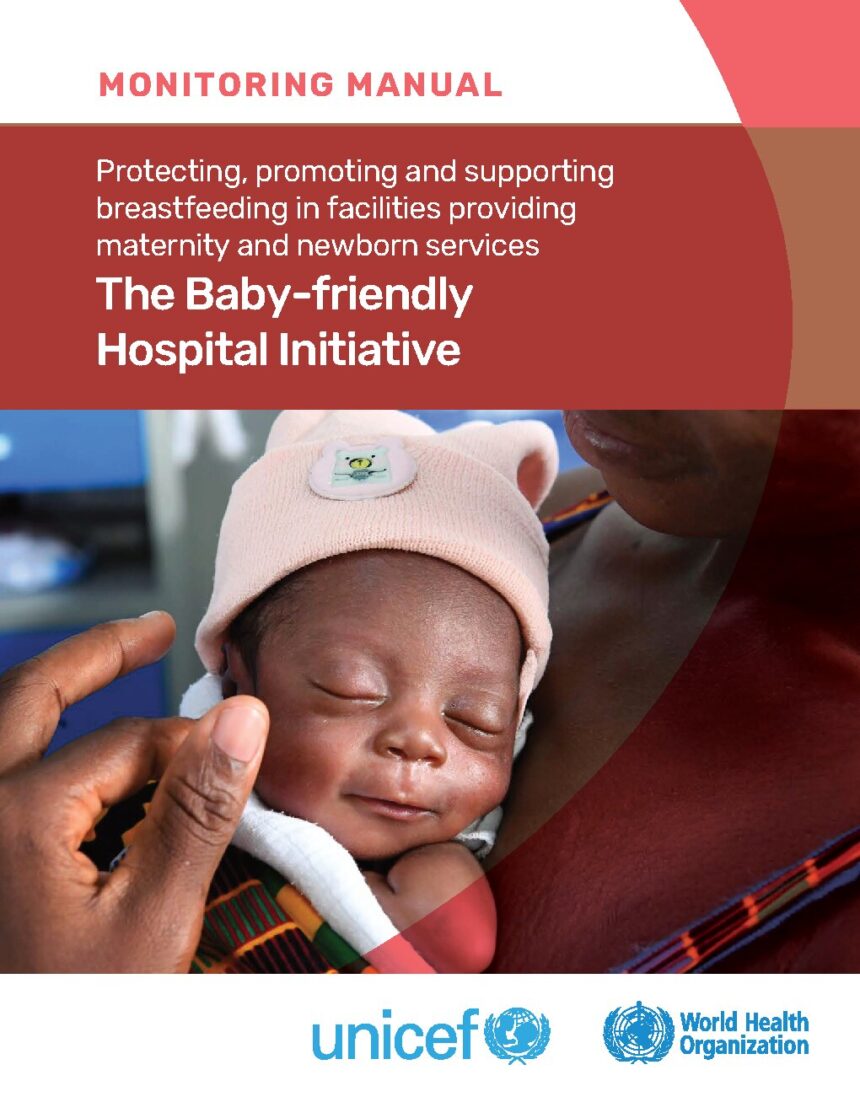
This 2025 monitoring manual provides health facilities, oversight bodies, and national governments with practical tools to assess implementation of the Baby-friendly Hospital Initiative (BFHI) Ten Steps to Successful Breastfeeding. The manual shifts from a traditional facility-designation model toward systemwide integration as a driver of practice change, emphasizing continuous quality improvement through well-functioning data-management systems.
The framework establishes three interconnected monitoring levels: internal monitoring by facility managers tracking clinical practices (Steps 3–10) using patient exit surveys, routine administrative data, or medical chart review; external monitoring by oversight bodies assessing critical management procedures (Steps 1–2) and providing quality assurance; and national monitoring aggregating data across facilities to inform programme planning and evaluation. Each level is designed to integrate with existing health information systems to ensure sustainability.
The manual recommends two sentinel indicators—early initiation of breastfeeding within one hour and exclusive breastfeeding throughout the facility stay—that all facilities should routinely track. Additional indicators assess antenatal counselling, skin-to-skin contact, breastfeeding support, rooming-in, and discharge planning. Global standards recommend achieving 80% compliance for most indicators, though thresholds may be adjusted based on local contexts and current adherence levels.
Key points
For clinicians — doses and thresholds as stated in the guideline
- Two sentinel indicators should be routinely tracked for all mother–infant pairs: early initiation of breastfeeding within one hour after birth and exclusive breastfeeding throughout the facility stay
- Global standards recommend achieving ≥80% compliance for most Ten Steps indicators, adjustable based on local norms and current adherence levels
- Infants should be placed in skin-to-skin contact continuously with their mothers immediately after birth for at least 60 minutes
- All mothers should receive antenatal counselling on breastfeeding, teaching on positioning, identification of adequate milk consumption, and breast-milk expression techniques
- Term infants should stay with their mother throughout their facility stay (rooming-in 24 hours a day) without separation for more than one hour at any time
- Internal monitoring should be reviewed at least every six months by facility quality improvement teams; during concentrated quality improvement periods, monthly review is required
- External assessment of all maternity care facilities should occur at least every three to five years by independent oversight bodies
- Facilities falling below established thresholds should receive targeted technical assistance focused on sustainably achieving necessary improvements in underperforming areas
Recommended indicators for facility-based monitoring of key clinical practices (Steps 3–10)
Table extracted from the guideline
| Step | Indicator definition | Threshold | Data source |
|---|---|---|---|
| Step 4 (SENTINEL) | % of term infants put to breast within one hour after birth | 80% | Patient exit surveys; HMIS; medical charts |
| Step 6 (SENTINEL) | % of infants receiving only breast-milk throughout facility stay | 80% | Patient exit surveys; HMIS; medical charts |
| Step 3 | % of mothers receiving antenatal counselling on breastfeeding | 80% | Patient exit surveys; HMIS; medical charts |
| Step 4 | % of infants placed skin-to-skin continuously ≥60 minutes after birth | 80% | Patient exit surveys; HMIS; medical charts |
| Step 5 | % of breastfeeding mothers taught positioning, adequacy signs, expression | 80% | Patient exit surveys; HMIS; medical charts |
| Step 7 | % of term infants staying with mother throughout facility stay | 80% | Patient exit surveys; HMIS; medical charts |
| Step 10 | % of mothers informed about breastfeeding support after discharge | 80% | Patient exit surveys; HMIS; medical charts |
Source: World Health Organization, Protecting, promoting and supporting breastfeeding in facilities providing maternity and newborn services: the Baby-friendly Hospital Initiative: monitoring manual. Reproduced in summary form.
What changed in this edition
Versus the previous edition
- Revised 2018 BFHI guidance shifted from traditional facility designation model to systemwide integration as driver of practice change
- Emphasis moved to well-functioning internal monitoring and data-management systems facilitating continuous quality assurance
- Streamlined external monitoring procedures introduced to reduce compliance burden while strengthening accountability
- National monitoring framework added to strengthen accountability and programme planning at country level
From the guideline
Verbatim
“Monitoring of the Ten Steps is most likely to be sustained over time if data fields or questions are incorporated into existing data collection platforms rather than attempting to create separate stand-alone systems.”
Editor’s perspective
Why this matters for Georgia and the region
Prof. Giorgi Pkhakadze, MD, MPH, PhD
Editor-in-Chief, Georgian Medical Journal · Chair, Public Health Institute of Georgia · WHO consultant, health and migration
As Chair of the Public Health Institute of Georgia, I recognize this monitoring manual addresses a critical gap in our maternal and child health systems. Georgia has made substantial progress in health system strengthening since introducing the Universal Health Coverage programme in 2013, and our existing HMIS infrastructure provides a ready platform for integrating these breastfeeding indicators without creating parallel systems. I would particularly stress to Georgian clinicians the importance of the two sentinel indicators—early initiation within one hour and exclusive breastfeeding during facility stay—as these are measurable, actionable outcomes that reflect the cumulative effect of all Ten Steps. However, a realistic caveat for implementation in our region is the need for substantial investment in training clinical staff on accurate data recording and ensuring that private maternity facilities, which serve a significant proportion of births in Georgia and neighbouring countries, are equally engaged in monitoring systems that have traditionally focused on public sector facilities.
ORCID 0000-0001-7609-4515 · Perspective written for the GMJ Guidelines Library, 18 Oct 2026
Applicability
Georgia and the South Caucasus
For Georgia and the South Caucasus, this monitoring framework offers a pragmatic pathway to institutionalize breastfeeding support within existing maternal and child health systems. Countries in the region with established Health Management Information Systems (HMIS) or electronic health records can readily integrate the recommended indicators into routine data collection. Where external quality assurance systems already conduct periodic facility supervision or accreditation, adding Ten Steps assessment would be cost-effective. National programmes should consider the current capacity of maternity facilities: those with historically low breastfeeding rates or limited prior attention to the Ten Steps may need to set initial compliance goals below the 80% global threshold and increase targets progressively. The manual’s emphasis on using patient exit surveys aligns well with growing mHealth capacity in the region, though attention must be paid to populations facing barriers in language, literacy, or digital access. Integration with existing national household surveys (such as DHS or MICS conducted periodically in regional countries) would provide nationally representative data without establishing parallel systems.
Questions this guideline answers
Quick answers
What are the two sentinel indicators that every facility must track?
All facilities should routinely track: (1) the percentage of term infants put to the breast within one hour after birth, and (2) the percentage of infants who received only breast-milk (from their own mother or human milk bank) throughout their stay at the facility. These reflect breastfeeding behaviours affected by the other Steps.
How often should facilities conduct internal monitoring reviews?
Facilities should review progress on indicators at least every six months. During concentrated periods of quality improvement, monthly review is needed. The frequency of data collection depends on the system used: administrative systems collect data continuously, while patient exit surveys may be conducted at discharge or shortly thereafter.
What is the recommended threshold for external assessment of facilities?
External assessment should be conducted for all maternity care facilities at least every three to five years, preferably more often if quality issues are a known concern. The depth and frequency depend on the quality and frequency of internal monitoring and which information is reported to higher levels.
Can the 80% compliance threshold be adjusted for local contexts?
Yes. While WHO and UNICEF have established global standards of achieving 80% for the indicators, these may be adjusted upwards or downwards depending on local, regional or national norms and current levels of adherence to the Ten Steps. Facilities with historically poor compliance may need to establish lower time-specific goals and adjust them upwards over time in accordance with progress and capacity.
Related on GMJ
Interconnected resources
Quality & accreditation
Other guidelines on this topic
- Development and implementation of national action plans for infection prevention and control: practical guide
- Tool for Promoting Culturally Safe Childbirth: Basic Manual
- Respiratory Protection Program for Healthcare Workers
- Guidelines for healthcare workers on the proper interpretation of vaccine vial monitors and their use
- STAR-H: Strategic Toolkit for Assessing Risks in Health Facilities
- Issuer
- World Health Organization
- Type
- Manual
- Edition
- 1st edition, 2025
- Status
- Current
- Published
- 2025-04-14
- Languages
- English
- Scope
- Global, all facilities providing maternity and newborn services
- Audience
- Quality improvement teams in maternity facilities; regional/administrative oversight bodies; ministry of health policy-makers and programme managers
- Pages
- 48
- Licence
- CC BY-NC-SA 3.0 IGO
- ISBN
- 978-92-4-010376-4
- Evidence
- Expert consensus with integration of established BFHI standards and monitoring best practices
- Record history
- Created 18 Oct 2026 · updated 18 Oct 2026 · next check Apr 2027
World Health Organization, United Nations Children's Fund (UNICEF). Protecting, promoting and supporting breastfeeding in facilities providing maternity and newborn services: the Baby-friendly Hospital Initiative: monitoring manual. Geneva: World Health Organization; 2025. Licence: CC BY-NC-SA 3.0 IGO.GMJ Guidelines Library records are original summaries written by the GMJ editorial team from the issuer’s published document and reviewed by a physician. They do not replace the full guideline. The document is the copyright of its issuer and is linked, not hosted. Spotted an error or a newer edition? Tell the Guidelines Desk.
Was this article helpful?