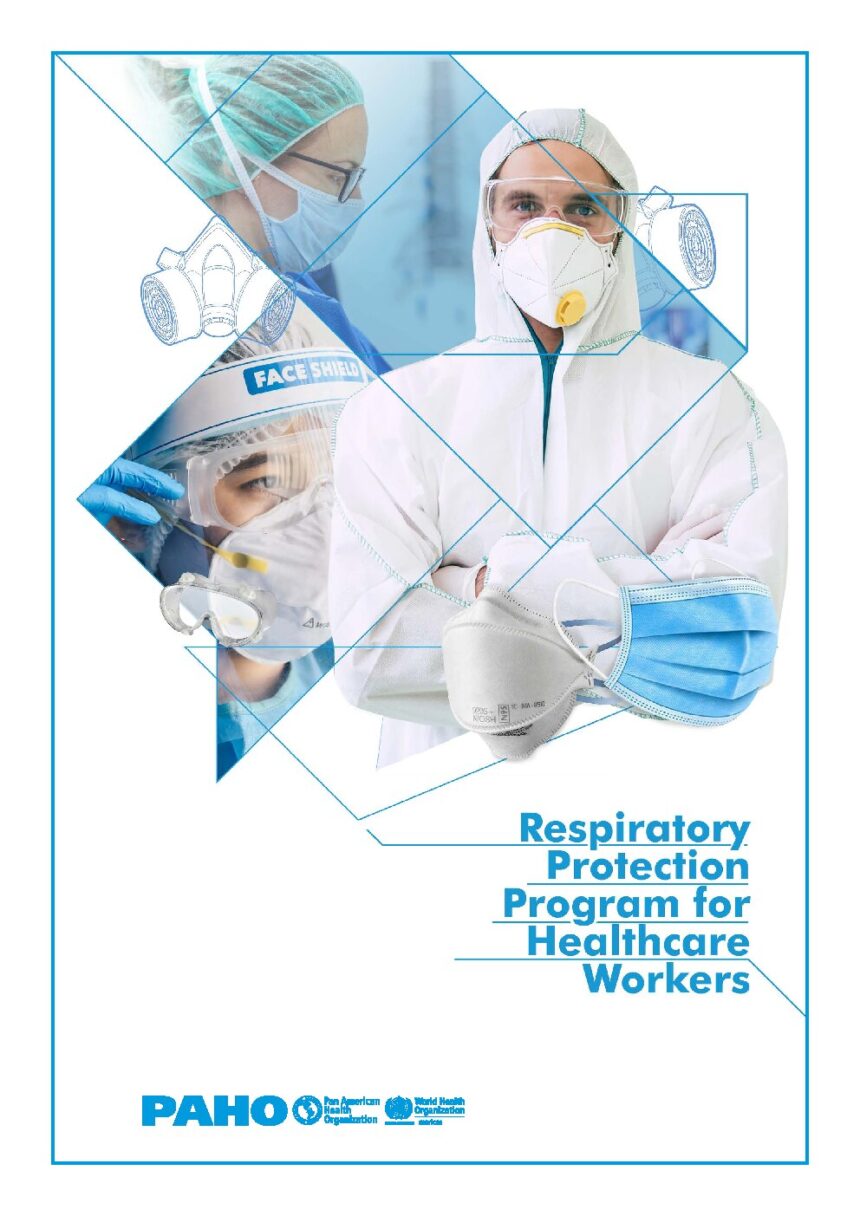
Pan American Health Organization · 1st edition, 2022
Comprehensive guidance for hospital RPP administrators on respirator selection, fit testing, medical screening, and programme management.
- Issuer
- Pan American Health Organization
- Edition
- 1st edition, 2022
- Audience
- Respiratory protection programme administrators, occupational health professionals, infection prevention and control staff, hospital managers, healthcare workers
- Evidence
- Expert consensus based on OSHA regulatory standards and NIOSH technical guidance
- Reviewed
- 17 Oct 2026 · GMJ
What this guideline says
GMJ summary
This 2022 PAHO manual provides a complete framework for establishing and managing respiratory protection programmes in healthcare facilities. It covers four modules: respiratory hazards in healthcare settings, types of respirators and their selection, programme development and administration, and fit testing and maintenance procedures.
The document emphasises that respirators are the last line of defence in the hierarchy of controls, after elimination, substitution, and engineering controls. It provides detailed technical specifications for N95, elastomeric, and powered air-purifying respirators (PAPR), explaining filtration mechanisms, assigned protection factors (APF), and maximum use concentrations. The manual requires medical screening of all respirator users, annual fit testing for tight-fitting respirators, documented training, and regular programme evaluation following PDCA (Plan-Do-Check-Act) cycles.
Key programme elements include: assigning a competent respiratory protection administrator; conducting risk assessments for both chemical and biological hazards; selecting appropriate respirators based on APF and exposure levels; implementing standard and airborne precautions; maintaining proper storage conditions (–20 °C to +30 °C, ≤80% relative humidity); and ensuring respirators are not used beyond their five-year shelf life from manufacture.
Key points
For clinicians — doses and thresholds as stated in the guideline
- N95 respirators filter ≥95% of 0.3 µm particles and have an assigned protection factor (APF) of 10, meaning they can be used up to 10 times the occupational exposure limit
- Half-face elastomeric respirators have APF of 10; full-face elastomeric APF of 50; loose-fitting PAPR APF of 25; tight-fitting PAPR (blower off) APF of 1,000
- All tight-fitting respirator users require medical screening before use, annual fit testing, and retraining every 12 months or when respirator model changes
- Respirators must be stored at –20 °C to +30 °C, ≤80% relative humidity, away from sunlight and chemicals, with a maximum shelf life of 5 years from manufacture date
- Qualitative fit testing uses Bitrex® or saccharin with 10–30 squeezes; quantitative fit testing uses instruments to measure air leakage and provides a numerical fit factor
- Seal checks (positive and negative pressure) must be performed every time before entering a contaminated area, distinct from annual fit testing
- Elastomeric respirators can be disinfected by submersion for 2 minutes in 50 ppm sodium hypochlorite solution at 43 °C; disposable N95s should not be disinfected except in crisis/outbreak situations
- Airborne precautions require negative-pressure isolation rooms, N95 or higher respiratory protection, and patient masking during transport; required for TB, measles, varicella, SARS, smallpox, monkeypox
OSHA Assigned Protection Factors (APF) by respirator type
Table extracted from the guideline
| Respirator type | Quarter mask | Half mask | Full facepiece | Helmet/hood | Loose-fitting facepiece |
|---|---|---|---|---|---|
| Air-Purifying Respirator | 5 | 10 | 50 | — | — |
| Powered Air-Purifying (PAPR) | — | 50 | 1,000 | 25/1,000* | 25 |
| Supplied-Air (SAR) – Demand mode | — | 10 | 50 | — | — |
| SAR – Continuous flow | — | 50 | 1,000 | 25/1,000* | 25 |
| SAR – Pressure-demand | — | 50 | 1,000 | — | — |
| SCBA – Demand mode | — | 10 | 50 | 50 | — |
| SCBA – Pressure-demand | — | — | 10,000 | 10,000 | — |
Source: Pan American Health Organization, Respiratory Protection Program for Healthcare Workers. Reproduced in summary form.
From the guideline
Verbatim
“PPE would be less effective than engineering controls, such as isolation rooms, biological cabinets, ventilation systems, etc.”
Editor’s perspective
Why this matters for Georgia and the region
Prof. Giorgi Pkhakadze, MD, MPH, PhD
Editor-in-Chief, Georgian Medical Journal · Chair, Public Health Institute of Georgia · WHO consultant, health and migration
As Chair of Georgia's Public Health Institute, I recognise that formalising respiratory protection programmes is overdue in our healthcare system, particularly given persistent TB transmission and lessons from COVID-19. Georgian hospitals must prioritise the establishment of competent Respiratory Protection Administrator roles—potentially within existing occupational health or IPC departments—and invest in annual fit-testing capacity using qualitative methods (Bitrex® kits are affordable at €200–500) before pursuing expensive quantitative systems. The manual's emphasis on the hierarchy of controls is critical: we should exhaust engineering solutions (negative-pressure isolation, ventilation upgrades funded through Global Fund TB grants) before relying on respirators as the primary defence. One implementation challenge will be ensuring medical screening for all respirator users when many Georgian facilities lack dedicated occupational health physicians; partnerships with primary care or telemedicine consultations may bridge this gap, but documentation and follow-up protocols must be rigorous to meet OSHA-equivalent standards.
ORCID 0000-0001-7609-4515 · Perspective written for the GMJ Guidelines Library, 17 Oct 2026
Applicability
Georgia and the South Caucasus
This guidance is highly relevant for Georgia and the South Caucasus, where healthcare facilities often lack formalised respiratory protection programmes despite occupational exposure to tuberculosis (Georgia reported 2,100 TB cases in 2021), seasonal influenza, and COVID-19. Georgian hospitals would need to establish a competent Respiratory Protection Administrator role—likely within existing infection prevention and control (IPC) or occupational health structures—and ensure access to NIOSH-certified or equivalent respirators (EN 149 FFP2/FFP3 are acceptable alternatives). The manual’s emphasis on medical screening, annual fit testing, and documented training aligns with Georgia’s Labour Code requirements but requires investment in fit-testing equipment (qualitative kits cost approximately €200–500; quantitative systems €5,000–15,000). National IPC programmes should integrate respirator protection into existing airborne infection control protocols, particularly for TB and emerging respiratory pathogens, ensuring that engineering controls (negative-pressure rooms, ventilation) are prioritised where feasible before relying on personal protective equipment.
Questions this guideline answers
Quick answers
What is the difference between an N95 respirator and a surgical mask?
N95 respirators filter ≥95% of 0.3 µm particles and require a tight seal against the face with an APF of 10, protecting the wearer. Surgical masks filter ≤90% of particles, do not seal against the face, and primarily protect patients from the wearer's respiratory droplets. For protection against airborne pathogens, only respirators (N95 or equivalent) are appropriate.
How often must healthcare workers be fit tested?
Tight-fitting respirators (N95, elastomeric half-face and full-face) require fit testing annually, after medical clearance, before first use, and whenever there are changes in respirator model, facial features (e.g., weight loss >12 kg, facial surgery, dental changes), or if improper use is observed. Loose-fitting PAPRs do not require fit testing but need annual retraining.
Can N95 respirators be reused or disinfected?
Disposable N95 respirators are designed for single use and should not be disinfected under normal circumstances. They may only be reused during crisis situations (epidemic/outbreak) when supply is limited, using proper storage in breathable paper bags between uses. Elastomeric respirators can be disinfected by submersion for 2 minutes in 50 ppm sodium hypochlorite at 43 °C according to manufacturer instructions.
What respiratory protection is required for tuberculosis patient care?
TB requires airborne precautions: N95 respirator (minimum APF 10) or higher protection, use of airborne infection isolation (AII) rooms with negative pressure, and patient masking during transport. Healthcare workers entering AII rooms, performing aerosol-generating procedures, or transporting unmasked TB patients in enclosed vehicles must wear appropriate respiratory protection with documented fit testing and medical clearance.
Related on GMJ
Interconnected resources
Dictionary of Public Health
Conditions A–Z
GMJ News coverage
- Cancer and Tuberculosis in the Same Chest: The Diagnostic Trap a CT-Guided Biopsy SolvedAug 2026
- Mobile Health Tools Strengthen Tuberculosis Contact Tracing in Low-Resource SettingsJul 2026
- Influenza surge in Southern Hemisphere prompts PAHO call for vaccination and health system readinessSep 2026
- Close Contact Alone May Not Drive Influenza Transmission, Controlled Study SuggestsJul 2026
Quality & accreditation
Other guidelines on this topic
- Guidelines for healthcare workers on the proper interpretation of vaccine vial monitors and their use
- STAR-H: Strategic Toolkit for Assessing Risks in Health Facilities
- SHAKE the salt habit, 2nd edition
- Strengthening clinical diagnostic stewardship in the Western Pacific Region: a practical manual
- Digital transformation handbook for reporting substandard and falsified medical products
- Issuer
- Pan American Health Organization
- Type
- Procedures, manuals, guidelines
- Edition
- 1st edition, 2022
- Status
- Current
- Published
- 2023-01-01
- Languages
- English
- Scope
- Hospital and healthcare facility respiratory protection programmes covering chemical and biological hazards
- Audience
- Respiratory protection programme administrators, occupational health professionals, infection prevention and control staff, hospital managers, healthcare workers
- Licence
- CC BY-NC-SA 3.0 IGO
- Evidence
- Expert consensus based on OSHA regulatory standards and NIOSH technical guidance
- Record history
- Created 17 Oct 2026 · updated 17 Oct 2026 · next check Apr 2027
Pan American Health Organization. Respiratory Protection Program for Healthcare Workers. Washington, DC: PAHO; 2022.GMJ Guidelines Library records are original summaries written by the GMJ editorial team from the issuer’s published document and reviewed by a physician. They do not replace the full guideline. The document is the copyright of its issuer and is linked, not hosted. Spotted an error or a newer edition? Tell the Guidelines Desk.
Was this article helpful?