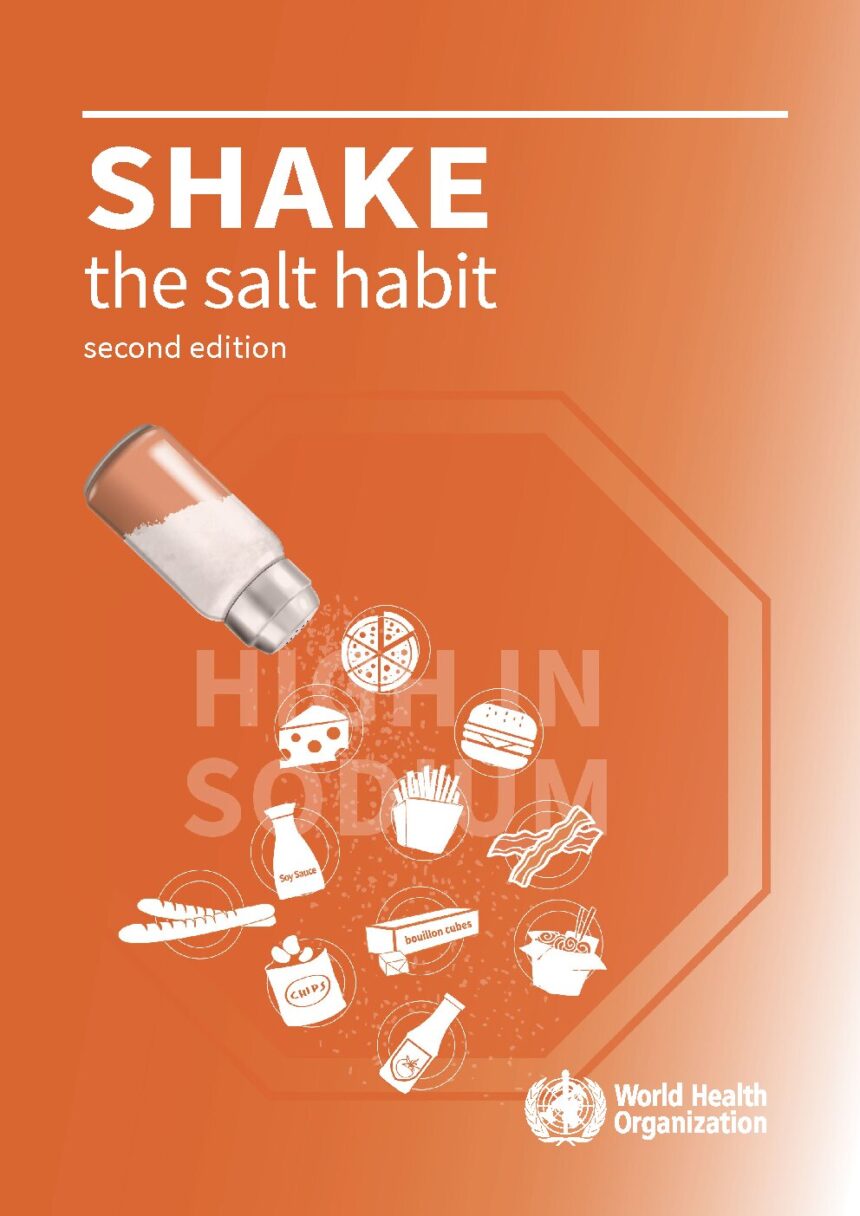
World Health Organization · 2nd edition, 2026 · 117 pages
A comprehensive manual for governments to design, implement, and monitor national sodium reduction programmes to prevent cardiovascular disease.
- Issuer
- World Health Organization
- Edition
- 2nd edition, 2026
- Audience
- Policy-makers, programme managers, public health professionals, academics
- Evidence
- Evidence-based recommendations from WHO guidelines on food reformulation, nutrition labelling, school food policies, food marketing restrictions, fiscal policies, and lower-sodium salt substitutes; best buys for NCD prevention and control
- Reviewed
- 17 Oct 2026 · GMJ
What this guideline says
GMJ summary
This second edition of SHAKE the salt habit is a comprehensive programme guide for governments to reduce population sodium intake through evidence-based, cost-effective policies and interventions. With global average sodium intake at 4,278 mg per day—more than double the WHO maximum recommendation of 2,000 mg per day—and 1.7 million deaths attributed to excess sodium in 2023, the manual outlines a systematic approach to sodium reduction as a ‘best buy’ for NCD prevention.
The guide presents seven core interventions: mandatory food reformulation setting maximum sodium limits in pre-packaged foods (using WHO global benchmarks for 70 food subcategories); interpretive front-of-pack warning labels identifying high-sodium products; food procurement and service policies prohibiting high-sodium foods in schools and public settings; marketing restrictions protecting children up to 18 years from high-sodium food advertising; taxation of unhealthy foods; behaviour change communication campaigns; and lower-sodium salt substitutes in appropriate settings where healthcare can monitor for kidney disease. Modelling suggests that implementing mandatory reformulation and other best buys could reduce sodium intake by 23% and prevent over 500,000 cardiovascular deaths annually by 2030.
The manual emphasizes mandatory government-led approaches over voluntary industry self-regulation, provides detailed implementation guidance including nutrition criteria development, addresses industry interference through conflict-of-interest safeguards, and includes comprehensive annexes on data collection, monitoring indicators, and country examples. It positions sodium reduction within a human rights framework as governments’ duty to facilitate the rights to adequate food and the highest attainable standard of health.
Key points
For clinicians — doses and thresholds as stated in the guideline
- WHO recommends maximum sodium intake of <2,000 mg/day in adults (equivalent to <5 g salt/day); global average is 4,278 mg/day, more than double the recommendation
- Mandatory food reformulation should set maximum sodium limits aligned with WHO global benchmarks covering 70 food subcategories (e.g., 540 mg/100 g for canned corned beef, 279 mg/100 g for lightly salted peanuts)
- Front-of-pack warning labels should flag products exceeding sodium thresholds (e.g., Chile: >400 mg/100 g solid food, >100 mg/100 mL liquid; PAHO: ≥1 mg/kcal plus absolute ceiling of 300 mg/100 g)
- Food procurement policies should ban service/sale of high-sodium foods in all public settings (schools, hospitals, government canteens) at national, state, and local levels
- Marketing restrictions should ban advertising of high-sodium foods to all children up to 18 years across all media, channels, and settings, including prohibition of child-appealing persuasive techniques
- Lower-sodium salt substitutes (LSSS) containing potassium may be used only in settings with adequate healthcare access to promptly detect kidney disease and manage hyperkalaemia risks
- Mandatory back-of-pack nutrition labels must declare sodium content on all pre-packaged foods to enable implementation, monitoring, and enforcement of sodium reduction policies
- Combined implementation of mandatory reformulation and other best buys could reduce sodium intake by 23% and prevent >500,000 CVD deaths annually by 2030
Sodium reduction policies and interventions included in WHO best buys or other WHO guidance
Table extracted from the guideline
| Intervention | What it is? | Included in WHO best buys | Included in other WHO guidance | Most comprehensive approach |
|---|---|---|---|---|
| Food reformulation | Policies that set maximum limits or targets for the sodium content of pre-packaged food | Yes | Yes | Mandatory approach: Set scope and criteria for maximum permissible limits for sodium (as defined by WHO global benchmarks or regional or national targets) that cover food categories that are major sources of dietary sodium |
| FOPL as part of comprehensive food and nutrition labelling | Policies that set scope and criteria for providing interpretive information about healthiness of food, including sodium content, on the front of pre-packaged food, as part of comprehensive food and nutrition labelling policies to list ingredients, declare sodium content, and regulate the use of sodium-related claims | Yes | Yes | Mandatory approach: Require that interpretive FOPL is mandatory on all pre-packaged food so that consumers can easily identify food products that exceed the nutrient threshold for sodium; require listing of ingredients and mandatory declaration of sodium content on all pre-packaged food; and prevent misleading health and nutrition claims related to sodium |
| Food procurement and service | Policies that set scope and criteria for food, including high-sodium food, served or sold in public settings and/or procured by governments for food programmes | Yes | Yes | Mandatory approach: Ban the procurement, use, sale and supply of any food that does not meet nutrition criteria related to sodium across all public settings at national, state and local or province level |
| Food marketing restrictions | Policies that set scope and criteria for restricting food marketing to protect children from its harmful impact on diet, including consumption of high-sodium food | No | Yes | Mandatory approach: Ban the marketing of any food products that exceed the nutrient threshold for sodium to all children aged up to 18 years in all media, channels and settings and prohibit the use of child-appealing persuasive techniques |
| Taxation of unhealthy food | Policies that set scope and criteria for taxes on unhealthy food, including high-sodium food | No | Yes | Mandatory approach: Require that a health levy or similar is applied to any food that does not meet nutrition criteria related to sodium |
| Behaviour change communication and mass media campaigns for healthy diets | A set of communication activities designed to change behaviours to reduce consumption of unhealthy food, including salt and high-sodium food | Yes | No | Behaviour change communication is integral to all public health responses and should be part of a comprehensive sodium reduction programme, including to build support for other policies and interventions |
| LSSS to replace regular table salt (in appropriate settings) | Alternatives to regular table salt in which a proportion of the sodium is typically replaced with potassium | No | Yes | LSSS may be considered as one of several potential interventions in a comprehensive sodium reduction programme, provided an assessment has been made that its use is appropriate in the setting |
Source: World Health Organization, SHAKE the salt habit, 2nd edition. Reproduced in summary form.
What changed in this edition
Versus the previous edition
- Second edition updated to reflect recent WHO evidence-based guidelines, new implementation tools for sodium reduction policies and interventions, and the 2024 update of best buys for prevention and control of NCDs
- Guide structure evolved from original SHAKE acronym (Surveillance, Harness industry, Adopt standards, Knowledge, Environment) to current three-section approach: preparing, developing/implementing, and monitoring/enforcing
- Expanded coverage of mandatory government-led approaches versus voluntary industry self-regulation, with emphasis on safeguards against industry interference
- Added comprehensive annexes on data collection (Annex 4), data sources (Annex 5), monitoring indicators (Annex 6), and visualization of sodium content thresholds (Annex 7)
From the guideline
Verbatim
“Implementing a comprehensive, government-led sodium reduction programme with a mandatory approach to food reformulation, food and nutrition labelling, food procurement and service, food marketing restrictions and taxation of unhealthy food – complemented by behaviour change communication and mass media campaigns – is expected to be the most effective approach to lowering sodium intake.”
Editor’s perspective
Why this matters for Georgia and the region
Prof. Giorgi Pkhakadze, MD, MPH, PhD
Editor-in-Chief, Georgian Medical Journal · Chair, Public Health Institute of Georgia · WHO consultant, health and migration
As Editor-in-Chief of GMJ and WHO consultant on health and migration, I recognize that cardiovascular disease remains the leading cause of death in Georgia and across the South Caucasus, making this comprehensive sodium reduction manual immediately relevant to our region. The most critical recommendation for Georgian clinicians and public health professionals is to advocate for mandatory food reformulation aligned with WHO global sodium benchmarks, starting with our major dietary sodium sources: traditional breads (puri, lavash, shotis puri), Georgian cheeses (sulguni, imeruli), and processed meats, where sodium content can be reduced by 20-30% without noticeable taste changes, as demonstrated in European programmes. The realistic implementation caveat for Georgia is that our food supply includes both large multinational manufacturers and thousands of small bakeries and cheese producers, requiring a phased regulatory approach that provides technical assistance to small enterprises while ensuring laboratory capacity for compliance monitoring. Given Georgia's Universal Health Coverage programme since 2013 and established food safety laboratory infrastructure, we have the foundation to implement these evidence-based interventions, but success will require coordinated action across the Ministries of Health, Agriculture, Education, and Finance, with clear safeguards against food industry interference in policy development as outlined in this manual.
ORCID 0000-0001-7609-4515 · Perspective written for the GMJ Guidelines Library, 17 Oct 2026
Applicability
Georgia and the South Caucasus
Georgia and the South Caucasus face significant cardiovascular disease burdens as the leading cause of death across the region, making sodium reduction highly relevant. The WHO European Region average sodium intake is 3,477 mg/day—nearly double the WHO recommendation—and Eastern European countries typically consume high amounts of bread, processed meats, cheese, and salty condiments that are primary sodium sources. National programmes in Georgia, Armenia, and Azerbaijan would need to conduct 24-hour urine sodium collection surveys to establish baselines, assess sodium content in locally produced and imported foods (particularly traditional breads, cheeses, pickled vegetables, and canned products), and evaluate the feasibility of mandatory reformulation given the mix of large multinational food companies and small-scale domestic producers. The manual’s emphasis on mandatory approaches is particularly relevant given the region’s capacity for food safety regulation and laboratory infrastructure. For lower-sodium salt substitutes, countries would need to assess healthcare system capacity for detecting and managing kidney disease before promoting products containing potassium chloride. School food policies could build on existing school meal programmes common across former Soviet republics, while front-of-pack warning labels would require amendment of food labelling regulations and consideration of Eurasian Economic Union harmonization requirements for Armenia, Belarus, Kazakhstan, Kyrgyzstan, and Russia.
Questions this guideline answers
Quick answers
What is the WHO recommended maximum sodium intake and how does it compare to current global consumption?
WHO recommends maximum sodium intake of <2,000 mg per day in adults (equivalent to <5 g salt per day), adjusted downward for children based on energy requirements. The global average sodium intake in 2021 was 4,278 mg per day (11 g salt), more than double the WHO recommendation. Regional averages range from 2,736 mg/day in the African Region to 6,281 mg/day in the Western Pacific Region. High sodium intake was responsible for an estimated 1.7 million deaths in 2023.
What are the WHO global sodium benchmarks and how should countries use them for food reformulation policies?
WHO global sodium benchmarks establish maximum limits for sodium levels in 70 food subcategories, based on the lowest (strictest) maximum limit value from existing national or regional limits or targets. Countries should implement the full suite of benchmarks across food categories, adapting them to the local context as appropriate. A phased approach is recommended, starting with food categories that are major sources of dietary sodium and gradually expanding coverage and/or setting progressively stricter thresholds over time. For example, the benchmark for canned corned beef is 540 mg sodium/100 g, for lightly salted peanuts 279 mg/100 g, and for bouillon/stock cubes 13,000 mg/100 g.
Should countries implement voluntary or mandatory sodium reduction policies?
Countries should prioritize mandatory, government-led approaches rather than voluntary industry self-regulation. Mandatory approaches establish legally binding obligations enforceable with sanctions, create a level playing field for all food businesses, and have greater potential to effectively reduce sodium intake. Industry self-regulation lacks accountability, enforceability, and transparency; does not legally oblige commercial actors to reduce sodium; leads to uneven progress across the industry; and can result in multiple inconsistent standards. Mandatory policies support a healthier food environment for all and should be implemented across food reformulation, food labelling, food procurement and service, food marketing restrictions, and taxation.
When can lower-sodium salt substitutes (LSSS) containing potassium be safely recommended?
LSSS containing potassium should only be used in settings where the health system has adequate capacity to detect promptly and manage kidney disease and other conditions where increased potassium intake is potentially harmful (hyperkalaemia). Countries must conduct a risk assessment considering: the proportion of the population at risk of kidney disease and hyperkalaemia; access to healthcare; sources of sodium in the diet (LSSS are most relevant when discretionary salt is a major source); capacity for monitoring sodium and potassium intakes; the potassium content of LSSS products; use of warning labels; consumer awareness of risks and benefits; and cost implications. LSSS should be considered as one intervention within a comprehensive programme, not a standalone solution. The WHO recommendation applies only to LSSS replacing discretionary salt, not salt used in food processing, due to lack of evidence for non-discretionary use.
Related on GMJ
Interconnected resources
Dictionary of Public Health
Conditions A–Z
GMJ News coverage
- Hypertension's Hidden Complexity: Why One-Size-Fits-All Treatment FailsOct 2026
- Primary aldosteronism: why screening for this overlooked cause of hypertension mattersSep 2026
- Eight Common Food Additives Linked to Hypertension and Cardiovascular Disease in Large Cohort StudyJul 2026
- Heat Exhaustion and Heat Stroke on Safari: Clinical Recognition and PreventionOct 2026
- Post-stroke heart failure triples risk of poor outcome in large vessel occlusion patients treated with endovascular therapySep 2026
Quality & accreditation
Other guidelines on this topic
- Digital transformation handbook for reporting substandard and falsified medical products
- Regional manual with operating guides on respiratory care equipment and devices
- Prevention and management of heat-related illness at mass gatherings: systematic reviews
- Resilient Hospitals: An inter-regional guidance on strengthening resilience to health emergencies and disasters in health facilities
- EVAC-H: Evacuation of hospitals and their critical areas
- Issuer
- World Health Organization
- Type
- Manual
- Edition
- 2nd edition, 2026
- Replaces
- SHAKE the salt habit: the technical package for salt reduction, 2016
- Status
- Current
- Published
- 2026-05-12
- Languages
- English
- Scope
- Global, applicable to all countries
- Audience
- Policy-makers, programme managers, public health professionals, academics
- Pages
- 117
- Licence
- CC BY-NC-SA 3.0 IGO
- ISBN
- 978-92-4-012034-1
- Evidence
- Evidence-based recommendations from WHO guidelines on food reformulation, nutrition labelling, school food policies, food marketing restrictions, fiscal policies, and lower-sodium salt substitutes; best buys for NCD prevention and control
- Record history
- Created 17 Oct 2026 · updated 17 Oct 2026 · next check Apr 2027
World Health Organization. SHAKE the salt habit, second edition. Geneva: World Health Organization; 2026. Licence: CC BY-NC-SA 3.0 IGO.GMJ Guidelines Library records are original summaries written by the GMJ editorial team from the issuer’s published document and reviewed by a physician. They do not replace the full guideline. The document is the copyright of its issuer and is linked, not hosted. Spotted an error or a newer edition? Tell the Guidelines Desk.
Was this article helpful?