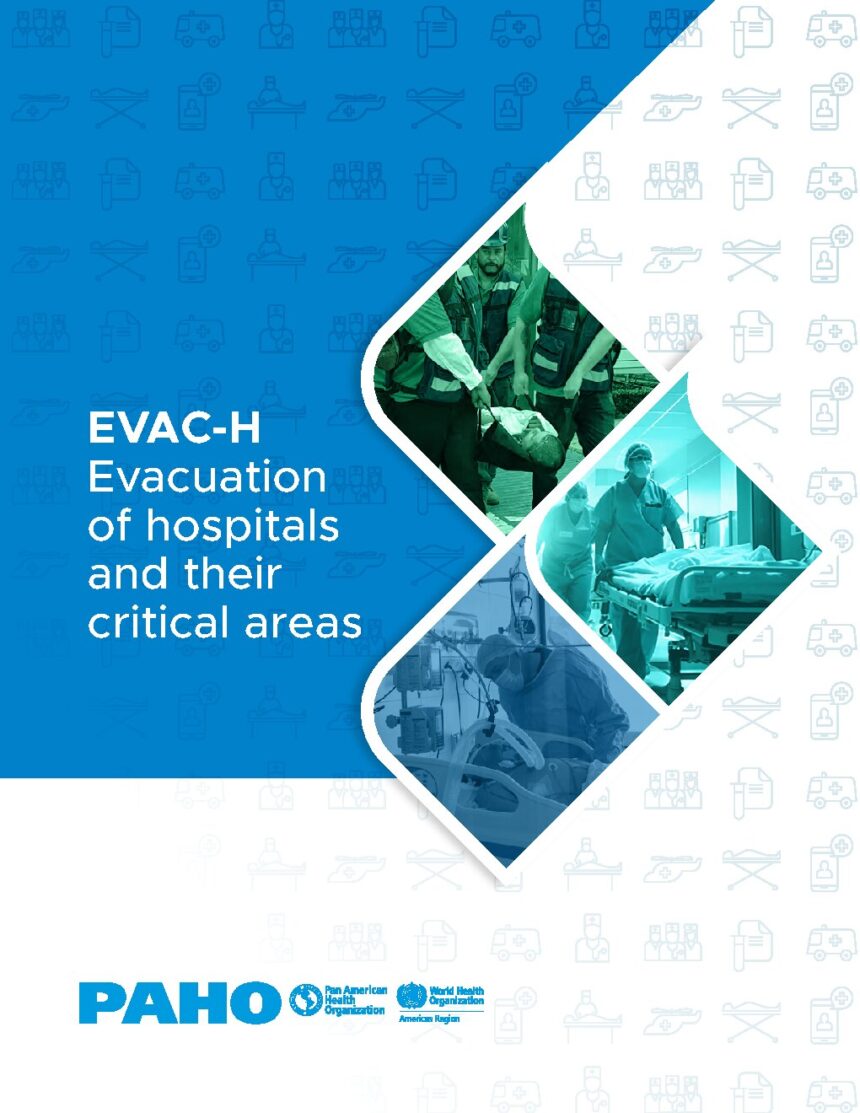
Pan American Health Organization · 1st edition, 2025 · 39 pages
Operational guidance for hospital managers and emergency planners on developing evacuation procedures for patients, including critical-care areas.
- Issuer
- Pan American Health Organization
- Edition
- 1st edition, 2025
- Audience
- Hospital managers, emergency planners, disaster response coordinators, critical-care clinicians
- Evidence
- Expert consensus, adapted from peer-reviewed literature and field experience
- Reviewed
- 16 Oct 2026 · GMJ
What this guideline says
GMJ summary
EVAC-H is a procedural toolkit from the Pan American Health Organization designed to help hospitals develop or update evacuation procedures as part of their emergency and disaster management plans. The document emphasises that hospital evacuation should be a last resort, undertaken only when risk assessment indicates that remaining poses greater danger to patients, staff, and visitors than the inherent risks of transfer, particularly for critically ill patients.
The guidance provides a systematic framework spanning preparation (planning, staff training, coordination with health networks), activation criteria (before anticipated events, during sudden disruptions, or when essential services fail), and implementation across five phases: preparation, transfer, reception, support, and data recording. A core feature is the patient classification system for critical areas, which triages patients into five groups based on ventilatory support requirements (FiO₂, PEEP), vasopressor dependence (norepinephrine dosing), and survival prognosis, enabling prioritised evacuation with appropriate resources.
The tool advocates a multi-hazard approach grounded in the Hospital Safety Index and STAR-H risk assessments, integration with health services networks for receiving facilities and transport, disability inclusion (following INGRID methodology), and regular testing through drills. Emphasis is placed on evacuating critical areas—emergency departments, intensive care units (adult, neonatal, paediatric), operating rooms, and haemodialysis—where patient complexity and technological dependence are highest.
Key points
For clinicians — doses and thresholds as stated in the guideline
- Patient classification for evacuation in critical areas uses five groups: Group 1 (stable, not ventilated), Group 2 (not ventilated, may need O₂), Group 3 (low ventilatory support: FiO₂ ≤50% or PEEP ≤10 cmH₂O or noninvasive ventilation, norepinephrine ≤0.3 μg/kg/min), Group 4 (high support: FiO₂ >50% and PEEP 10–20 cmH₂O, norepinephrine up to 0.5 μg/kg/min, no multi-organ failure), and Group 5 (PaO₂/FiO₂ <100, PEEP >20, norepinephrine >0.5 μg/kg/min with poor response, multi-organ failure or brain death—consider not evacuating initially).
- Evacuation should be activated before anticipated high-impact events (e.g. hurricanes), during sudden service disruptions (fire, earthquake with structural damage), or when essential services fail (mechanical room failure, oxygen supply loss, power outage without backup).
- For safe transfer, ensure blood pressure SBP >90 mmHg and DBP >60 mmHg, oxygen saturation >88%, secure all vascular access and tubes, verify sufficient medication for transfer duration, and use functional monitoring (blood pressure, pulse oximetry, three-lead ECG).
- Evacuation can be total (entire building vacated), partial (specific services/areas only), horizontal (occupants moved to same-level safe zone inside building), or vertical (to upper or lower floors depending on hazard type).
- Pre-transfer stabilisation follows ABCD sequence: Airway (elective intubation if ventilation at risk, verify tube position, suction secretions), Breathing (optimise ventilation, insert chest tube if pneumothorax suspected), Circulation (two patent venous access points, stable haemodynamics, control haemorrhage), Disability (adequate sedation, avoid transporting agitated patients with RASS +2 to +4, ICP must be <20 mmHg).
- Group 3 patients require one nurse, one physician, one stretcher-bearer, one respiratory therapist, transport ventilator, basic monitoring, two infusion pumps, and oxygen supply during transfer.
- Group 4 patients require one or two nurses, one physician, one stretcher-bearer, one respiratory therapist, transport ventilator, two to three infusion pumps, two oxygen tanks, and bag-valve mask.
- All hospitals with Hospital Safety Index classification of C (high vulnerability) must have an updated, approved, and tested evacuation procedure; procedures should be validated annually through drills and linked to specific contingency plans (fire, earthquake).
List of resources for patient transfer according to patient classification
Table extracted from the guideline
| Group | Human resources | Equipment | Medications |
|---|---|---|---|
| 1 | Auxiliary or administrative personnel | Transfer stretcher, wheelchair, or other device | No medications |
| 2 | One nurse, one stretcher-bearer | Transfer stretcher or wheelchair; basic monitoring (BP, pulse oximetry, 3-lead ECG); infusion pump; oxygen tank with interface (nasal cannulas, reservoir mask, face tent) | Analgesics, crystalloid solutions |
| 3 | One nurse, one physician, one stretcher-bearer | Transfer stretcher; transport mechanical ventilator; basic monitoring (BP, pulse oximetry, 3-lead ECG); infusion pump; oxygen tank; bag-valve mask | Analgesics, vasopressors, sedative-hypnotics, neuromuscular blockers, crystalloid and colloid solutions |
| 4 | One or two nurses, one physician, one stretcher-bearer, one respiratory therapist | One transfer stretcher; one transport mechanical ventilator; basic monitoring (BP, pulse oximetry, 3-lead ECG); two to three infusion pumps; two oxygen tanks; bag-valve mask | Analgesics, vasopressors, inotropes, sedative-hypnotics, neuromuscular blockers, crystalloid and colloid solutions |
| 5 (if transfer determined) | One or two nurses, one physician, one stretcher-bearer, one respiratory therapist | One transfer stretcher; one transport mechanical ventilator; basic monitoring (BP, pulse oximetry, 3-lead ECG); two to three infusion pumps; two oxygen tanks; bag-valve mask | Analgesics, vasopressors and vagolytics, inotropes, sedative-hypnotics, neuromuscular blockers, crystalloid and colloid solutions |
Source: Pan American Health Organization, EVAC-H: Evacuation of hospitals and their critical areas. Reproduced in summary form.
From the guideline
Verbatim
“An evacuation always represents a risk to the lives of patients, especially those with serious health conditions.”
Editor’s perspective
Why this matters for Georgia and the region
Prof. Giorgi Pkhakadze, MD, MPH, PhD
Editor-in-Chief, Georgian Medical Journal · Chair, Public Health Institute of Georgia · WHO consultant, health and migration
As Chair of the Public Health Institute of Georgia and a WHO consultant, I recognise that EVAC-H addresses a critical gap in Georgian hospital preparedness, particularly given our seismic vulnerability and the lessons from the 2015 Tbilisi flood that affected healthcare facilities. The five-tier patient classification system for critical areas, based on objective ventilatory and haemodynamic thresholds, provides a rational framework that Georgian intensivists can adapt to local capacity, especially important as our ICU bed availability (approximately 400 nationally) remains limited and concentrated in Tbilisi. I would stress to Georgian colleagues the imperative of pre-evacuation coordination with regional referral hospitals and the Emergency Management Service, annual drills involving actual patient simulation in critical areas, and ensuring transport ventilators with sufficient battery capacity are pre-positioned—our experience with COVID-19 surges demonstrated how rapidly critical-care capacity can be overwhelmed. One realistic caveat: implementing disability-inclusive evacuation procedures will require investment in accessible alarm systems and training that many Georgian hospitals currently lack, necessitating phased implementation prioritising high-risk facilities first.
ORCID 0000-0001-7609-4515 · Perspective written for the GMJ Guidelines Library, 16 Oct 2026
Applicability
Georgia and the South Caucasus
Georgia’s health system, with its universal health coverage programme and growing network of accredited hospitals, would benefit substantially from standardised hospital evacuation procedures, particularly given seismic risk in Tbilisi and the South Caucasus, flood hazards in western Georgia, and the need for disaster preparedness in conflict-affected regions near occupied territories. The EVAC-H framework aligns with Georgia’s ongoing implementation of the Hospital Safety Index (supported by WHO Country Office) and the national disaster risk reduction strategy. Georgian hospitals should prioritise developing institution-specific procedures adapted to local hazards (earthquakes, landslides, floods), ensure integration with the national emergency medical services system and regional referral networks, incorporate accessibility requirements per the UN Convention on the Rights of Persons with Disabilities (ratified by Georgia in 2014), and conduct annual drills coordinated with the Emergency Management Service of the Ministry of Internal Affairs. Critical-care capacity in Georgia remains concentrated in Tbilisi and regional centres (Batumi, Kutaisi, Rustavi), necessitating inter-facility agreements for patient reception during evacuations and pre-positioned transport ventilators and monitoring equipment.
Questions this guideline answers
Quick answers
Which patients should be evacuated first from a hospital critical care unit?
Evacuation order prioritises patients who can move independently or with minimal assistance (Group 1), followed by non-ventilated patients requiring stretcher or wheelchair (Group 2), then patients on low ventilatory support (Group 3: FiO₂ ≤50%, PEEP ≤10 cmH₂O, norepinephrine ≤0.3 μg/kg/min), then high-support patients (Group 4: FiO₂ >50%, PEEP 10–20, norepinephrine ≤0.5 μg/kg/min), and finally Group 5 patients (PaO₂/FiO₂ <100, PEEP >20, norepinephrine >0.5 μg/kg/min, multi-organ failure) only if safe for staff and conditions permit. This classification minimises resource use and transfer risk while maximising survival.
What are the minimum vital signs and conditions required before transferring a critically ill patient during evacuation?
Before transfer, ensure systolic blood pressure >90 mmHg and diastolic >60 mmHg, oxygen saturation >88% (acceptable for clinical condition), secure airway with verified endotracheal tube position if intubated, all vascular access points secured, adequate sedation (avoid RASS +2 to +4 agitation), intracranial pressure <20 mmHg if monitored, sufficient medication for transfer duration, functional monitoring equipment (pulse oximetry, blood pressure, ECG), and charged ventilator batteries. Perform suctioning of secretions if time allows and insert chest tube if pneumothorax suspected.
When should a hospital activate its evacuation procedure?
Activate evacuation: (1) before an anticipated severe event that could prevent operations or endanger occupants (e.g. high-intensity hurricane, bomb threat); (2) during sudden service disruption posing life or operational risk (fire, sudden flooding, earthquake with structural damage); or (3) when auxiliary or essential services fail critically (mechanical room failure, oxygen supply loss, power outage without backup). The incident commander or designated authority (business hours) or on-duty emergency/security personnel (non-business hours) makes the activation decision based on risk assessment.
What equipment and personnel are needed to transfer a ventilated ICU patient on moderate vasopressor support during hospital evacuation?
For Group 4 patients (high ventilatory support: FiO₂ >50%, PEEP 10–20 cmH₂O, norepinephrine up to 0.5 μg/kg/min), the transfer team requires: one or two nurses, one physician, one stretcher-bearer, one respiratory therapist; equipment includes one transport mechanical ventilator, basic monitoring (blood pressure, pulse oximetry, three-lead ECG), two to three infusion pumps, two oxygen tanks, and bag-valve mask; medications include analgesics, vasopressors, inotropes, sedative-hypnotics, neuromuscular blockers, and crystalloid/colloid solutions.
Related on GMJ
Interconnected resources
Dictionary of Public Health
GMJ News coverage
Quality & accreditation
Other guidelines on this topic
- Protocol for the Use of the Performance Monitoring Tool for the National Expanded Program on Immunization
- Global standards for quality health care services for adolescents
- Water and Sanitation Technologies for Health-care Facilities: Selecting Options for Adoption and Scale-up in the Western Pacific Region
- Water and Sanitation Technologies for Health-care Facilities
- Measuring the progress and impact of the UN Decade of Healthy Ageing (2021–2030): framework and indicators recommended by WHO Technical Advisory Group
- Issuer
- Pan American Health Organization
- Type
- Procedures, manuals, guidelines
- Edition
- 1st edition, 2025
- Status
- Current
- Published
- 2025-01-30
- Languages
- English, Spanish
- Scope
- Hospitals and health facilities providing inpatient care, with emphasis on critical areas (emergency departments, intensive care units, operating rooms, haemodialysis)
- Audience
- Hospital managers, emergency planners, disaster response coordinators, critical-care clinicians
- Pages
- 39
- Licence
- CC BY-NC-SA 3.0 IGO
- ISBN
- 978-92-75-12783-4 (PDF)
- Evidence
- Expert consensus, adapted from peer-reviewed literature and field experience
- Record history
- Created 16 Oct 2026 · updated 16 Oct 2026 · next check Apr 2027
Pan American Health Organization. EVAC-H: Evacuation of hospitals and their critical areas. Washington, D.C.: PAHO; 2025. Available from: https://doi.org/10.37774/9789275127834GMJ Guidelines Library records are original summaries written by the GMJ editorial team from the issuer’s published document and reviewed by a physician. They do not replace the full guideline. The document is the copyright of its issuer and is linked, not hosted. Spotted an error or a newer edition? Tell the Guidelines Desk.
Was this article helpful?