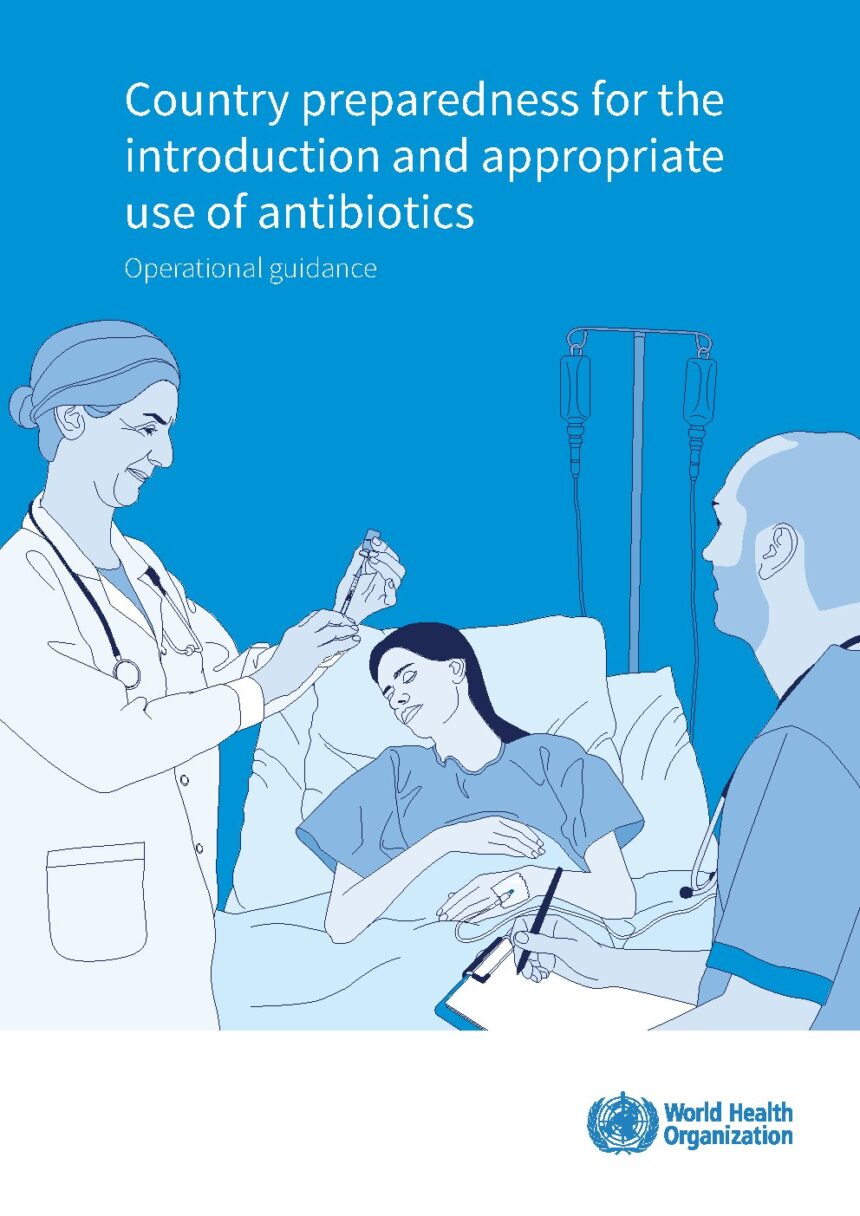
World Health Organization · 1st edition, 2025 · 204 pages
Step-by-step operational framework for countries to introduce Watch and Reserve antibiotics with stewardship safeguards
- Issuer
- World Health Organization
- Edition
- 1st edition, 2025
- Audience
- Country-level decision-makers, AMR coordination committees, national regulatory authorities, facility-level AMS committees, programme managers, procurement agencies, laboratory directors, health care professionals, implementing partners
- Evidence
- Developed through desk research, key informant interviews, review of disease-specific product introduction guidance (TB, HIV, malaria, vaccines), and two-day technical consultation with country representatives, disease experts, and product introduction specialists; consensus-based operational framework
- Reviewed
- 14 Oct 2026 · GMJ
What this guideline says
GMJ summary
This 204-page operational guidance, developed by WHO and the Global Antibiotic Research and Development Partnership (GARDP) through the SECURE initiative, provides countries with a systematic framework for introducing antibiotics—particularly Watch and Reserve categories—into national health systems. It addresses the dual challenge of expanding access to essential antibiotics for multidrug-resistant organisms (MDROs) in low- and middle-income countries while simultaneously ensuring appropriate use through antimicrobial stewardship (AMS) programmes.
The guidance walks countries through five core elements: pre-planning (establishing leadership and stakeholder engagement); deciding to introduce an antibiotic (evidence-based selection based on AMR surveillance and clinical need); developing a comprehensive introduction plan (covering policy adoption, registration, procurement, supply chain, laboratory capacity, facility readiness, and awareness-raising); planning monitoring and evaluation; and costing all activities. Unlike typical medicine introduction processes, this framework emphasizes integrating stewardship measures from the outset, ensuring diagnostic capacity is in place, and linking introduction to national AMR action plans.
The guidance is intentionally flexible, designed to be tailored to each country’s unique health system, regulatory environment, laboratory capacity, and AMR burden. It emphasizes that introducing Reserve antibiotics requires demonstrated capacity for antimicrobial susceptibility testing, functional AMS committees at facility level, and robust surveillance systems—or planned investments to build this capacity before introduction. Seven guiding principles anchor the approach: strong country-led planning; sustained comprehensive access; balanced essential medicines lists aligned with WHO AWaRe classification; safe and effective supply; robust AMS policies and programmes; links to infection prevention and control (IPC) and diagnostics; and adequate resource allocation.
Key points
For clinicians — doses and thresholds as stated in the guideline
- Antibiotic selection should be based on local AMR surveillance data, resistance patterns, current formulary gaps, and alignment with WHO Essential Medicines List and AWaRe classification (Access, Watch, Reserve).
- Reserve antibiotics should ideally be used only after antimicrobial susceptibility testing (AST) results, except in severe life-threatening MDRO infections where empiric use may be necessary with subsequent treatment modification based on culture results.
- Facilities introducing Watch/Reserve antibiotics must have: AMS programmes with audit and feedback mechanisms; access to microbiology laboratory services for culture and AST; infection prevention and control (IPC) programmes; and capacity for prescription monitoring through point prevalence surveys or prescription audits.
- National regulatory authorities should implement facilitated registration pathways (e.g., WHO Collaborative Registration Procedure, reliance on WHO-listed authorities, accelerated approval for unmet medical needs) and consider fee waivers for antibiotics targeting serious infections.
- Procurement planning must consolidate national demand (including private sector), leverage pooled procurement where feasible, and include long-term demand forecasting to address supplier concerns about low/unpredictable volumes for Reserve antibiotics.
- Laboratory capacity requirements include: standardized AST methodology (Clinical and Laboratory Standards Institute or European Committee on Antimicrobial Susceptibility Testing guidelines); quality assurance through proficiency testing; trained staff; and integration into national AMR surveillance (GLASS) reporting.
- Phased introduction approaches should prioritize facilities with: existing AMS committees; access to microbiology laboratories; demonstrated capacity for appropriate antibiotic use; adequate infrastructure (cold chain if needed, IV administration equipment); and ability to participate in monitoring and reporting.
- Monitoring frameworks must track: antibiotic consumption patterns (aligned with GLASS methodology); resistance trends and antibiogram data; prescription appropriateness through facility audits; pharmacovigilance including treatment failures; and supply chain performance (stockouts, expiries).
Facility readiness checklist for appropriate antibiotic use
Table extracted from the guideline
| Core element | Requirement |
|---|---|
| Leadership & accountability | Facility has commitment to ensure AMS is implemented and appropriate antibiotic use |
| Resources | Allocated human and financial resources to conduct AMS activities |
| Bacteriology services | Access to laboratory services to guide appropriate use (on-site or referral) |
| Genomic monitoring | Access to data that allows monitoring to take place |
| AMS/IPC/AST programmes | Policies and programmes in place to prevent hospital-acquired infections, being implemented |
| Prescription monitoring | Capacity to conduct regular prescription audits, point prevalence surveys to assess appropriateness |
Source: World Health Organization, Country preparedness for the introduction and appropriate use of antibiotics: operational guidance. Reproduced in summary form.
From the guideline
Verbatim
“Reserve antibiotics are last-resort treatments that are primarily used in hospital settings, they often face restricted or limited demand making them commercially unviable for pharmaceutical investment.”
Editor’s perspective
Why this matters for Georgia and the region
Prof. Giorgi Pkhakadze, MD, MPH, PhD
Editor-in-Chief, Georgian Medical Journal · Chair, Public Health Institute of Georgia · WHO consultant, health and migration
As Chair of the Public Health Institute of Georgia and having supported WHO initiatives in the region, I view this operational guidance as particularly timely for Georgia and neighbouring countries in the South Caucasus and Eastern Europe. The framework directly addresses a gap we face: sporadic availability of newer antibiotics for multidrug-resistant infections in our hospitals, often without the stewardship infrastructure to preserve their effectiveness. The recommendation I would stress most to Georgian clinicians and hospital administrators is the facility readiness checklist—we cannot responsibly introduce Reserve antibiotics without functional AMS committees, reliable access to microbiology laboratories for culture and susceptibility testing, and established prescription audit mechanisms. The realistic implementation caveat is laboratory capacity: while our national reference laboratories have advanced considerably, extending quality-assured AST for Reserve antibiotics to regional hospitals will require phased implementation and likely regional hub-and-spoke models, as the guidance suggests. Georgia's experience with vertical disease programmes (our hepatitis C elimination programme since 2015, TB programme) demonstrates we can implement structured introduction pathways, but antibiotic stewardship requires a different kind of horizontal integration across all hospital departments that will take sustained investment in training and supervision.
ORCID 0000-0001-7609-4515 · Perspective written for the GMJ Guidelines Library, 14 Oct 2026
Applicability
Georgia and the South Caucasus
For Georgia and the South Caucasus region, this guidance is highly relevant given ongoing AMR surveillance strengthening through GLASS participation and the need to expand access to newer antibiotics while preserving their effectiveness. Georgian national programmes would need to assess current microbiology laboratory network capacity (particularly for AST of Reserve antibiotics), review whether existing national essential medicines lists include second- and third-line hospital antibiotics or require supplementary lists, evaluate regulatory pathways for accelerated registration of WHO-prequalified antibiotics, and determine whether facility-level AMS committees are established beyond major referral hospitals. The guidance’s emphasis on linking antibiotic introduction to national AMR action plans aligns with regional commitments, while the flexible framework allows adaptation to the mixed public-private health systems common in the region. Countries would need to consider cold chain requirements for certain Reserve antibiotics (cefiderocol, ceftolozane-tazobactam require 2–8°C storage) within existing pharmaceutical supply chains.
Questions this guideline answers
Quick answers
When should a Reserve antibiotic be used without waiting for AST results?
In cases of severe, life-threatening infections with suspected multidrug-resistant organisms, Reserve antibiotics may be used empirically prior to—or in the absence of—AST results, because early treatment has the greatest benefit and delaying use until results are available may decrease health benefits. Treatment should then be modified (stepped up or de-escalated) based on clinical progress and susceptibility results when available. This is an exception to the general principle that Reserve antibiotics should follow test results.
What laboratory capacity is the minimum required to introduce a Reserve antibiotic?
Minimum capacity includes: well-trained laboratory staff; adequate equipment and diagnostic supplies for bacterial culture; standard operating procedures following AST standards (CLSI or EUCAST guidelines); an established laboratory information system; and quality assurance through proficiency testing participation. Countries with weak or no national reference laboratory capacity can be supported by regional/supranational reference centres (WHO Collaborating Centres) while building capacity in a stepwise manner.
How can countries address the tension between low demand and high prices for Reserve antibiotics?
Strategies include: consolidating and forecasting demand nationally (including private sector) to demonstrate viable market to suppliers; participating in regional pooled procurement initiatives to aggregate volumes across countries; implementing pricing policies such as external reference pricing or negotiated subscription-based models; including antibiotics in social health insurance/reimbursement schemes; and using facilitated regulatory pathways with fee waivers to reduce market entry costs for suppliers.
What is the difference between introducing an antibiotic through phased versus simultaneous national roll-out?
Phased (pilot) approach introduces the antibiotic initially to selected facilities with demonstrated capacity (AMS programmes, laboratory access, trained staff) before expanding, allowing for monitoring, learning, and capacity building; this is appropriate when infrastructure varies widely or for very low-volume Reserve antibiotics. Simultaneous national roll-out makes the antibiotic available across all eligible facilities at once; this may be appropriate when AMS programmes and laboratory capacity are already in place nationally, or for antibiotics addressing urgent widespread resistance threats. The choice depends on existing health system capacity, urgency of need, and available resources.
Related on GMJ
Interconnected resources
GMJ News coverage
- Bacteriophage Therapy Saves Patient from Antibiotic-Resistant Skull InfectionJul 2026
- Overuse of 'Just in Case' Antibiotics Accelerates Antimicrobial Resistance Crisis, Researchers WarnSep 2026
- WHO Adopts New Decade-Long Strategy to Combat Antimicrobial Resistance Through 2036Aug 2026
- Hospital-Acquired Infections Rising in UK: Latest Surveillance Data Shows Increases in Dangerous PathogensAug 2026
Quality & accreditation
- ASF Laboratory — Standard 1 — Governance & Document Control
- ASF Laboratory — Standard 6 — Pre-Examination: Specimen Pathway
- ASF Laboratory — Standard 7 — Examination: Process & Safety
- ASF Laboratory — Standard 8 — Post-Examination: Reporting & Critical Values
- ASF Hospital — Standard 4 — Care & Treatment
- ASF Hospital — Standard 7 — Governance & Management
- ASF Hospital — Standard 5 — Safety & Emergency Preparedness
Other guidelines on this topic
- Mass gathering practical guide for simulation exercises and after action reviews
- Abortion care guideline, 2nd edition
- Recommendation on antibiotic prophylaxis during labour for vaginal birth
- Consolidated guidelines for the prevention, diagnosis and treatment of postpartum haemorrhage
- Selected practice recommendations for contraceptive use, 4th edition
- Issuer
- World Health Organization
- Type
- Guideline
- Edition
- 1st edition, 2025
- Status
- Current
- Published
- 2025-09-03
- Languages
- English
- Scope
- Global, with focus on low- and middle-income countries; covers introduction of antibiotics (particularly Watch and Reserve categories) for multidrug-resistant organisms in human health sector
- Audience
- Country-level decision-makers, AMR coordination committees, national regulatory authorities, facility-level AMS committees, programme managers, procurement agencies, laboratory directors, health care professionals, implementing partners
- Pages
- 204
- Licence
- CC BY-NC-SA 3.0 IGO
- ISBN
- 978-92-4-011109-7
- Evidence
- Developed through desk research, key informant interviews, review of disease-specific product introduction guidance (TB, HIV, malaria, vaccines), and two-day technical consultation with country representatives, disease experts, and product introduction specialists; consensus-based operational framework
- Record history
- Created 14 Oct 2026 · updated 14 Oct 2026 · next check Apr 2027
Country preparedness for the introduction and appropriate use of antibiotics: operational guidance. Geneva: World Health Organization; 2025. Licence: CC BY-NC-SA 3.0 IGO.GMJ Guidelines Library records are original summaries written by the GMJ editorial team from the issuer’s published document and reviewed by a physician. They do not replace the full guideline. The document is the copyright of its issuer and is linked, not hosted. Spotted an error or a newer edition? Tell the Guidelines Desk.
Was this article helpful?