World Health Organization · 2025 · 34 pages
Systematic framework for national health systems to translate WHO PPH clinical guidelines into sustained practice and policy reform.
- Issuer
- World Health Organization
- Edition
- 2025
- Audience
- National, sub-national and district policymakers; programme managers; implementers; professional associations; development partners; humanitarian organisations; women's groups and civil society organisations
- Evidence
- Implementation science framework (EPIS) informed by stakeholder consultation with 130+ experts and technical workshop with policymakers from Democratic Republic of Congo, Kenya, Pakistan, South Africa and United Republic of Tanzania
- Reviewed
- 14 Oct 2026 · GMJ
What this guideline says
GMJ summary
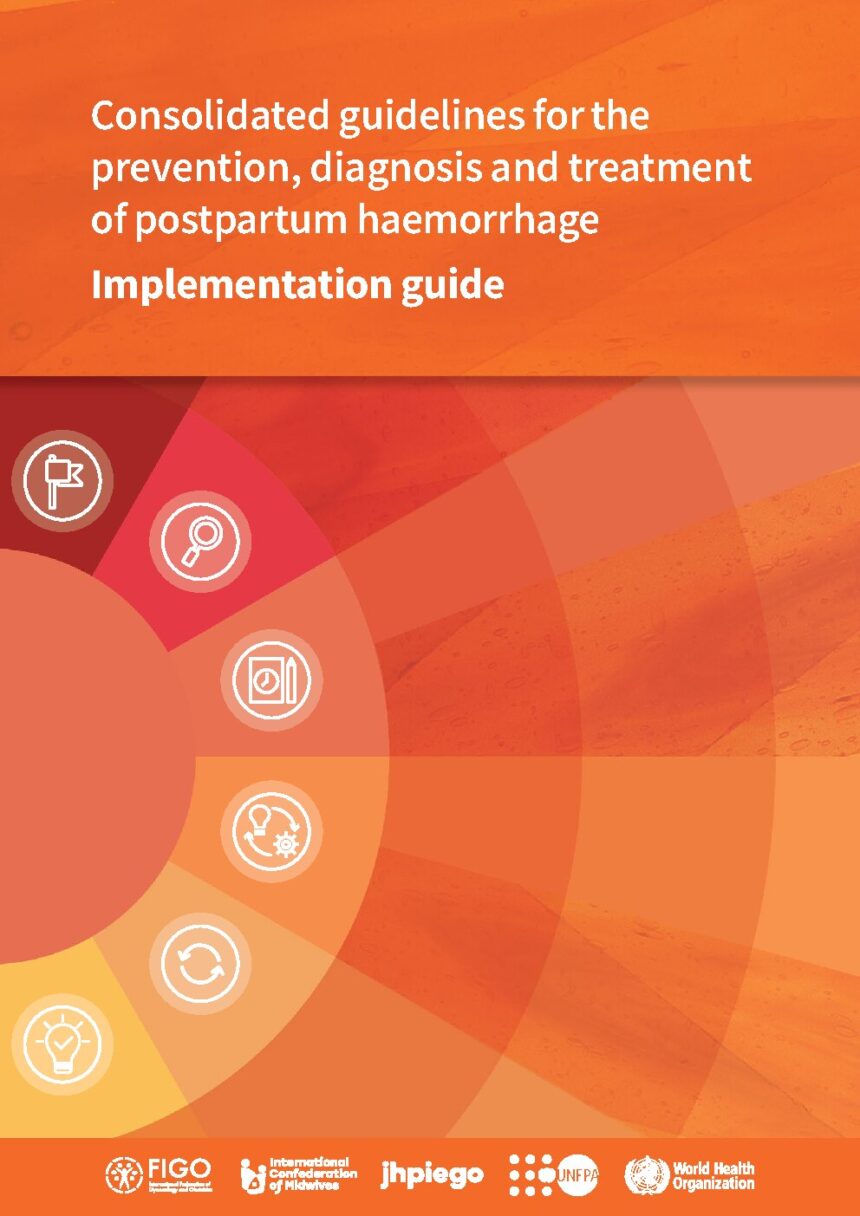
This implementation guide provides a structured, evidence-informed approach for national health systems to adopt and sustain the WHO Consolidated guidelines for the prevention, diagnosis and treatment of postpartum haemorrhage (2025). Postpartum haemorrhage (PPH) remains one of the leading causes of maternal mortality globally, with approximately 80% of related deaths occurring in low- and middle-income countries, particularly in sub-Saharan Africa and South Asia. Despite the availability of effective interventions, implementation remains inconsistent due to systemic barriers including misaligned policies, compromised supply chains, inadequate health worker capacity, and delayed diagnosis and treatment.
Developed through extensive stakeholder consultation involving over 130 experts and informed by the Roadmap to combat postpartum haemorrhage between 2023 and 2030, this guide employs the EPIS (Exploration, Preparation, Implementation, Sustainment) conceptual framework. It provides a four-stage systematic approach validated through implementation science research, offering flexible frameworks that accommodate local adaptation whilst maintaining fidelity to evidence-based recommendations. Special consideration is given to fragile and humanitarian contexts, including complex emergencies, where additional constraints may require modified implementation approaches.
Critical success factors emphasised include leadership engagement at all health system levels, strategic stakeholder engagement ensuring women and girls are placed at the centre of programme design, resource alignment through costed national implementation plans, and comprehensive capacity strengthening extending beyond standard training to encompass community engagement, referral network strengthening, and supply chain optimisation. The guide advocates for step-down training models that create peer coaching networks and ongoing mentorship systems rather than one-off educational interventions.
Key points
For clinicians — doses and thresholds as stated in the guideline
- Use the EPIS framework across four stages: Exploration (assess current state, identify stakeholders), Preparation (form National PPH Implementation Team, adapt guidelines, secure commodities), Active Implementation (deliver step-down training, launch initial sites), and Full Implementation and Sustainment (ongoing monitoring, adaptation, institutionalisation)
- Establish a National PPH Implementation Team of 3–5 core members with dedicated time for managing and executing implementation activities, particularly during Preparation and Active Implementation stages
- Conduct accurate quantification of PPH commodity needs using quality surveillance data on number of births and PPH prevalence; integrate all recommended commodities into national RMNCH quantification exercises and supply plans
- Deliver comprehensive step-down training beginning with National Clinical Champions who train Facility Clinical Champions, who then provide ongoing peer coaching and support at facility level using the Bleeding after birth course
- Integrate PPH recommendations into national guidelines through contextual adaptation, ensure commodities are registered and included in the national Essential Medicines List, and embed into UHC financing models
- Implement facility-level sustainability strategies including monthly interprofessional PPH simulation drills, routine incorporation of PPH commodities into inventory systems, and regular MPDSR (Maternal and Perinatal Death Surveillance and Response)
- Plan for sustainability from the outset by aligning with existing health system structures, creating budget line-items for ongoing training and procurement, and embedding PPH capacity-building into pre- and in-service curricula
- Monitor implementation using adapted project indicators during Active Implementation, transitioning to routine surveillance systems; conduct regular stakeholder consultation and share implementation successes to maintain momentum
Editor’s perspective
Why this matters for Georgia and the region
Prof. Giorgi Pkhakadze, MD, MPH, PhD
Editor-in-Chief, Georgian Medical Journal · Chair, Public Health Institute of Georgia · WHO consultant, health and migration
As Georgia continues strengthening its maternal health infrastructure within the framework of universal health coverage, this WHO implementation guide provides a validated roadmap directly applicable to our regional context where PPH management practices vary considerably between Tbilisi tertiary centres and rural facilities. I would particularly emphasise to Georgian obstetricians and midwives the step-down training model using facility-based clinical champions and monthly interprofessional simulation drills, as these approaches align well with our existing continuing professional development structures and can be integrated without requiring entirely new systems. The realistic caveat, however, is that successful implementation will depend on early engagement with our pharmaceutical regulatory authority to expedite registration of newer evidence-based uterotonics and our health financing ministry to create dedicated budget lines, processes that historically move slowly and require sustained advocacy from the clinical community.
ORCID 0000-0001-7609-4515 · Perspective written for the GMJ Guidelines Library, 14 Oct 2026
Applicability
Georgia and the South Caucasus
For Georgia and the South Caucasus region, this implementation guide offers a systematic roadmap to strengthen maternal health systems and reduce preventable PPH-related deaths. National programmes will need to assess current PPH management practices against the 2025 consolidated clinical guidelines, identify gaps in commodity availability (particularly newer evidence-based uterotonics and devices for objective blood loss measurement), and evaluate health worker training needs across all levels of care. The phased implementation approach is well-suited to contexts with regional variation in health system capacity, allowing initial rollout in higher-capacity facilities whilst building evidence for national scale-up. Particular attention should be paid to integrating PPH commodities into existing procurement systems, ensuring continuous supply chains, and embedding training into existing maternal health programmes. The emphasis on sustainability planning is critical given resource constraints, requiring early engagement with medical education institutions to integrate PPH recommendations into pre-service midwifery and obstetric curricula, and with health financing authorities to ensure adequate reimbursement under universal health coverage schemes.
Questions this guideline answers
Quick answers
What is the EPIS framework and why is it used for PPH guideline implementation?
EPIS stands for Exploration, Preparation, Implementation, and Sustainment – a systems-level conceptual model that outlines the stages at which different implementation activities occur. It provides a structured, evidence-based approach validated through implementation science research. The framework helps organise planning and action, though implementation is not always linear and new stages can begin before completing previous ones. It was chosen because failure to implement evidence-based interventions was identified as the single greatest challenge to reducing PPH-related morbidity and mortality.
What is the National PPH Implementation Team and who should be on it?
The National PPH Implementation Team is a temporary coordinating body of 3–5 core members with dedicated time for managing implementation, especially during Preparation and Active Implementation stages. Members should have a track record of driving health system change, time and expertise for day-to-day operations, and strong stakeholder relationships. The team does not require new staff – it works best with existing staff who have deep knowledge of current systems. Composition depends on priorities identified during Exploration; for example, if pharmaceutical registration is a barrier, include someone familiar with commodity registration, procurement and distribution processes.
How does the step-down training model work for PPH guideline implementation?
The comprehensive step-down training model creates a sustainable cascade of knowledge transfer in three levels: (1) National Clinical Champions – senior clinical leaders who are respected experts on PPH and effective coaches – lead train-the-trainers sessions; (2) Facility Clinical Champions attend these sessions then lead on-site training for their peers at facility level using the WHO Bleeding after birth course; (3) ongoing peer coaching and support continues through regular check-ins between national and facility champions, often using social media platforms alongside formal progress reviews. This approach ensures knowledge and skills are not only transferred effectively but sustained through continuous mentorship, rather than relying on one-off educational sessions.
How should countries quantify their actual commodity needs for PPH prevention and treatment?
Countries should use quality surveillance data on annual number of births and local PPH prevalence rates to conduct accurate quantification, then integrate all recommended PPH commodities into national reproductive, maternal, newborn and child health quantification exercises and supply chain planning to ensure continuous availability.
Related on GMJ
Interconnected resources
Dictionary of Public Health
GMJ News coverage
Quality & accreditation
- ASF Hospital — Standard 20 — Supporting the Care Workforce
- ASF Laboratory — Standard 3 — Personnel & Competence
- ASF Hospital — Standard 4 — Care & Treatment
- ASF Hospital — Standard 6 — Aftercare & Follow-up
- ASF Hospital — Standard 7 — Governance & Management
- ASF Hospital — Standard 5 — Safety & Emergency Preparedness
Other guidelines on this topic
- Recommendations on the management of sickle-cell disease during pregnancy, childbirth and the interpregnancy period
- Digital adaptation kit for self-monitoring of blood pressure during pregnancy: operational requirements for implementing WHO recommendations in digital systems
- Mass gathering practical guide for simulation exercises and after action reviews
- Abortion care guideline, 2nd edition
- Country preparedness for the introduction and appropriate use of antibiotics: operational guidance
- Issuer
- World Health Organization
- Type
- Guideline
- Edition
- 2025
- Status
- Current
- Published
- 2026-03-18
- Languages
- English (original)
- Scope
- Implementation guidance for WHO PPH clinical guidelines across all health system levels, including humanitarian and complex emergency settings
- Audience
- National, sub-national and district policymakers; programme managers; implementers; professional associations; development partners; humanitarian organisations; women's groups and civil society organisations
- Pages
- 34
- Licence
- CC BY-NC-SA 3.0 IGO
- ISBN
- 978-92-4-011611-5
- Evidence
- Implementation science framework (EPIS) informed by stakeholder consultation with 130+ experts and technical workshop with policymakers from Democratic Republic of Congo, Kenya, Pakistan, South Africa and United Republic of Tanzania
- Record history
- Created 14 Oct 2026 · updated 14 Oct 2026 · next check Apr 2027
Consolidated guidelines for the prevention, diagnosis and treatment of postpartum haemorrhage: implementation guide. Geneva: World Health Organization; 2025. Licence: CC BY-NC-SA 3.0 IGO.GMJ Guidelines Library records are original summaries written by the GMJ editorial team from the issuer’s published document and reviewed by a physician. They do not replace the full guideline. The document is the copyright of its issuer and is linked, not hosted. Spotted an error or a newer edition? Tell the Guidelines Desk.
Was this article helpful?