World Health Organization · 1st edition, 2025 · 62 pages
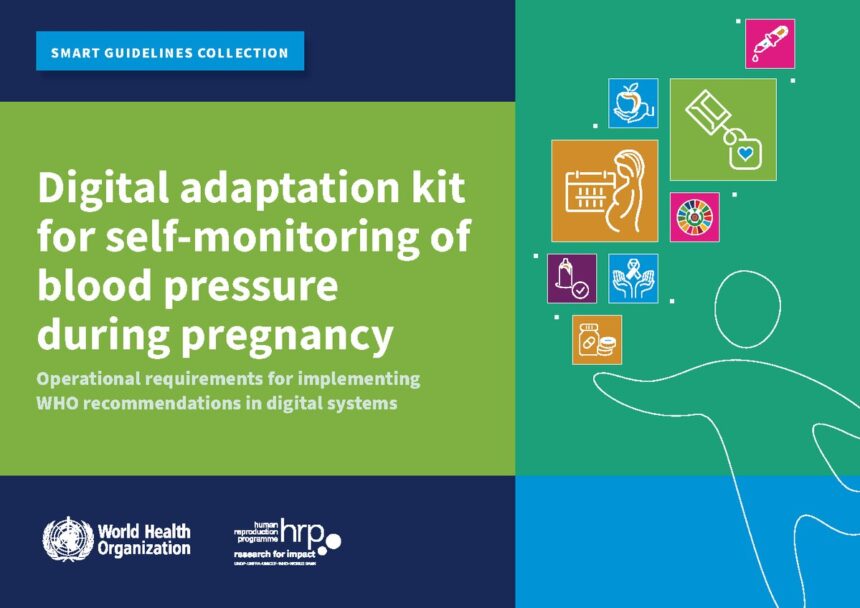
Technical specifications for integrating self-monitoring of blood pressure in pregnancy into interoperable digital health systems.
- Issuer
- World Health Organization
- Edition
- 1st edition, 2025
- Audience
- Software developers, digital health teams, health programme managers (maternal health, digital health), business analysts interfacing between health content experts and software development teams.
- Evidence
- Based on WHO guideline on self-care interventions for health and well-being (2022 revision) and related WHO clinical guidance on hypertensive disorders of pregnancy; expert consensus on digital adaptation methodology.
- Reviewed
- 14 Oct 2026 · GMJ
What this guideline says
GMJ summary
This Digital Adaptation Kit (DAK) provides standardised, software-neutral documentation to guide the development of digital systems that support self-monitoring of blood pressure (SMBP) during pregnancy. It translates WHO’s recommendation that pregnant women with hypertensive disorders may choose to self-monitor their blood pressure—in addition to clinic-based measurements—into operational requirements for digital personal health tracking applications.
The DAK follows the WHO SMART guidelines approach, offering seven core components: health interventions and recommendations, generic personas (pregnant clients, midwives, nurses, community health workers), user scenarios, business process workflows, core data elements mapped to international terminologies (ICD-11, LOINC, SNOMED), decision-support logic tables, and functional/non-functional system requirements. It is designed to work in a modular fashion alongside the antenatal care DAK and other primary health-care digital tools.
The kit emphasises interoperability, evidence-based decision algorithms (e.g. blood pressure thresholds triggering immediate health-worker contact), and person-centred design. It includes ready-to-adapt spreadsheets of data dictionaries and decision-support tables, enabling countries to deploy standards-compliant digital SMBP interventions without starting from scratch, reducing vendor lock-in and ensuring fidelity to WHO clinical guidance.
Key points
For clinicians — doses and thresholds as stated in the guideline
- WHO suggests making SMBP available as an additional option to clinic BP monitoring for pregnant women with hypertensive disorders of pregnancy.
- SMBP requires health-worker determination of eligibility; only facility-based health workers can approve a client for this intervention.
- One SMBP measurement comprises an average of two readings taken 1–2 minutes apart from the same designated arm, with the client seated.
- The digital system must provide real-time decision support: if systolic BP ≥160 mmHg or diastolic BP ≥110 mmHg, the client receives an alert to contact a health worker and go to the nearest health facility immediately.
- Contextual data (recent physical activity, food/drink, symptoms) should be collected alongside BP measurements to support accurate interpretation.
- Danger signs (breathing difficulty, vaginal bleeding, convulsions, severe headache, visual disturbance, severe abdominal pain, fever, severe vomiting) trigger immediate facility referral.
- The personal health tracking application must allow clients to share SMBP data electronically with their facility-based health record (with opt-in consent) or transfer data manually.
- Follow-up appointments should be scheduled within 1–2 days after SMBP initiation for clients at risk of pre-eclampsia, to review device use and data quality.
Digital health interventions incorporated in this DAK (extracted from WHO Classification of digital interventions)
Table extracted from the guideline
| DHI category | Digital health interventions |
|---|---|
| 1.1 Targeted communication to persons | 1.1.1 Transmit health event alerts to specific population group(s); 1.1.2 Transmit targeted health information based on health status or demographics; 1.1.3 Transmit targeted alerts and reminders; 1.1.4 Transmit diagnostics result or availability of result |
| 2.1 Identification and registration | 2.1.2 Enrol person(s) for health services/clinical care plan |
| 1.4 Personal health tracking | 1.4.1 Access by individual to own medical or summary health records; 1.4.2 Self-monitoring of health or diagnostic data; 1.4.3 Active data capture/documentation by individual; 1.4.4 Access to verifiable documentation of a health event or status |
| 2.10 Laboratory and diagnostics imaging management | 2.10.3 Capture diagnostic results from digital devices |
Source: World Health Organization, Digital adaptation kit for self-monitoring of blood pressure during pregnancy: operational requirements for implementing WHO recommendations in digital systems. Reproduced in summary form.
From the guideline
Verbatim
“WHO suggests making the self-monitoring of blood pressure during pregnancy available as an additional option to clinic blood pressure monitoring by health workers solely during antenatal contacts, for individuals with hypertensive disorders of pregnancy.”
Editor’s perspective
Why this matters for Georgia and the region
Prof. Giorgi Pkhakadze, MD, MPH, PhD
Editor-in-Chief, Georgian Medical Journal · Chair, Public Health Institute of Georgia · WHO consultant, health and migration
As someone who has worked with WHO on health systems and witnessed Georgia's progress in digital health since the introduction of our UHC programme in 2013, I see this DAK as a practical bridge between clinical guidelines and real-world eHealth implementation. For Georgian clinicians and programme managers, the most immediately actionable element is the structured decision-support logic: clear BP thresholds (systolic ≥160 or diastolic ≥110 mmHg) that trigger automatic alerts, which can reduce delays in managing severe hypertension in pregnancy even when women live far from facilities. One realistic caveat is that successful deployment will require not only digital infrastructure—which many Georgian regions now have—but also a parallel investment in training midwives and nurses to counsel women on correct BP device use and to interpret self-monitored data during antenatal contacts, a competency gap that must be addressed through the undergraduate and continuing education curricula of our medical and nursing schools.
ORCID 0000-0001-7609-4515 · Perspective written for the GMJ Guidelines Library, 14 Oct 2026
Applicability
Georgia and the South Caucasus
For Georgia and the South Caucasus, this DAK offers a standardised roadmap to digitise antenatal hypertension management within existing eHealth infrastructure. National programmes will need to assess the maturity of digital connectivity, the availability of validated automated BP devices approved for home use, and the capacity to train midwives and nurses in SMBP counselling and device calibration. Countries in Eastern Europe implementing UHC or antenatal care reforms can use the DAK’s interoperability standards (HL7 FHIR, ICD-11, LOINC) to ensure that client-generated SMBP data integrate seamlessly with facility-based electronic health records, reducing fragmentation and supporting continuity of care for pregnant women in remote or underserved areas.
Questions this guideline answers
Quick answers
Which pregnant women are eligible for SMBP according to this DAK?
Only pregnant women who have been diagnosed with a hypertensive disorder of pregnancy by a health worker are eligible. Eligibility is determined by the health worker during an antenatal care contact, and the client must consent to share SMBP data and demonstrate correct device use before starting.
What blood pressure thresholds trigger an immediate alert in the digital system?
If the average of two seated readings shows systolic BP ≥160 mmHg or diastolic BP ≥110 mmHg, the system alerts the client to contact a health worker and go to the nearest health facility right away.
How should BP measurements be taken for SMBP?
One measurement comprises an average of two readings taken 1–2 minutes apart from the same designated arm (the arm producing the higher average during set-up), while the client is seated. The client must rest at least 30 minutes after eating, drinking or physical activity before measuring.
Can the DAK be adapted for countries with limited digital infrastructure?
Yes. The DAK specifies non-functional requirements for offline functionality, data synchronisation when intermittent internet is available, and manual paper-based data transfer if electronic sharing is not feasible. However, full digital SMBP intervention requires at least basic connectivity for alerts and decision support.
Related on GMJ
Interconnected resources
Dictionary of Public Health
GMJ News coverage
Quality & accreditation
Other guidelines on this topic
- Recommendations on the management of sickle-cell disease during pregnancy, childbirth and the interpregnancy period
- Scaling up postpregnancy family planning: practical guide
- Recommendation on antibiotic prophylaxis during labour for vaginal birth
- Consolidated guidelines for the prevention, diagnosis and treatment of postpartum haemorrhage
- Recommendations on care for women with diabetes during pregnancy
- Issuer
- World Health Organization
- Type
- Guideline
- Edition
- 1st edition, 2025
- Status
- Current
- Published
- 2025-07-07
- Languages
- English
- Scope
- Self-monitoring of blood pressure during pregnancy for women with diagnosed hypertensive disorders; applicable in antenatal care settings with digital health infrastructure.
- Audience
- Software developers, digital health teams, health programme managers (maternal health, digital health), business analysts interfacing between health content experts and software development teams.
- Pages
- 62
- Licence
- CC BY-NC-SA 3.0 IGO
- ISBN
- 978-92-4-011035-9
- Evidence
- Based on WHO guideline on self-care interventions for health and well-being (2022 revision) and related WHO clinical guidance on hypertensive disorders of pregnancy; expert consensus on digital adaptation methodology.
- Record history
- Created 14 Oct 2026 · updated 14 Oct 2026 · next check Apr 2027
World Health Organization. Digital adaptation kit for self-monitoring of blood pressure during pregnancy: operational requirements for implementing WHO recommendations in digital systems. Geneva: World Health Organization; 2025. (SMART Guidelines collection). Licence: CC BY-NC-SA 3.0 IGO.GMJ Guidelines Library records are original summaries written by the GMJ editorial team from the issuer’s published document and reviewed by a physician. They do not replace the full guideline. The document is the copyright of its issuer and is linked, not hosted. Spotted an error or a newer edition? Tell the Guidelines Desk.
Was this article helpful?