World Health Organization · 1st edition, 2025 · 62 pages
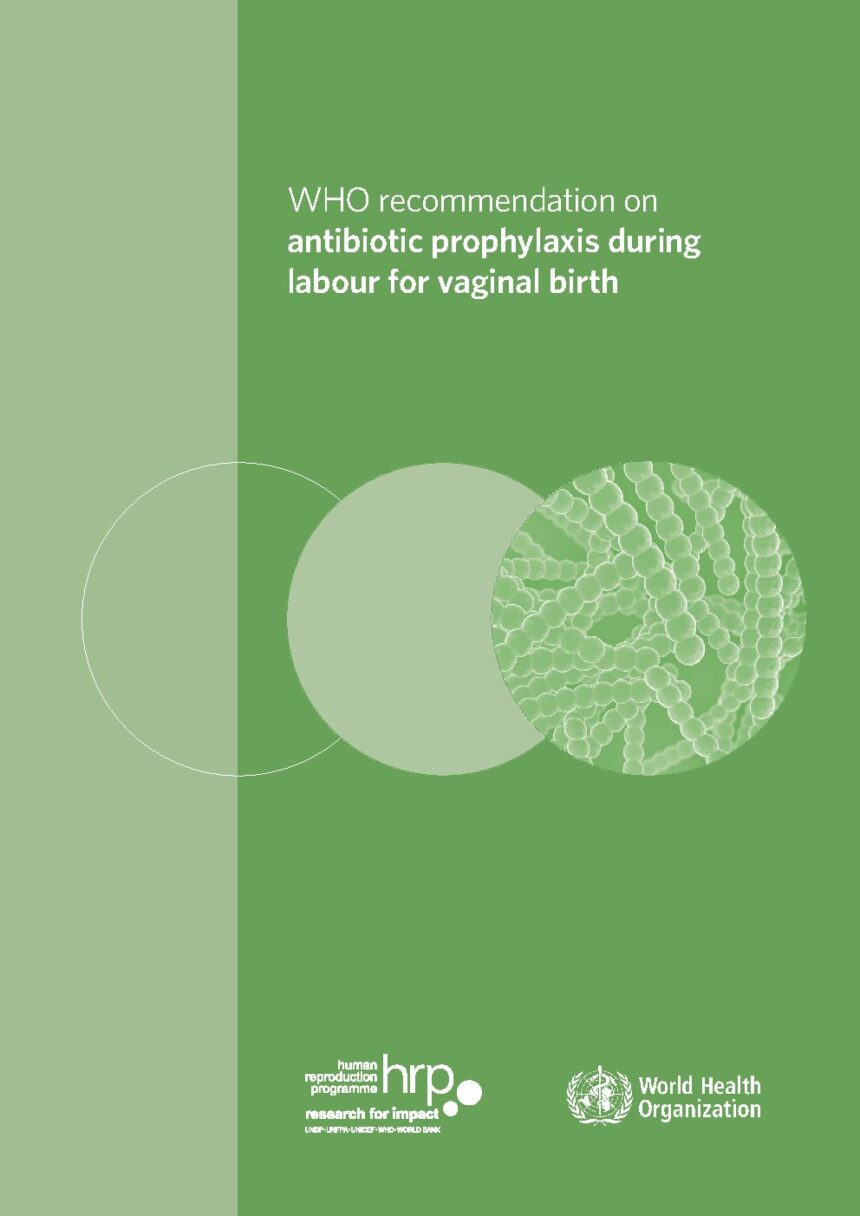
Guidance for clinicians and policy-makers on routine antibiotic prophylaxis during labour for vaginal birth
- Issuer
- World Health Organization
- Edition
- 1st edition, 2025
- Audience
- Obstetricians, midwives, nurses, general practitioners providing intrapartum care; guideline developers; maternal health programme managers; ministry of health officials; training institutions
- Evidence
- GRADE-rated recommendations from systematic review of 4 RCTs (42,846 women), modelling studies, qualitative evidence, and economic evaluations
- Reviewed
- 14 Oct 2026 · GMJ
What this guideline says
GMJ summary
This 2025 WHO guideline recommends against routine antibiotic prophylaxis during labour for vaginal birth. The recommendation is based on evidence from four randomized trials (42,846 women) in low- and middle-income countries, primarily using single-dose oral azithromycin 2 g.
While the intervention showed small to moderate reductions in maternal infections including sepsis (RR 0.65, NNT 167), endometritis (RR 0.66, NNT 143), and wound infections, it demonstrated no effect on maternal mortality or neonatal outcomes. Critically, modelling studies projected that increased macrolide resistance in Staphylococcus aureus and Streptococcus pneumoniae would result in 9–29 times more disability-adjusted life years (DALYs) than those averted through reduced sepsis.
The guideline emphasizes strengthening infection prevention and control measures, risk-based assessment for targeted antibiotic prophylaxis when clinically indicated, and prompt diagnosis and management of infections as the preferred strategy. Azithromycin, classified as a WHO AWaRe “Watch” antibiotic, should be prioritized for antimicrobial stewardship.
Key points
For clinicians — doses and thresholds as stated in the guideline
- Routine antibiotic prophylaxis during labour for vaginal birth is <strong>not recommended</strong> in any setting or context
- Azithromycin 2 g single oral dose reduced maternal sepsis (RR 0.65, NNT 167) but had no effect on maternal mortality or neonatal sepsis
- Modelling shows 96,000 additional DALYs from macrolide resistance in Africa versus 11,000 DALYs averted from reduced sepsis – a 9:1 negative ratio
- Azithromycin-resistant <em>S. aureus</em> and group A <em>Streptococcus</em> increased transiently in maternal and neonatal samples at 6 weeks post-birth
- Antibiotic prophylaxis remains indicated for operative vaginal birth, caesarean section, preterm prelabour rupture of membranes, group B <em>Streptococcus</em> colonization, and manual removal of placenta per existing WHO guidance
- Standard infection prevention and control precautions (hand hygiene, aseptic technique, clean equipment) are the cornerstone of preventing maternal infections
- Azithromycin is a WHO AWaRe "Watch" antibiotic with high resistance potential and should be prioritized for antimicrobial stewardship policies
- Early-life macrolide exposure may alter gut microbiota and has been linked to increased risk of asthma, obesity, food allergies, and inflammatory bowel disease in children
Effects of antibiotic prophylaxis during labour for vaginal birth – key maternal outcomes
Table extracted from the guideline
| Outcome | Trials/Women | Relative effect (95% CI) | Absolute effect per 1000 | NNT | Certainty |
|---|---|---|---|---|---|
| Maternal sepsis | 4/42,430 | RR 0.65 (0.56–0.77) | 6 fewer (8 to 4 fewer) | 167 | Moderate |
| Maternal death | 4/42,371 | RR 1.21 (0.63–2.33) | No effect | — | Moderate |
| Endometritis | 2/29,973 | RR 0.66 (0.55–0.78) | 7 fewer (9 to 5 fewer) | 143 | High |
| Wound infection (perineal) | 1/25,114 | RR 0.80 (0.64–0.99) | 3 fewer (5 to 0 fewer) | 335 | High |
| Neonatal sepsis | 4/42,862 | aRR 1.03 (0.96–1.10) | No effect | — | High |
| Neonatal mortality | 4/42,678 | aRR 1.03 (0.87–1.21) | No effect | — | High |
Source: World Health Organization, Recommendation on antibiotic prophylaxis during labour for vaginal birth. Reproduced in summary form.
What changed in this edition
Versus the previous edition
- First WHO recommendation specifically addressing routine antibiotic prophylaxis during labour for vaginal birth (no previous edition)
- Incorporates new evidence from four RCTs (2017–2023) not available for the 2015 peripartum infections guideline
- Includes modelling data on population-level antimicrobial resistance impacts, projecting regional DALY burdens from macrolide resistance in key pathogens
- Explicitly addresses azithromycin's classification as a WHO AWaRe "Watch" antibiotic requiring stewardship prioritization
From the guideline
Verbatim
“The GDG concluded that the undesirable consequences of routine antibiotic prophylaxis in labour for vaginal birth outweigh the potential benefits and therefore recommended against its use.”
Editor’s perspective
Why this matters for Georgia and the region
Prof. Giorgi Pkhakadze, MD, MPH, PhD
Editor-in-Chief, Georgian Medical Journal · Chair, Public Health Institute of Georgia · WHO consultant, health and migration
As Chair of the Public Health Institute of Georgia and a WHO consultant, I view this guideline as critically important for our region. Georgia has made impressive strides in antimicrobial stewardship – we established national action plans on antimicrobial resistance in 2019 and have functioning surveillance systems. However, this recommendation challenges a growing international practice and requires us to resist pressure for routine intrapartum antibiotics. I would stress to Georgian obstetricians and midwives that the evidence clearly shows no maternal mortality benefit and substantial population harm through resistance – the 9:1 DALY ratio against the intervention is compelling. Our implementation priority must be strengthening infection prevention and control in maternity facilities, where hand hygiene compliance and aseptic technique offer proven, sustainable protection without resistance risks. One realistic caveat: many Georgian maternity hospitals lack consistent access to clean water and alcohol-based hand rub, so we must invest in these fundamentals before we can credibly discourage antibiotic prophylaxis as a substitute for proper infection control.
ORCID 0000-0001-7609-4515 · Perspective written for the GMJ Guidelines Library, 14 Oct 2026
Applicability
Georgia and the South Caucasus
For Georgia and the South Caucasus, this guideline is directly applicable. The recommendation against routine antibiotic prophylaxis applies universally, regardless of local maternal sepsis rates. National programmes should prioritize strengthening infection prevention and control in maternity facilities, ensuring access to clean water, hand hygiene products (alcohol-based hand rub), and sterilization of instruments. Georgia’s antimicrobial resistance surveillance capacity and antibiotic stewardship programmes in maternity hospitals would need assessment and strengthening to monitor appropriate antibiotic use. Existing protocols should be reviewed to ensure antibiotics are prescribed only for established indications (operative vaginal birth, caesarean section, preterm prelabour rupture of membranes). Midwifery regulatory frameworks should support targeted antibiotic administration when clinically indicated while preventing routine use.
Questions this guideline answers
Quick answers
Why is routine antibiotic prophylaxis not recommended if it reduces maternal sepsis?
While azithromycin reduced maternal sepsis by 35% (NNT 167), it had no effect on maternal mortality or neonatal outcomes. Modelling shows the population-level harm from increased antimicrobial resistance (96,000 DALYs in Africa) far outweighs the benefit from reduced sepsis (11,000 DALYs averted) – a 9:1 negative ratio. The undesirable effects outweigh the benefits.
When should antibiotics still be given during labour?
Antibiotic prophylaxis remains indicated for: operative vaginal birth (vacuum, forceps), caesarean section, preterm prelabour rupture of membranes, group B Streptococcus colonization, manual removal of placenta, and third- or fourth-degree perineal tears, as per existing WHO recommendations. This recommendation only addresses <em>routine</em> use without clinical indication.
What are the main strategies to prevent maternal infections instead of antibiotics?
Standard infection prevention and control measures: hand hygiene according to WHO's 5 Moments; aseptic technique for all procedures; clean and sterile instruments and supplies; personal protective equipment; clean birth environment with safe water and sanitation; clinical monitoring for early detection of infection; and prompt treatment when infection is identified.
How long do azithromycin resistance effects persist after intrapartum use?
Trial data showed increased azithromycin-resistant <em>S. aureus</em> in maternal nasal samples at day 7, 6 weeks, and 3 months, but not at 6 and 12 months. However, modelling and follow-up studies from mass drug administration suggest resistance can persist in communities for 3.5+ years through transmission to unexposed individuals, including macrolide-resistant <em>S. pneumoniae</em> in children born after the intervention ended.
Related on GMJ
Interconnected resources
Dictionary of Public Health
Drugs A–Z
GMJ News coverage
Quality & accreditation
- ASF Laboratory — Standard 1 — Governance & Document Control
- ASF Laboratory — Standard 6 — Pre-Examination: Specimen Pathway
- ASF Laboratory — Standard 7 — Examination: Process & Safety
- ASF Laboratory — Standard 8 — Post-Examination: Reporting & Critical Values
- ASF Hospital — Standard 5 — Safety & Emergency Preparedness
- ASF Medical Transport — Standard 5 — Infection Prevention & Control
- ASF Hospital — Standard 4 — Care & Treatment
- ASF Hospital — Standard 6 — Aftercare & Follow-up
Other guidelines on this topic
- Recommendations on the management of sickle-cell disease during pregnancy, childbirth and the interpregnancy period
- Strategic actions for infection prevention and control and water, sanitation and hygiene during mpox outbreak response
- Digital adaptation kit for self-monitoring of blood pressure during pregnancy: operational requirements for implementing WHO recommendations in digital systems
- Strategic actions for infection prevention and control and water, sanitation and hygiene during mpox outbreak response
- Country preparedness for the introduction and appropriate use of antibiotics: operational guidance
- Issuer
- World Health Organization
- Type
- Guideline
- Edition
- 1st edition, 2025
- Status
- Current
- Published
- 2025-09-26
- Languages
- Arabic, Chinese, English, French, Russian, Spanish
- Scope
- Routine antibiotic prophylaxis during labour for women planning vaginal birth, irrespective of risk level, in all settings
- Audience
- Obstetricians, midwives, nurses, general practitioners providing intrapartum care; guideline developers; maternal health programme managers; ministry of health officials; training institutions
- Pages
- 62
- Licence
- CC BY-NC-SA 3.0 IGO
- ISBN
- 978-92-4-011575-0
- Evidence
- GRADE-rated recommendations from systematic review of 4 RCTs (42,846 women), modelling studies, qualitative evidence, and economic evaluations
- Next review
- To be determined by WHO Executive Guideline Steering Group annual review process; immediate update if new evidence emerges
- Record history
- Created 14 Oct 2026 · updated 14 Oct 2026 · next check Apr 2027
WHO recommendation on antibiotic prophylaxis during labour for vaginal birth. Geneva: World Health Organization; 2025. Licence: CC BY-NC-SA 3.0 IGO.GMJ Guidelines Library records are original summaries written by the GMJ editorial team from the issuer’s published document and reviewed by a physician. They do not replace the full guideline. The document is the copyright of its issuer and is linked, not hosted. Spotted an error or a newer edition? Tell the Guidelines Desk.
Was this article helpful?