World Health Organization · 4th edition, 2025 · 108 pages
Evidence-based WHO guidance on how to safely and effectively initiate, use, and manage all hormonal contraceptives, IUDs, and other family planning methods.
- Issuer
- World Health Organization
- Edition
- 4th edition, 2025
- Audience
- Policy-makers, family planning programme managers, scientific community, and contraceptive service providers for adaptation into national or facility-level guidelines and protocols.
- Evidence
- GRADE-rated recommendations for new topics (medication and non-pharmacological interventions for IUD placement); reaffirmed recommendations from 3rd edition based on systematic reviews monitored through WHO's Continuous Identification of Research Evidence (CIRE) system; consensus-driven by multidisciplinary Guideline Development Group.
- Reviewed
- 14 Oct 2026 · GMJ
What this guideline says
GMJ summary
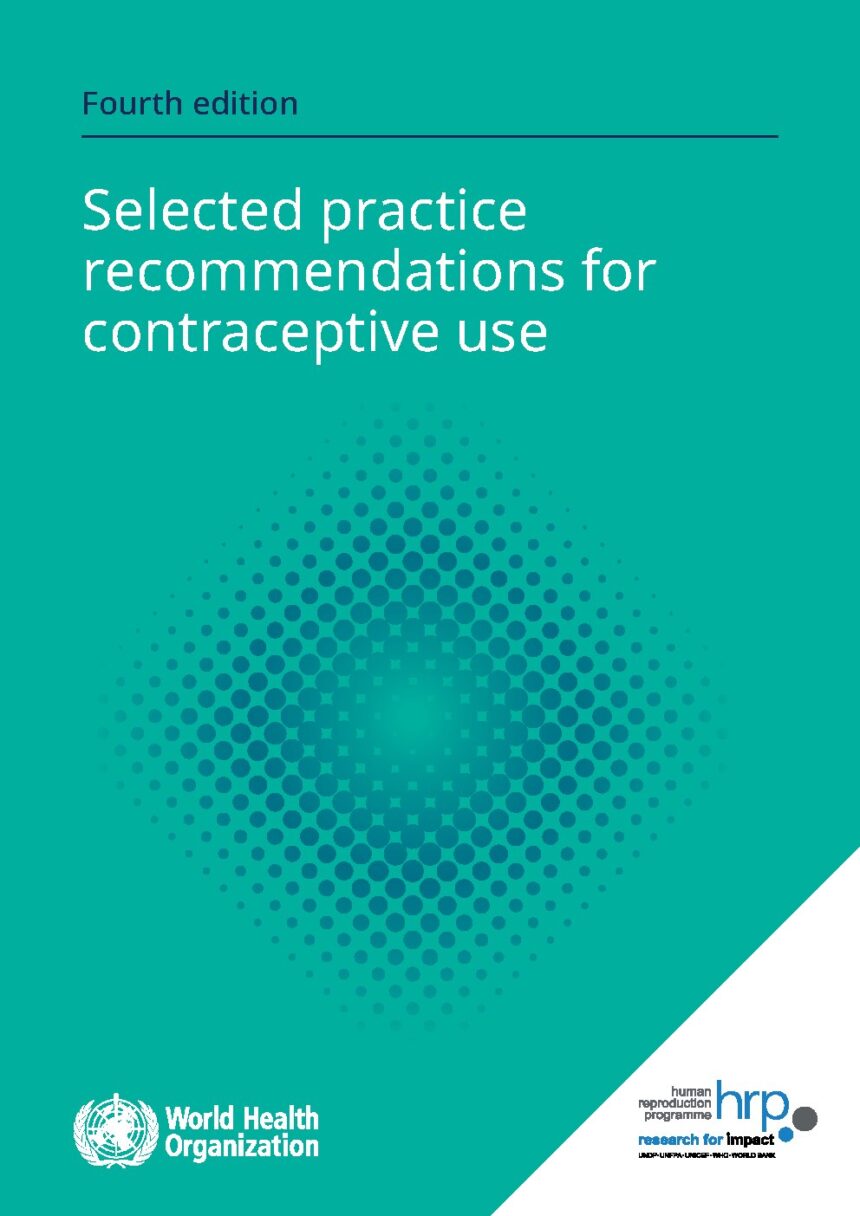
This fourth edition of the WHO Selected Practice Recommendations (SPR) provides comprehensive, evidence-based recommendations on the safe initiation, continuation, and management of contraceptive methods including copper and levonorgestrel IUDs, progestogen-only and combined hormonal contraceptives, emergency contraception, fertility-awareness methods, and male sterilization. The guideline complements the Medical Eligibility Criteria (MEC) by addressing not who can use methods safely, but how to use them effectively once medical appropriateness is established.
New in this edition are conditional recommendations on medication to ease interval IUD placement: paracervical blocks with lidocaine, topical anaesthetics, and NSAIDs may be offered routinely where available, but IUDs should not be withheld when these agents are unavailable; misoprostol is not recommended for routine use. The guideline emphasizes that in healthy women, very few examinations are mandatory before contraceptive initiation—only pelvic examination and STI risk assessment are essential for IUDs; no tests are mandatory for hormonal methods, though blood pressure measurement is desirable when feasible.
A central message is the removal of unnecessary medical barriers: women should not be denied hormonal contraception simply because blood pressure cannot be measured, and up to one year’s supply of pills may be provided at once. All recommendations prioritize informed consent, contraceptive choice, and client values, with detailed guidance on managing common problems such as menstrual irregularities, missed pills, and dosing errors to support method continuation.
Key points
For clinicians — doses and thresholds as stated in the guideline
- For interval IUD placement, paracervical lidocaine blocks, topical lidocaine (gel/spray/cream), and NSAIDs (ibuprofen, ketorolac, naproxen) may be offered routinely but are not mandatory; misoprostol is not recommended for routine use (conditional recommendations, low-to-moderate quality evidence).
- Cu-IUDs can be placed within 5 days of unprotected intercourse for emergency contraception, or up to 5 days after ovulation if timing can be estimated.
- For progestogen-only injectables among breastfeeding women <6 weeks postpartum, MEC classification has changed from Category 3 to Category 2 (can generally use).
- Combined hormonal contraceptives (COCs, patch, ring) can be initiated within 5 days of menses with no additional protection needed; if started after day 5, abstinence or back-up contraception is needed for 7 days.
- DMPA reinjection can be given up to 4 weeks late without additional protection; NET-EN up to 2 weeks late. If later, pregnancy must be excluded and back-up contraception used for 7 days.
- For COC pills containing 30–35 µg ethinyl estradiol: missing 1–2 pills requires no back-up; missing ≥3 pills requires 7 days of back-up contraception and omission of hormone-free interval if pills were missed in week 3.
- Only pelvic/genital examination and STI risk assessment are Class A (mandatory) before IUD placement; all other tests including cervical cancer screening, routine labs, and haemoglobin are Class B or C.
- No examinations or tests are Class A (mandatory) before initiating any hormonal contraceptive; blood pressure measurement is desirable but women should not be denied hormonal methods if it is unavailable.
Examinations and tests before initiation of Cu-IUD or LNG-IUD
Table extracted from the guideline
| Examination or test | Classification |
|---|---|
| Breast examination by provider | C |
| Pelvic/genital examination | A |
| Cervical cancer screening | C |
| Routine laboratory tests | C |
| Haemoglobin test | B |
| STI risk assessment: medical history and physical examination | A |
| STI/HIV screening: laboratory tests | B |
| Blood pressure screening | C |
Source: World Health Organization, Selected practice recommendations for contraceptive use, 4th edition. Reproduced in summary form.
What changed in this edition
Versus the previous edition
- New conditional recommendations on medication to ease interval IUD placement: paracervical lidocaine blocks, topical lidocaine, and NSAIDs may be offered routinely; misoprostol not recommended for routine use.
- MEC classification for DMPA use among breastfeeding women <6 weeks postpartum changed from Category 3 (usually not recommended) to Category 2 (can generally use).
- New topic reviewed on non-pharmacological interventions to ease IUD placement; insufficient evidence for recommendations.
- All other recommendations from the third edition (2016) were reaffirmed with no changes after CIRE review found no new evidence requiring updates.
From the guideline
Verbatim
“Women should not be denied use of hormonal methods simply because their blood pressure cannot be measured.”
Editor’s perspective
Why this matters for Georgia and the region
Prof. Giorgi Pkhakadze, MD, MPH, PhD
Editor-in-Chief, Georgian Medical Journal · Chair, Public Health Institute of Georgia · WHO consultant, health and migration
As a WHO consultant and chair of Georgia's Public Health Institute, I see this SPR update as directly actionable for our national family planning programme. The most important shift for Georgian clinicians is the clear message that blood pressure measurement, pelvic examination, and laboratory tests should not be barriers to initiating pills, injectables, or implants in healthy women—a principle that can expand access in our rural areas where equipment is limited. The new conditional recommendations on lidocaine and NSAIDs for IUD insertion are evidence-based but must be adapted to our context: while ibuprofen is widely available and inexpensive, training primary-care providers in paracervical block technique will require structured capacity-building. One implementation caveat is that providing up to one year's supply of oral contraceptives, though recommended to improve continuation, depends on reliable forecasting and supply-chain management—an area where Georgia's essential medicines programme has made progress but still faces occasional stockouts, particularly for newer formulations like the 75 µg desogestrel POP.
ORCID 0000-0001-7609-4515 · Perspective written for the GMJ Guidelines Library, 14 Oct 2026
Applicability
Georgia and the South Caucasus
For Georgia and the South Caucasus, this guideline supports national family planning programmes in removing unnecessary medical barriers to contraception access. The recommendation that blood pressure measurement, while desirable, should not prevent initiation of hormonal contraception is particularly relevant in rural areas where equipment or trained personnel may be limited. The new evidence on pain management for IUD insertion can inform national protocols, though programmes must balance the conditional recommendations with local availability of lidocaine and NSAIDs. National adaptations should consider which provider cadres are trained in IUD placement and paracervical blocks, the availability of contraceptive commodities in the essential medicines list, and integration of family planning into primary health care and postpartum services. The emphasis on providing up to one year’s supply of oral contraceptives at once aligns with efforts to reduce barriers and improve continuation, but requires robust supply-chain management.
Questions this guideline answers
Quick answers
Can I place an IUD outside of a woman's menstrual period?
Yes. A Cu-IUD can be placed at any time up to 12 days after menses starts with no back-up needed; an LNG-IUD within 7 days of menses. After these windows, placement is still possible any day if you are reasonably certain she is not pregnant; she will need 7 days of abstinence or back-up contraception for LNG-IUD, none for Cu-IUD.
What should I offer for pain relief during IUD insertion?
Where available, you may offer paracervical lidocaine block (1–2%, 10–20 ml), topical lidocaine (gel, spray or cream applied to cervix), or oral NSAIDs (ibuprofen, naproxen, ketorolac). These are conditional recommendations; do not withhold IUDs if pain relief is unavailable. Misoprostol is not recommended for routine use but might help in women with a recent failed placement.
A breastfeeding woman 4 weeks postpartum wants DMPA; can I give it?
Yes, you can generally give it (MEC Category 2). This represents a change from earlier guidance when DMPA was Category 3 (usually not recommended) before 6 weeks in breastfeeding women. All other progestogen-only methods remain safe for breastfeeding women at any time postpartum.
What examinations are mandatory before giving combined oral contraceptive pills?
None are mandatory in a healthy woman. Blood pressure measurement is desirable, but if unavailable, do not deny pills solely for that reason. Pelvic exam, breast exam, cervical cancer screening, and lab tests are not needed before pill initiation. Take a medical history to confirm MEC eligibility.
Related on GMJ
Interconnected resources
Dictionary of Public Health
Drugs A–Z
GMJ News coverage
- Early sexual initiation in Zambia: New data reveals age 17 median, literacy as protective factorAug 2026
- Pituitary Tumor Surgery Restores Fertility for Illinois Mother Seeking Second ChildJun 2026
- How Your Body Stores and Deploys Nutrients: A Systems View of Micronutrient ManagementSep 2026
- Gonorrhea burden in sub-Saharan Africa remains stubbornly high: new meta-analysis reveals 3.2% general population prevalenceSep 2026
Quality & accreditation
Other guidelines on this topic
- Recommendations on the management of sickle-cell disease during pregnancy, childbirth and the interpregnancy period
- Recommendations on the delivery of health services for the prevention and care of sexually transmitted infections
- Abortion care guideline, 2nd edition
- Country preparedness for the introduction and appropriate use of antibiotics: operational guidance
- Scaling up postpregnancy family planning: practical guide
- Issuer
- World Health Organization
- Type
- Guideline
- Edition
- 4th edition, 2025
- Replaces
- Selected practice recommendations for contraceptive use, 3rd edition, 2016
- Status
- Current
- Published
- 2025-10-30
- Languages
- English
- Scope
- Initiation, continuation, management of copper and levonorgestrel IUDs, progestogen-only implants (LNG, ETG), progestogen-only injectables (DMPA, NET-EN), progestogen-only pills, combined oral contraceptives (≤35 µg EE), combined patch and vaginal ring, combined injectable contraceptives, emergency contraception (Cu-IUD, ECPs), Standard Days Method, and male sterilization (vasectomy). Covers timing of initiation, examinations/tests needed, switching methods, managing side-effects and dosing errors, and follow-up.
- Audience
- Policy-makers, family planning programme managers, scientific community, and contraceptive service providers for adaptation into national or facility-level guidelines and protocols.
- Pages
- 108
- Licence
- CC BY-NC-SA 3.0 IGO
- ISBN
- 978-92-4-011560-6
- Evidence
- GRADE-rated recommendations for new topics (medication and non-pharmacological interventions for IUD placement); reaffirmed recommendations from 3rd edition based on systematic reviews monitored through WHO's Continuous Identification of Research Evidence (CIRE) system; consensus-driven by multidisciplinary Guideline Development Group.
- Next review
- 2030 (5 years); interim updates if new evidence warrants reconsideration
- Record history
- Created 14 Oct 2026 · updated 14 Oct 2026 · next check Apr 2027
Selected practice recommendations for contraceptive use, fourth edition. Geneva: World Health Organization; 2025. Licence: CC BY-NC-SA 3.0 IGO.GMJ Guidelines Library records are original summaries written by the GMJ editorial team from the issuer’s published document and reviewed by a physician. They do not replace the full guideline. The document is the copyright of its issuer and is linked, not hosted. Spotted an error or a newer edition? Tell the Guidelines Desk.
Was this article helpful?