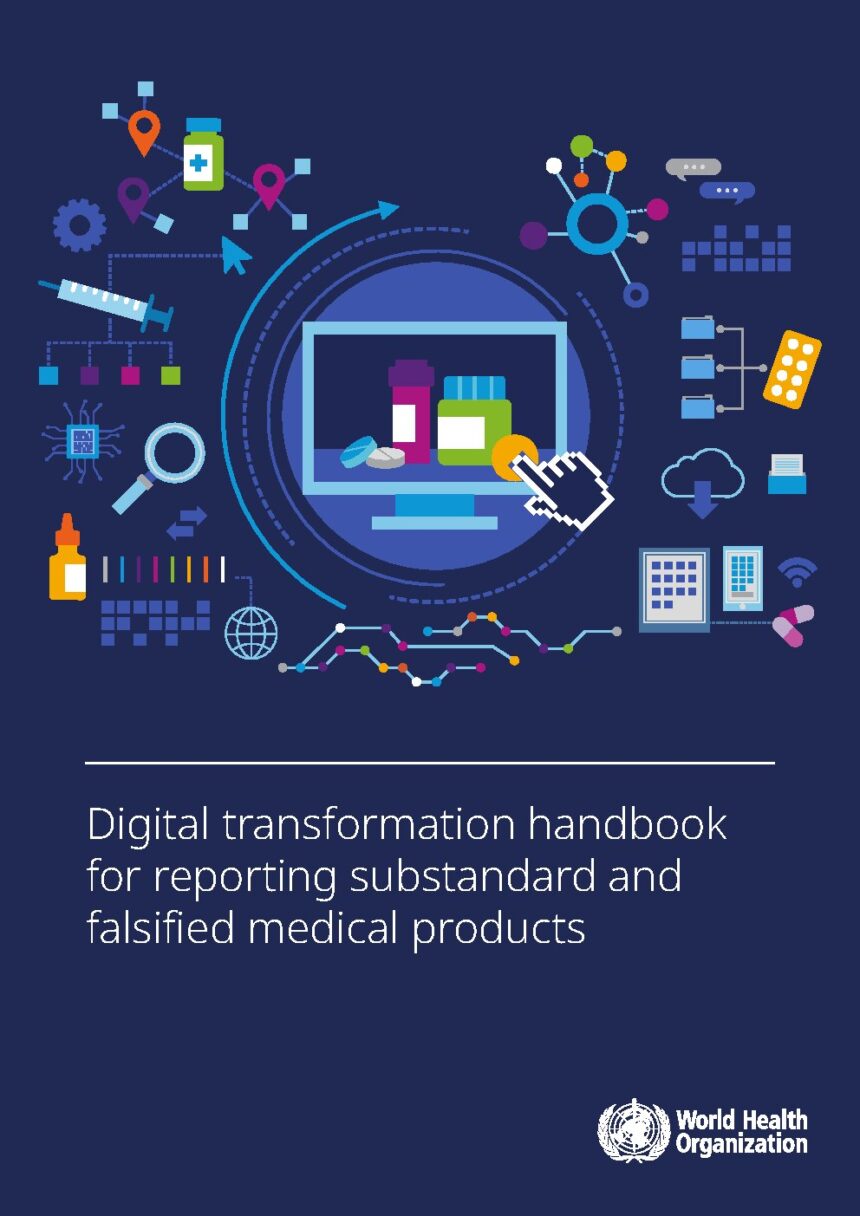
World Health Organization · 1st edition, 2026 · 72 pages
A practical guide for NMRAs and health ministries to implement digital reporting systems for substandard and falsified medicines.
- Issuer
- World Health Organization
- Edition
- 1st edition, 2026
- Audience
- National medicines regulatory authorities, ministries of health, digital health departments, implementation partners, health care professional associations
- Evidence
- Informed by pilot implementations in Indonesia and United Republic of Tanzania, consultations with Member States, and DIIG framework
- Reviewed
- 17 Oct 2026 · GMJ
What this guideline says
GMJ summary
This handbook provides step-by-step guidance for countries to transition from paper-based to digital systems for reporting substandard and falsified (SF) medical products. An estimated one in ten medical products in low- and middle-income countries may be substandard or falsified, threatening patient safety and undermining antimicrobial resistance efforts. Digital reporting tools can reduce barriers to reporting by health care professionals, streamline NMRA investigations, and facilitate global data sharing via the WHO Global Surveillance and Monitoring System (GSMS).
The handbook follows the WHO Digital Implementation Investment Guide (DIIG) framework and SMART Guidelines approach, covering seven key phases: assessing the current state and enabling environment; establishing governance and strategic planning; defining the future state architecture; determining functional and non-functional requirements; planning implementation; monitoring, evaluation and scale; and sharing implementation experiences. Pilot projects in Indonesia and the United Republic of Tanzania demonstrated that smartphone applications significantly improve reporting convenience compared with paper forms, though challenges with connectivity, device compatibility and NMRA capacity require attention.
The guide emphasizes stakeholder engagement, interoperability with existing digital health systems, user-centred design, and addressing barriers such as health worker time constraints, fear of repercussions, limited NMRA resources, and lack of awareness. It provides practical templates for user personas, business process mapping, data dictionaries, and functional requirements tailored to the needs of pharmacists, doctors, nurses and other health care professionals.
Key points
For clinicians — doses and thresholds as stated in the guideline
- Digital reporting systems should enable health care professionals to report suspected SF products with minimal data entry, photo upload capability, and offline functionality that syncs when connectivity is available
- Essential data elements include product identification (name, batch number, expiry date), type of report (substandard vs falsified), presence of adverse reactions or therapeutic failure, and reporter details
- The application must integrate with existing registries (product, facility, health worker) and use open interoperability standards (HL7 FHIR) to exchange data with pharmacovigilance systems and the WHO GSMS
- Implementation requires multi-stakeholder governance including NMRA leadership, technical working groups, ministry of health coordination, and engagement with health care professional associations
- Common barriers to reporting include health worker time constraints, fear of legal or reputational consequences, lack of NMRA feedback, polypharmacy complicating causality assessment, and inadequate internet connectivity in remote areas
- Digital readiness assessment should evaluate network coverage, electricity availability at facilities, smartphone penetration, cybersecurity frameworks, and existence of national digital health strategies
- Pilot studies in Indonesia and Tanzania generated 36 reports of 27 products, with health workers praising simplicity and photo upload features but identifying needs for improved backend systems and offline capabilities
- Monitoring should track metrics including reports per health worker, data completeness rate, time to submit report, system uptime, and average NMRA response time to investigations
Common challenges and barriers to SF reporting and potential solutions
Table extracted from the guideline
| Category | Challenges and barriers | Potential solutions |
|---|---|---|
| Health care professional capacity | Overburdened with work; time constraints; fear of repercussions | Integrate app into existing workflow; automate data capture; minimize manual entry; protect reporter identity |
| Regulatory support | Under-resourced NMRAs; lack of legal authority; lack of trained personnel | Design features for report processing and feedback; provide training; integrate NMRA feedback; legislate reporting requirements |
| Health care system practices | Polypharmacy preventing pinpointing individual medicine effects; lack of continuity of care | Provide detailed guidance on reporting in polypharmacy context; design flexible solution adaptable to different settings |
| Economic factors | Economic and reputational damage for suppliers; cost of internet access | Provide offline reporting with Wi-Fi sync; provide financial incentives for reporting |
| Social factors | Fear of reporting due to reputational, professional or personal reasons; fear of legal consequences | Provide anonymous reporting options; incorporate regulatory and legal protection |
| Education | Lack of awareness of SF products and how to recognize them | Integrate guidance on SF detection within the reporting application |
| Technology | Lack of digitalization requiring lengthy paper-based systems; limited connectivity | User-friendly, intuitive, appropriately automated solution; offline options with online sync capability |
Source: World Health Organization, Digital transformation handbook for reporting substandard and falsified medical products. Reproduced in summary form.
From the guideline
Verbatim
“An estimated one in ten medical products in low- and middle-income countries could be substandard and falsified.”
Editor’s perspective
Why this matters for Georgia and the region
Prof. Giorgi Pkhakadze, MD, MPH, PhD
Editor-in-Chief, Georgian Medical Journal · Chair, Public Health Institute of Georgia · WHO consultant, health and migration
For Georgia and neighboring South Caucasus countries, digital transformation of substandard and falsified product reporting represents an essential step toward pharmaceutical systems aligned with EU regulatory standards. As Georgia continues strengthening its National Regulatory Authority and expanding surveillance capacity, implementing the structured seven-phase approach outlined in this handbook—from stakeholder analysis through monitoring and scale—will ensure digital tools genuinely support rather than burden frontline health workers. I would particularly emphasize to Georgian clinicians the handbook's guidance on integrated reporting: rather than creating yet another standalone system, SF reporting should be embedded within existing pharmacovigilance workflows, leveraging the infrastructure Georgia has developed. The realistic implementation caveat is NMRA capacity; the pilot studies in Indonesia and Tanzania revealed that while health workers appreciated the simplified mobile reporting, regulatory authorities struggled with backend case management systems and timely follow-up, underscoring that technology alone cannot compensate for under-resourced inspection and enforcement functions.
ORCID 0000-0001-7609-4515 · Perspective written for the GMJ Guidelines Library, 17 Oct 2026
Applicability
Georgia and the South Caucasus
For Georgia and the South Caucasus region, this handbook addresses critical medicine quality challenges as countries strengthen pharmaceutical regulation aligned with EU standards. Georgia’s National Regulatory Authority and neighboring countries can use the framework to digitize SF reporting, complementing existing pharmacovigilance systems. The emphasis on interoperability is particularly relevant given Georgia’s ongoing digital health infrastructure development and integration with regional surveillance networks. National programmes should assess connectivity gaps in rural mountainous areas, ensure Georgian and minority language support, and coordinate with existing eHealth initiatives under the Ministry of Health to avoid fragmented systems.
Questions this guideline answers
Quick answers
What is the difference between substandard and falsified medical products?
Substandard products are authorized medical products that fail to meet quality standards or specifications due to manufacturing issues. Falsified products deliberately or fraudulently misrepresent their identity, composition or source—these are criminal acts. Both threaten patient safety but require different regulatory and enforcement responses.
Should SF reporting be integrated with existing pharmacovigilance systems?
Yes, if digital pharmacovigilance tools already exist, incorporating SF reporting into these applications is advantageous. The handbook recommends assessing current adverse drug reaction reporting forms and systems, then designing SF reporting to complement rather than duplicate these processes, using shared registries and interoperability standards.
What are the minimum functional requirements for an SF reporting application?
The application must allow users to: select report type (substandard/falsified); search and select products from a registry; capture batch number and expiry date; indicate whether adverse effects or therapeutic failure occurred; upload photos; and submit reports with confirmation and tracking numbers. It should work offline and sync when connectivity is available, support role-based access, and integrate with NMRA case management systems.
How can countries address health worker reluctance to report?
Solutions include: protecting reporter identity through anonymization options; minimizing data entry by auto-populating fields from registries and scanning barcodes; integrating reporting into existing workflows; providing timely NMRA feedback on investigations; offering legal protection from liability; and conducting awareness training on how to recognize SF products. The pilot studies showed that photo upload and simplicity significantly improved health worker willingness to report.
Related on GMJ
Interconnected resources
Dictionary of Public Health
GMJ News coverage
- MHRA publishes register of authorised online medicine sellers in Northern IrelandAug 2026
- Nigeria's NAFDAC Launches Digital Platform to Combat Counterfeit MedicinesJun 2026
- Digital health tools increase physical activity in heart disease patients, meta-analysis showsJul 2026
- Digital Health Wearables Could Address Women's Medical Under-RepresentationMay 2026
Quality & accreditation
- ASF Hospital — Standard 19 — Digital Care and Artificial Intelligence Systems for Care
- ASF Telemedicine — Standard 10 — Artificial Intelligence Systems for Care
- ASF Hospital — Standard 4 — Care & Treatment
- ASF Hospital — Standard 7 — Governance & Management
- ASF Hospital — Standard 5 — Safety & Emergency Preparedness
Other guidelines on this topic
- Regional manual with operating guides on respiratory care equipment and devices
- Prevention and management of heat-related illness at mass gatherings: systematic reviews
- Resilient Hospitals: An inter-regional guidance on strengthening resilience to health emergencies and disasters in health facilities
- EVAC-H: Evacuation of hospitals and their critical areas
- Protocol for the Use of the Performance Monitoring Tool for the National Expanded Program on Immunization
- Issuer
- World Health Organization
- Type
- Handbook
- Edition
- 1st edition, 2026
- Status
- Current
- Published
- 2026-06-09
- Languages
- English
- Scope
- Global, with emphasis on low- and middle-income countries
- Audience
- National medicines regulatory authorities, ministries of health, digital health departments, implementation partners, health care professional associations
- Pages
- 72
- Licence
- CC BY-NC-SA 3.0 IGO
- ISBN
- 978-92-4-012074-7
- Evidence
- Informed by pilot implementations in Indonesia and United Republic of Tanzania, consultations with Member States, and DIIG framework
- Record history
- Created 17 Oct 2026 · updated 17 Oct 2026 · next check Apr 2027
World Health Organization. Digital transformation handbook for reporting substandard and falsified medical products. Geneva: World Health Organization; 2026. Licence: CC BY-NC-SA 3.0 IGO.GMJ Guidelines Library records are original summaries written by the GMJ editorial team from the issuer’s published document and reviewed by a physician. They do not replace the full guideline. The document is the copyright of its issuer and is linked, not hosted. Spotted an error or a newer edition? Tell the Guidelines Desk.
Was this article helpful?