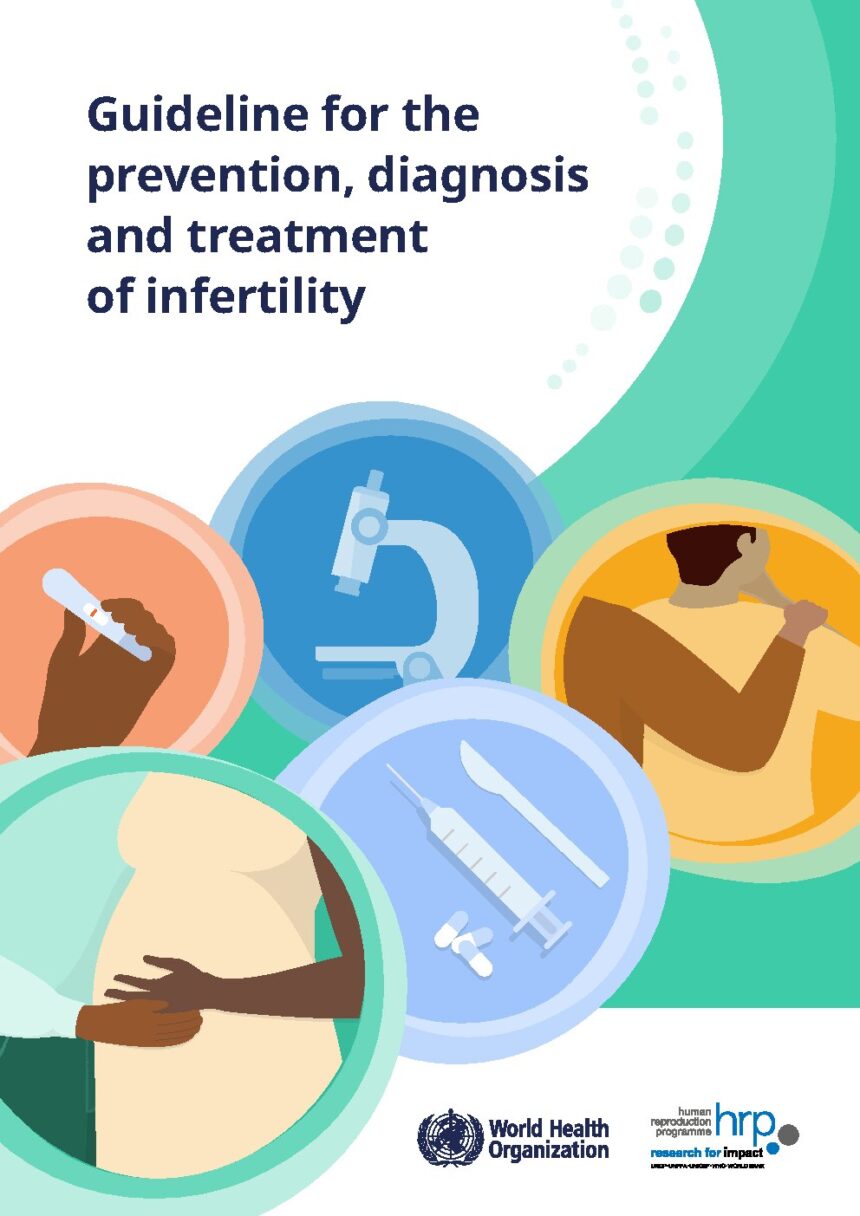
World Health Organization · 1st edition, 2025 · 262 pages
First WHO guideline providing evidence-based recommendations for fertility care to improve global access and outcomes.
- Issuer
- World Health Organization
- Edition
- 1st edition, 2025
- Audience
- Physicians, embryologists, nurses, midwives, laboratory specialists, other health care providers; policy-makers; patient support organizations; professional societies
- Evidence
- GRADE-rated recommendations based on systematic reviews and meta-analyses; good practice statements where evidence review not warranted
- Reviewed
- 14 Oct 2026 · GMJ
What this guideline says
GMJ summary
This is the first comprehensive WHO guideline on infertility, addressing a global public health issue that affects approximately one in six people of reproductive age at some point in their lives. The guideline provides 35 evidence-based recommendations covering prevention (including information provision and tobacco cessation), diagnosis (of ovulatory dysfunction, tubal disease, uterine cavity disorders, and male factors), and treatment of female-factor, male-factor, and unexplained infertility.
Key diagnostic recommendations include using mid-luteal serum progesterone to confirm ovulation, hysterosalpingogram (HSG) or hysterosalpingo contrast sonography (HyCoSy) for tubal patency, and saline infusion sonohysterography (SIS) for uterine cavity assessment. For treatment, the guideline recommends letrozole over clomiphene citrate for PCOS-related infertility, surgical or radiological treatment for clinical varicocele, and a stepwise approach for unexplained infertility starting with expectant management, then stimulated intrauterine insemination (S-IUI), and finally IVF.
Developed using GRADE methodology with a multidisciplinary international panel, the guideline emphasizes that fertility care should be integrated into universal health coverage, accessible without stigma or discrimination, and provided with attention to equity, cost-effectiveness, and patient values. The recommendations use a public health perspective and are intended for adaptation to local contexts worldwide.
Key points
For clinicians — doses and thresholds as stated in the guideline
- For confirming ovulation in females with regular cycles: measure mid-luteal serum progesterone (approximately 7 days before expected menses); if no ovulation indicated, repeat measurement to minimize inaccurate diagnosis
- For PCOS-related infertility: use letrozole as first-line over clomiphene citrate or metformin; where letrozole off-label use not permitted, use clomiphene citrate with metformin
- For tubal patency assessment: use either HSG or HyCoSy based on local feasibility and trained provider availability
- For uterine cavity assessment when disorder suspected: use SIS rather than 3D US, 2D US, or HSG
- For males with abnormal semen parameters (outside WHO reference ranges): repeat semen analysis after minimum 11 weeks; if all parameters normal, do not repeat
- For unexplained infertility: first-line is expectant management (3–6 months) rather than unstimulated IUI or ovarian stimulation; second-line is S-IUI with clomiphene citrate or letrozole (3–6 cycles); third-line is IVF without ICSI
- For clinical varicocele in males: offer surgical or radiological treatment over expectant management; microscopic surgery preferred over other surgical approaches
- Brief tobacco cessation advice (30 seconds to 3 minutes) should be routinely provided to all tobacco users in any health care setting, as smoking is associated with higher infertility risk, especially in women
Summary of recommendations and key guidance
Table extracted from the guideline
| Domain | Recommendation | Strength/Quality |
|---|---|---|
| Prevention – General population | Provide information on fertility/infertility using low-cost strategies when opportunities occur | Conditional, very low certainty |
| Prevention – Couples with infertility | Provide low-cost lifestyle advice before and during treatment | Conditional, low certainty |
| Prevention – Tobacco | Brief advice to all tobacco users in any health care setting | Strong, moderate certainty |
| Diagnosis – Ovulation confirmation | Mid-luteal serum progesterone rather than ultrasound; repeat if no ovulation | Conditional, very low certainty |
| Diagnosis – Ovarian reserve | Base on age rather than tests; if testing: use AFC, AMH, or day 2/3 FSH | Conditional, very low certainty |
| Diagnosis – Tubal patency | Use either HSG or HyCoSy | Conditional, low certainty |
| Diagnosis – Uterine cavity | Use SIS rather than 3D US, 2D US, or HSG | Conditional, low to very low certainty |
| Diagnosis – Semen analysis | Repeat after ≥11 weeks if parameters abnormal; do not repeat if all normal | Conditional, very low certainty |
| Treatment – PCOS | Letrozole over clomiphene citrate or metformin | Conditional, low certainty |
| Treatment – PCOS second-line | Gonadotrophins over laparoscopic ovarian drilling | Conditional, low certainty |
| Treatment – Tubal (age <35, mild-moderate) | Surgery rather than IVF | Conditional, very low certainty |
| Treatment – Tubal (age <35, severe) | IVF rather than surgery | Conditional, very low certainty |
| Treatment – Tubal (age ≥35) | IVF rather than surgery | Conditional, very low certainty |
| Treatment – Hydrosalpinx | Salpingectomy or tubal occlusion before IVF | Conditional, very low certainty |
| Treatment – Uterine septum | Do not perform septoplasty if no recurrent pregnancy loss | Conditional, low certainty |
| Treatment – Varicocele | Surgical or radiological treatment over expectant management | Conditional, low certainty |
| Treatment – Varicocele technique | Microscopic surgery rather than other surgical procedures | Conditional, very low certainty |
| Treatment – Unexplained 1st-line | Expectant management over U-IUI or ovarian stimulation | Conditional, low certainty |
| Treatment – Unexplained 2nd-line | S-IUI with clomiphene citrate or letrozole | Conditional, low to very low certainty |
| Treatment – Unexplained 3rd-line | IVF over expectant management; IVF alone rather than IVF with ICSI | Conditional/Strong, low certainty |
Source: World Health Organization, Guideline for the prevention, diagnosis and treatment of infertility. Reproduced in summary form.
From the guideline
Verbatim
“Approximately one in six people of reproductive age experience infertility at some stage in their lives.”
Editor’s perspective
Why this matters for Georgia and the region
Prof. Giorgi Pkhakadze, MD, MPH, PhD
Editor-in-Chief, Georgian Medical Journal · Chair, Public Health Institute of Georgia · WHO consultant, health and migration
As someone who has worked with WHO on health systems strengthening in our region, I find this guideline particularly timely for Georgia and neighbouring countries. The stepwise, cost-effectiveness approach to unexplained infertility—starting with expectant management before moving to S-IUI and only then to IVF—is exactly the kind of rational pathway our healthcare systems need to adopt to make fertility care accessible within limited budgets. I would especially stress to Georgian clinicians the recommendation to use letrozole as first-line for PCOS-related infertility, though we must first address the regulatory pathway for off-label use. The realistic caveat is that while we can relatively quickly build capacity for basic diagnostics like mid-luteal progesterone testing and HSG at the secondary care level, establishing quality-assured semen analysis according to the WHO 2021 manual and advanced procedures like SIS will require sustained investment in laboratory infrastructure and specialist training—challenges that our 2013 UHC reforms have not yet fully addressed for fertility services.
ORCID 0000-0001-7609-4515 · Perspective written for the GMJ Guidelines Library, 14 Oct 2026
Applicability
Georgia and the South Caucasus
For Georgia and the South Caucasus, this guideline is highly relevant as infertility affects approximately 17% of the reproductive-age population globally, with no significant regional variation. Countries in this region will need to assess current gaps in fertility care coverage within their universal health coverage frameworks (Georgia introduced its UHC programme in 2013) and determine which basic diagnostic and treatment services can be integrated into primary and secondary care. Key implementation considerations include: establishing standardized semen analysis capacity following the WHO laboratory manual (6th edition, 2021); training providers in HSG, HyCoSy, and SIS for diagnostic evaluations; ensuring access to essential medicines like letrozole and clomiphene citrate; addressing regulatory frameworks for off-label use of letrozole; and developing financing mechanisms to reduce catastrophic out-of-pocket expenditures that currently prevent many couples from accessing care. National programmes should also adapt fertility education messages to local cultural contexts, integrate STI prevention and treatment (building on existing programmes), and establish referral pathways between primary care and specialist fertility centres.
Questions this guideline answers
Quick answers
When should infertility evaluation begin?
After 12 months of regular unprotected sexual intercourse without achieving pregnancy. Evaluation of both partners should be initiated simultaneously to enable prompt diagnosis and treatment.
What is the recommended first-line treatment for PCOS-related infertility?
Letrozole is suggested over clomiphene citrate or metformin. Where off-label use of letrozole is not permitted, use clomiphene citrate with metformin rather than either alone. Lifestyle advice (diet, physical activity, weight management) should also be provided.
How should unexplained infertility be managed?
A stepwise approach is recommended: first, expectant management (typically 3–6 months) rather than unstimulated IUI or ovarian stimulation; second, stimulated IUI with clomiphene citrate or letrozole (3–6 cycles); third, IVF alone (not with ICSI) if S-IUI unsuccessful.
What diagnostic test is best for assessing the uterine cavity?
Saline infusion sonohysterography (SIS) is suggested over 3D ultrasound, 2D ultrasound, or HSG for suspected uterine cavity disorders. However, where 3D US is already available within existing resources, it may be the preferred option.
Related on GMJ
Interconnected resources
Dictionary of Public Health
Drugs A–Z
GMJ News coverage
Quality & accreditation
- ASF Hospital — Standard 13 — Radiology
- ASF Laboratory — Standard 4 — Equipment, Reagents & Traceability
- ASF Hospital — Standard 7 — Governance & Management
- ASF Hospital — Standard 5 — Safety & Emergency Preparedness
- ASF Hospital — Standard 4 — Care & Treatment
- ASF Hospital — Standard 6 — Aftercare & Follow-up
Other guidelines on this topic
- Recommendations on the management of sickle-cell disease during pregnancy, childbirth and the interpregnancy period
- Guidelines on lenacapavir for HIV prevention and testing strategies for long-acting injectable pre-exposure prophylaxis
- Recommendations on the delivery of health services for the prevention and care of sexually transmitted infections
- Mass gathering practical guide for simulation exercises and after action reviews
- Abortion care guideline, 2nd edition
- Issuer
- World Health Organization
- Type
- Guideline
- Edition
- 1st edition, 2025
- Status
- Current
- Published
- 2025-11-27
- Languages
- English
- Scope
- Prevention, diagnosis and treatment of female-factor (ovulatory dysfunction, tubal disease, uterine cavity disorders), male-factor and unexplained infertility
- Audience
- Physicians, embryologists, nurses, midwives, laboratory specialists, other health care providers; policy-makers; patient support organizations; professional societies
- Pages
- 262
- Licence
- CC BY-NC-SA 3.0 IGO
- ISBN
- 978-92-4-011577-4
- Evidence
- GRADE-rated recommendations based on systematic reviews and meta-analyses; good practice statements where evidence review not warranted
- Next review
- Not specified; anticipated subsequent editions will expand scope
- Record history
- Created 14 Oct 2026 · updated 14 Oct 2026 · next check Apr 2027
World Health Organization. Guideline for the prevention, diagnosis and treatment of infertility. Geneva: World Health Organization; 2025. Licence: CC BY-NC-SA 3.0 IGO.GMJ Guidelines Library records are original summaries written by the GMJ editorial team from the issuer’s published document and reviewed by a physician. They do not replace the full guideline. The document is the copyright of its issuer and is linked, not hosted. Spotted an error or a newer edition? Tell the Guidelines Desk.
Was this article helpful?