World Health Organization · 1st edition, 2026 · 61 pages
WHO framework and 93 indicators to monitor abortion care quality, access, and enabling environment for health programmes, ministries, and researchers.
- Issuer
- World Health Organization
- Edition
- 1st edition, 2026
- Audience
- Ministries of health, NGOs, civil society organisations, health programme managers, community-based care providers, research institutions, policy-makers, and public health professionals
- Evidence
- Framework and indicator menu developed through Delphi process with over 90 experts from all WHO regions; indicators selected by expert consensus (≥60% agreement) and based on validation, prior use in multi-country programmes, or inclusion in global indicator lists
- Reviewed
- 15 Oct 2026 · GMJ
What this guideline says
GMJ summary
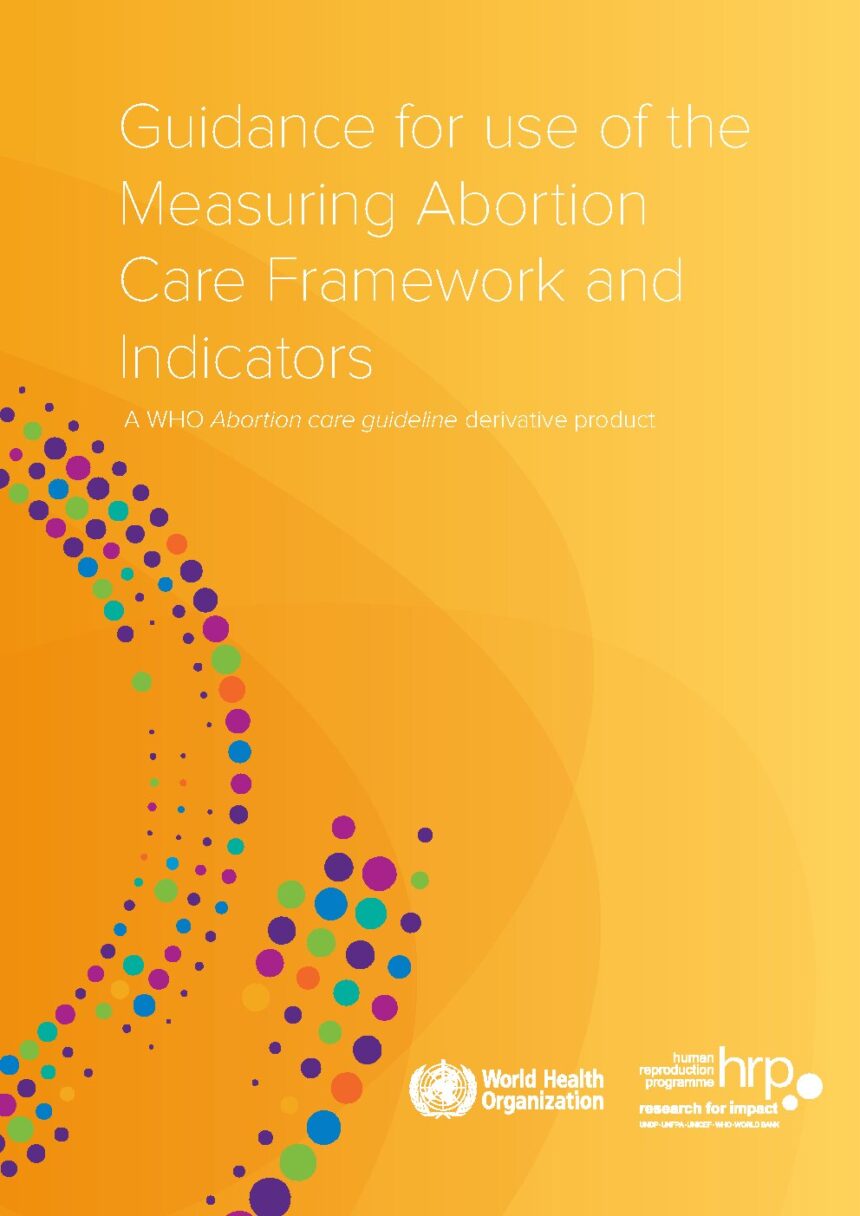
This WHO derivative product of the Abortion Care Guideline (2024) presents the Measuring Abortion Care Framework and Indicators (MACFI): a results-chain measurement framework and a curated menu of 93 validated indicators to support standardised monitoring of abortion care quality at programme, local, national, and global levels. Developed through a Delphi process with over 90 experts from all WHO regions, the MACFI organises measurement concepts across five domains—Structures, Inputs and processes, Outputs, Outcomes, and Impacts—connecting health system and law/policy levers to quality of care, universal access, reproductive rights fulfilment, and ultimately to SDG 3 (healthy lives) and SDG 5 (gender equality).
The framework centres the abortion seeker, integrates the enabling environment (law, policy, stigma, information access), and aligns with WHO’s health systems strengthening approach. The indicator menu spans law and policy (e.g. alignment with WHO recommendations, medicine registration, third-party authorisation), health systems (e.g. service availability and readiness, abortion commodities, provider competence, financing), clinical care (e.g. pain management, appropriate evacuation method, person-centred counselling, respect for autonomy, contraceptive access), and empowered people and communities (e.g. abortion knowledge and stigma, barriers to care, unsafe abortion incidence, reproductive autonomy). Indicators are drawn from facility surveys, provider observation, client exit interviews, population surveys, routine health information systems, and desk review of government documents.
The MACFI is designed as a flexible menu: users select the subset of indicators relevant to their programme focus, context, and data capacity. Metadata for each indicator (provided in the Web Annex) include definitions, calculation, preferred data sources, prior use, and references. The guidance identifies major measurement gaps—especially for self-managed abortion, telemedicine and digital tools, abortion financing, law and policy implementation, and integration of abortion within primary health care—and calls for continued indicator development. The MACFI will be updated regularly as the field evolves and is intended to facilitate harmonised, evidence-based monitoring to accelerate progress in strengthening the quality of abortion care and improving the enabling environment worldwide.
Key points
For clinicians — doses and thresholds as stated in the guideline
- MACFI provides a 5-domain results-chain framework (Structures → Inputs/processes → Outputs → Outcomes → Impacts) linking abortion care interventions to SDG 3 (health) and SDG 5 (gender equality).
- 93 validated indicators organised in four tracks: Health systems (governance, finance, commodities, workforce, information systems), Clinical (standards, competence, quality of care), Law and policy (alignment with WHO recommendations, implementation), Empowered people and communities (knowledge, stigma, barriers, unsafe abortion).
- Users tailor indicator selection to programme priorities and context; full metadata (definitions, data sources, tools) provided in Web Annex.
- Law and policy: Indicator 1.3.1.1 assesses whether laws/policies align with Abortion Care Guideline recommendations (decriminalisation, removal of gestational-age limits and third-party authorisation, no mandatory waiting periods, conscientious objection addressed).
- Commodities: Indicators measure availability of surgical abortion equipment, misoprostol and mifepristone, abortion medicines on national essential medicines list and procurement lists, and registration of abortion products.
- Clinical quality: Indicators include appropriate uterine evacuation method used, effective pain management, client understanding of process, respect for client values, no reproductive coercion, timely follow-up, desired contraceptive method received without coercion.
- Access and equity: Indicators measure barriers to abortion care, unsafe abortion incidence, abortion admissions, waiting time, affordability, and equity of pain management; all client-level indicators can be disaggregated by age, marital status, geography, disability, and other equity markers.
- Major gaps identified: No validated indicators for self-managed abortion support, telemedicine/digital tools, abortion financing transparency, law/policy implementation (e.g. providers empowered to apply law in rights-compliant ways, care accessible without criminal threat), and integration of abortion into primary health care and emergency preparedness.
From the guideline
Verbatim
“States must respect, protect and fulfil abortion seekers' rights, including their sexual and reproductive health and rights.”
Editor’s perspective
Why this matters for Georgia and the region
Prof. Giorgi Pkhakadze, MD, MPH, PhD
Editor-in-Chief, Georgian Medical Journal · Chair, Public Health Institute of Georgia · WHO consultant, health and migration
As Editor-in-Chief of the Georgian Medical Journal and Chair of the Public Health Institute of Georgia, I see the MACFI as a timely and practical tool for our region. Georgia, Armenia, and Azerbaijan have relatively liberal abortion laws on paper, but evidence on actual access, quality, and the enabling environment is fragmented. The MACFI's structured approach allows us to systematically measure what matters—whether mifepristone is registered and available, whether pain management is routinely offered, whether women face informal fees or provider refusal, and whether stigma deters care-seeking. I would stress to Georgian clinicians and programme managers the importance of the person-centred care indicators: respect for autonomy, privacy, freedom from coercion, and comprehensive counselling on contraception without quotas. One realistic caveat: our routine health information systems do not currently capture many of these indicators—facility readiness, client experience, provider competence—so implementing the MACFI will require investment in periodic facility surveys, client exit interviews, and strengthened data quality. Collaboration with NGOs and academic partners will be essential to fill these gaps and use the evidence to advocate for policy improvements and resource allocation.
ORCID 0000-0001-7609-4515 · Perspective written for the GMJ Guidelines Library, 15 Oct 2026
Applicability
Georgia and the South Caucasus
For Georgia and the South Caucasus, the MACFI is highly relevant: abortion is legal on request up to 12 weeks in Georgia, Armenia, and Azerbaijan, but access, quality, and the enabling environment vary widely. National programmes should use the framework to identify measurement priorities—for example, assessing whether misoprostol and mifepristone are on national essential medicines lists and registered for abortion indication, whether clinical protocols align with WHO recommendations (e.g. no mandatory waiting periods, pain management routinely offered, self-assessment of completion permitted), and whether facility service readiness (equipment, trained providers, referral systems) supports timely access. Given documented abortion stigma in the region and potential barriers (informal fees, provider refusal, lack of contraceptive counselling integration), indicators on person-centred care (respect, privacy, freedom from coercion), affordability, reproductive autonomy, and provider and community stigma are critical. The framework’s call for data on telemedicine abortion and self-management is particularly salient as digital health expands. Ministries of health can integrate abortion indicators into routine SRMNCAH monitoring, use the MACFI to guide data quality reviews (indicator 2.4.1.1), and set targets for reducing unsafe abortion and improving equity of access—including for adolescents, rural populations, and displaced persons. Collaboration with NGOs, academic institutions, and community-based organisations to conduct facility surveys, client exit interviews, and population surveys will be essential, as routine health information systems in the region often do not capture abortion care comprehensively.
Questions this guideline answers
Quick answers
What is the MACFI and who is it for?
The Measuring Abortion Care Framework and Indicators (MACFI) is a WHO derivative product providing a measurement framework and menu of 93 validated indicators to monitor abortion care quality, access, and the enabling environment. It is intended for ministries of health, NGOs, civil society organisations, health programme managers, community-based services, and research institutions at subnational, national, and international levels. Users select indicators tailored to their priorities, context, and data capacity.
How does the MACFI align with the WHO Abortion Care Guideline?
The MACFI translates the Abortion Care Guideline's conceptual framework into a measurement framework, using a results-chain structure (Structures → Inputs/processes → Outputs → Outcomes → Impacts). It centres the abortion seeker, integrates the enabling environment (law, policy, stigma, information), and organises indicators around the guideline's 'WHO, WHERE, WHAT, HOW' components and quality-of-care dimensions (equitable, acceptable, accessible, effective, efficient, safe).
What are the key measurement gaps identified?
Major gaps include: no validated indicators for self-managed abortion support (access to information, medicines, post-abortion care outside facilities), telemedicine and digital health tools, abortion financing (transparent charges, sufficient funding), law and policy implementation (providers empowered to interpret law, care accessible without criminal threat, mechanisms for denied-care remedies), integration of abortion into primary health care and emergency preparedness, diverse service-delivery models' efficiency, and abortion's contribution to SDG 3.7 (universal access to SRH services) and SDG 5.1 (ending discrimination against women).
How should a national programme use the MACFI to monitor abortion care?
Step 1: Create a monitoring plan aligned with national SRMNCAH strategies, identifying relevant sub-domains and concepts. Step 2: Select indicators from the menu matching programme scope, context, and data capacity (e.g. law/policy indicators from government documents, service readiness from facility surveys, quality-of-care indicators from client exit interviews). Step 3: Set baseline values and targets. Step 4: Identify data sources (routine HMIS, surveys, special studies) and address gaps. Step 5: Collect, analyse, and interpret data using metadata guidance. Step 6: Disseminate evidence to policy-makers and stakeholders, plan responses, and integrate findings into annual reviews to drive continuous improvement.
Related on GMJ
Interconnected resources
Dictionary of Public Health
Quality & accreditation
Other guidelines on this topic
- Routine health information system and health facility data for neglected tropical diseases: Taenia solium taeniasis and cysticercosis
- Evidence-informed guidance for the implementation of HPV-based cervical cancer screening programmes
- Guideline on preventing early pregnancy and poor reproductive outcomes among adolescents in low- and middle-income countries
- Guideline on preventing early pregnancy and poor reproductive outcomes among adolescents in low- and middle-income countries – Web Annex: Evidence base
- Guideline on the prevention of female genital mutilation and clinical management of complications
- Issuer
- World Health Organization
- Type
- Guidance (normative)
- Edition
- 1st edition, 2026
- Status
- Current
- Published
- 2026-06-30
- Languages
- English
- Scope
- Global; applicable at programme, subnational, national, regional, and international levels; covers structures, inputs/processes, outputs, outcomes, and impacts of abortion care quality and enabling environment
- Audience
- Ministries of health, NGOs, civil society organisations, health programme managers, community-based care providers, research institutions, policy-makers, and public health professionals
- Pages
- 61
- Licence
- CC BY-NC-SA 3.0 IGO
- ISBN
- B09752
- Evidence
- Framework and indicator menu developed through Delphi process with over 90 experts from all WHO regions; indicators selected by expert consensus (≥60% agreement) and based on validation, prior use in multi-country programmes, or inclusion in global indicator lists
- Next review
- Regular updates planned as field evolves and new indicators are validated; suggestions accepted via online submission system at srhr.org/macfi
- Record history
- Created 15 Oct 2026 · updated 15 Oct 2026 · next check Apr 2027
World Health Organization. Guidance for use of the Measuring Abortion Care Framework and Indicators: a WHO Abortion care guideline derivative product. Geneva: World Health Organization; 2026. Licence: CC BY-NC-SA 3.0 IGO. https://doi.org/10.2471/B09752. IRIS: 10665/386427. ISBN: B09752.GMJ Guidelines Library records are original summaries written by the GMJ editorial team from the issuer’s published document and reviewed by a physician. They do not replace the full guideline. The document is the copyright of its issuer and is linked, not hosted. Spotted an error or a newer edition? Tell the Guidelines Desk.
Was this article helpful?