World Health Organization · 1st edition, 2025 · 29 pages
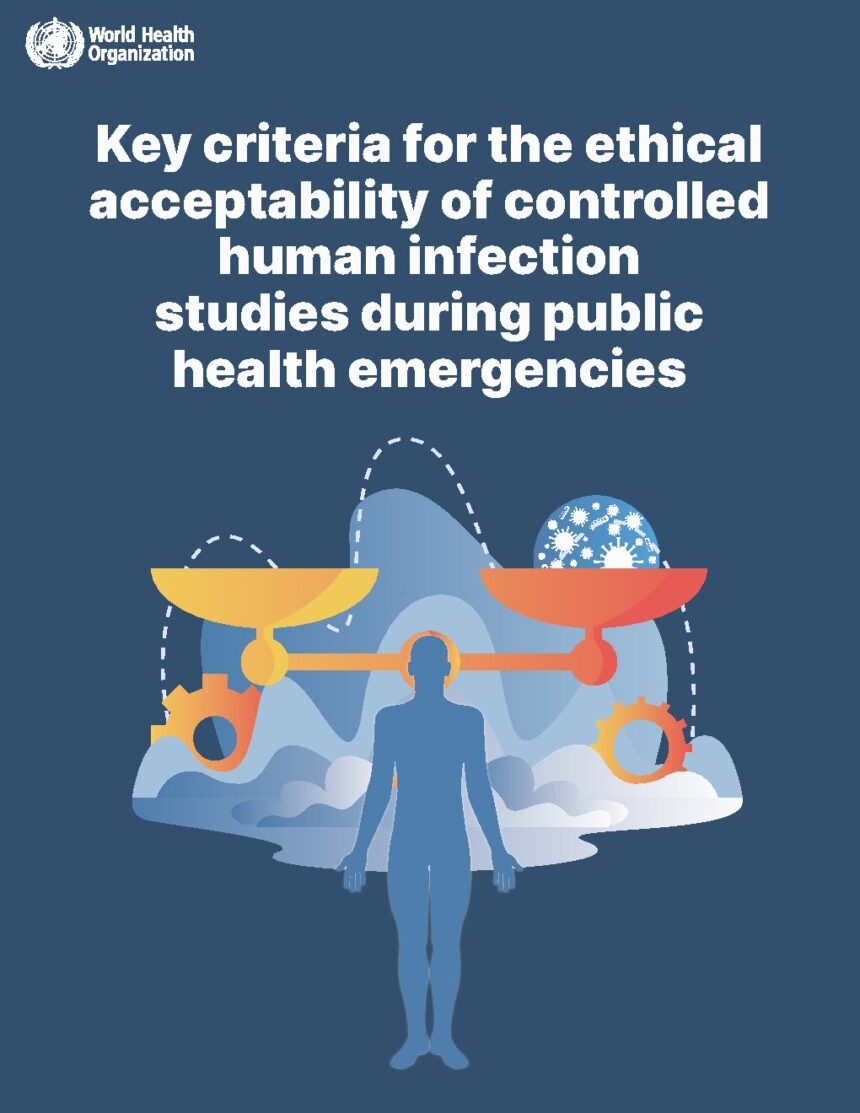
WHO ethical framework for challenge trials with epidemic pathogens—seven criteria for researchers, ethics committees and regulators.
- Issuer
- World Health Organization
- Edition
- 1st edition, 2025
- Audience
- Researchers, research ethics committees, regulators, funders, policy-makers, and public health authorities involved in emergency research
- Evidence
- Expert consensus informed by COVID-19 and Zika challenge study experiences and academic research ethics literature
- Reviewed
- 15 Oct 2026 · GMJ
What this guideline says
GMJ summary
This WHO guidance establishes seven ethical criteria for conducting controlled human infection studies (CHIS) during public health emergencies. CHIS involve deliberately infecting healthy volunteers with a pathogen to accelerate vaccine development, test diagnostics, or study disease transmission under controlled conditions. While such studies can provide robust data more quickly than field trials, they raise significant ethical concerns regarding participant risk, third-party transmission, and social value—particularly during emergencies when uncertainties are high and public scrutiny is intense.
The framework requires that CHIS have strong scientific justification with potential benefits outweighing risks, be coordinated with broader emergency research programmes, involve rigorous risk minimization, recruit only low-risk participants (typically young healthy adults), undergo expert independent review, and employ especially careful informed consent processes. The criteria are informed by COVID-19 and Zika challenge study experiences and are intended to apply to any pathogen causing a public health emergency.
The document emphasizes that standard research ethics requirements continue to apply during emergencies, but CHIS require heightened scrutiny given deliberate infection of participants, potential for vaccine-enhanced disease, risks to third parties including research staff, and the need to balance urgency against thorough ethical review. Challenge studies should be situated within coordinated international research strategies and include robust public engagement.
Key points
For clinicians — doses and thresholds as stated in the guideline
- CHIS during emergencies must have especially strong scientific justification, demonstrating advantages over alternative study designs such as phase 3 field trials, particularly when community transmission is low or multiple vaccine candidates require rapid comparison
- Participant selection must be restricted to adults at lowest risk of severe disease (typically young healthy adults); selection criteria should be updated as data on risk factors emerge during the emergency
- Initial challenge studies should use sequential small-group challenges starting with low viral doses, with close monitoring, guaranteed high-quality supportive and intensive care, and full compensation for any research-related harm including long-term follow-up
- Third-party risks must be minimized through stringent infection control in specialized facilities, protective equipment for staff, inpatient isolation until participants are no longer infectious, and careful selection to reduce community transmission risks
- CHIS research programmes require coordination between researchers, funders, government agencies and regulators, with pre-registration of all studies, rapid public reporting of safety and efficacy data, and integration into broader vaccine development pathways
- Independent expert review is required beyond local ethics committees, ideally at national or international level, with reviewers having specific expertise in CHIS science and ethics, and capacity for rigorous emergency review
- Informed consent must be particularly rigorous with testing of participant understanding, disclosure based on best available risk data, and consent revisited throughout the study especially when new relevant data emerge
- Public engagement should commence as soon as CHIS are considered, transparently present risks and potential benefits, and seek feedback on study design, continuing throughout the research programme
Key criteria for the ethical acceptability of CHIS during public health emergencies (Table 1)
Table extracted from the guideline
| Criterion | Explanation | Responsible parties |
|---|---|---|
| Scientific justification | CHIS must have especially strong scientific justification during public health emergencies | Research team, Ethics committee, Funders and sponsors, Independent oversight committees |
| Assessment of risks and potential benefits | It must be reasonable to expect that the potential benefits of CHIS outweigh risks | Research team, Ethics committee, Regulators, Funders and sponsors, Independent oversight committees |
| Coordination, consultation, and engagement | CHIS research programmes should be coordinated with other emergency research and involve engagement with the public as well as appropriate consultation | Research team, Funders and sponsors, Government agencies |
| Site selection | CHIS should be situated where the research can be conducted to the highest scientific, clinical and ethical standards | Research team, Ethics committee, Funders and sponsors, Government agencies |
| Participant selection | CHIS should involve assurance that participant selection criteria limit and minimize risk | Research team, Ethics committee |
| Expert review | CHIS should be reviewed by an appropriately qualified independent committee | Ethics committee, Government agencies, Independent oversight committees |
| Informed consent | CHIS must involve rigorous informed consent | Research team, Ethics committee |
Source: World Health Organization, Key criteria for the ethical acceptability of controlled human infection studies during public health emergencies. Reproduced in summary form.
From the guideline
Verbatim
“CHIS must have especially strong scientific justification during public health emergencies.”
Editor’s perspective
Why this matters for Georgia and the region
Prof. Giorgi Pkhakadze, MD, MPH, PhD
Editor-in-Chief, Georgian Medical Journal · Chair, Public Health Institute of Georgia · WHO consultant, health and migration
As someone who has worked on emergency preparedness in the South Caucasus, I recognize that this framework addresses a capability gap in our region. While Georgia has strengthened its outbreak response systems and research ethics infrastructure, we currently lack the specialized facilities, biosafety capacity, and trained ethics reviewers required for challenge studies with novel pathogens. The criterion I would emphasize for Georgian institutions is coordination—if international challenge study programmes emerge during the next pandemic, our national research and regulatory bodies must engage early to understand how such studies might inform vaccine access and public health measures relevant to our population. The realistic constraint is that participating as a host site would require substantial investment in containment facilities meeting international standards, specialized intensive care capabilities, and ethics committee training in CHIS-specific issues—resources that might be better directed toward strengthening field trial capacity and post-authorization surveillance systems where Georgia has demonstrable strengths.
ORCID 0000-0001-7609-4515 · Perspective written for the GMJ Guidelines Library, 15 Oct 2026
Applicability
Georgia and the South Caucasus
For Georgia and the South Caucasus, this guidance is directly relevant given the region’s experience with emerging infectious disease threats and participation in international research networks. Georgian research institutions considering participation in emergency challenge studies—whether as host sites or collaborators—would need to assess local capacity against these criteria, particularly regarding specialized biosafety facilities, intensive care capabilities, ethics review systems capable of rapid yet rigorous assessment, and established community engagement mechanisms. The emphasis on coordination with national health authorities and integration into broader public health responses aligns with Georgia’s experience in outbreak management. National ethics committees and regulatory bodies in Georgia, Armenia and Azerbaijan should familiarize themselves with these criteria to prepare for potential proposals during future epidemics, recognizing that capacity-building in specialized CHIS ethics review, infection control infrastructure, and regulatory frameworks may be required before such studies could ethically proceed in the region.
Questions this guideline answers
Quick answers
When are challenge studies ethically justified during an epidemic instead of standard vaccine trials?
CHIS are most justified when they can accelerate vaccine development more efficiently than field trials—particularly when community transmission is low (making field trials slow or infeasible), when multiple vaccine candidates need rapid comparison, when detecting asymptomatic infection is critical, or when diagnostic test accuracy needs validation under controlled conditions. They require strong scientific rationale showing advantages over alternatives, with potential benefits outweighing risks.
What risk-minimization measures are required for challenge studies with novel pathogens?
Studies must restrict participation to adults at lowest risk (typically young healthy adults), use sequential small-group challenges starting with low viral doses, conduct studies in specialized inpatient facilities with stringent infection control until participants are non-infectious, provide guaranteed high-quality supportive and intensive care, offer specific curative treatments if available, ensure long-term follow-up, and provide full compensation for any research-related harm. Challenge strains should be as well-characterized as possible.
Can challenge studies proceed if there is no specific treatment for the disease?
Yes—the existence of specific efficacious treatment is not a necessary condition for ethical acceptability of CHIS. Many ethically approved challenge studies have been conducted for pathogens without specific treatments (rhinovirus, rotavirus, dengue, influenza). However, high-quality supportive care including intensive care must be available, and if proven treatments are developed they should be administered when expected to reduce risks significantly.
What level of ethics review is needed for challenge studies during public health emergencies?
Initial CHIS during an emergency require specialized independent review beyond standard local ethics review, ideally at national or international level (e.g., by WHO or national agency). Review committees must include members with specific expertise in CHIS science and ethics, capacity for rigorous yet timely review, and regular consultation with investigators throughout the study. Subsequent CHIS with the same pathogen showing no unexpected harms may revert to usual local review practices.
Related on GMJ
Interconnected resources
Dictionary of Public Health
GMJ News coverage
- UK flu and COVID-19 surveillance data to May 2027 shows continued monitoring amid seasonal trendsOct 2026
- Community Health Workers Boost COVID-19 Testing Among Formerly Incarcerated PeopleAug 2026
- Palestinian Paediatrician's Health Deteriorates in Israeli Detention After 18 Months Without ChargeSep 2026
- Breakthrough Antibody Cocktail Shows Promise Against Deadly Henipavirus InfectionsJul 2026
Quality & accreditation
- ASF Hospital — Standard 20 — Supporting the Care Workforce
- ASF Laboratory — Standard 3 — Personnel & Competence
- ASF Hospital — Standard 7 — Governance & Management
- ASF Hospital — Standard 5 — Safety & Emergency Preparedness
- ASF Hospital — Standard 4 — Care & Treatment
- ASF Hospital — Standard 11 — Critical Care
- ASF Medical Transport — Standard 6 — Emergency Response During Transport
Other guidelines on this topic
- Global guidance on monitoring public health and social measures policies during health emergencies
- Kangaroo mother care: a clinical practice guide
- Leishmaniasis: 20 years of progress towards elimination in the WHO African Region
- National Health Simulation Exercise Programme: implementation guidance to strengthen emergency preparedness, readiness and response
- Compendium of practice to inform regional and national civilian-military collaboration for health emergency preparedness
- Issuer
- World Health Organization
- Type
- Guidance (normative)
- Edition
- 1st edition, 2025
- Status
- Current
- Published
- 2025-09-17
- Languages
- English
- Scope
- Ethical criteria for controlled human infection studies (challenge trials) during public health emergencies caused by any pathogen
- Audience
- Researchers, research ethics committees, regulators, funders, policy-makers, and public health authorities involved in emergency research
- Pages
- 29
- Licence
- CC BY-NC-SA 3.0 IGO
- ISBN
- 978-92-4-010906-3
- Evidence
- Expert consensus informed by COVID-19 and Zika challenge study experiences and academic research ethics literature
- Record history
- Created 15 Oct 2026 · updated 15 Oct 2026 · next check Apr 2027
Key criteria for the ethical acceptability of controlled human infection studies during public health emergencies. Geneva: World Health Organization; 2025. Licence: CC BY-NC-SA 3.0 IGO.GMJ Guidelines Library records are original summaries written by the GMJ editorial team from the issuer’s published document and reviewed by a physician. They do not replace the full guideline. The document is the copyright of its issuer and is linked, not hosted. Spotted an error or a newer edition? Tell the Guidelines Desk.
Was this article helpful?