By using this site, you agree to the Privacy Policy and Terms of Use.
Accept
GMJ NewsGMJ NewsGMJ News
  • Latest News
    • GMJ Briefs
  • Podcast & Media
    • Podcast Episodes
    • GMJ Audio
    • GMJ Videos
  • Research Digest
    • New Studies
    • Georgian Research
    • Data & Numbers
  • Policy & Systems
    • Health Policy
    • Quality & Safety
    • Migration & Health
    • Global Health
  • Practice
    • Clinical Updates
    • Case Discussions
    • Pharmacy & Prescribing
    • Ingredients A-Z
  • Perspectives
    • Editorial
    • Explainers
    • Voices
    • Letters
  • Health Topics
  • GMJ Articles
    • Vol. 1 Issue 2 (2026)
    • Vol. 1 Issue 1 (2026)
    • Pre-Launch Articles (2025)
  • Read the Journal →
  • About GMJ News
Notification Show More
Font ResizerAa
GMJ NewsGMJ News
Font ResizerAa
  • Latest News
    • GMJ Briefs
  • Podcast & Media
    • Podcast Episodes
    • GMJ Audio
    • GMJ Videos
  • Research Digest
    • New Studies
    • Georgian Research
    • Data & Numbers
  • Policy & Systems
    • Health Policy
    • Quality & Safety
    • Migration & Health
    • Global Health
  • Practice
    • Clinical Updates
    • Case Discussions
    • Pharmacy & Prescribing
    • Ingredients A-Z
  • Perspectives
    • Editorial
    • Explainers
    • Voices
    • Letters
  • Health Topics
  • GMJ Articles
    • Vol. 1 Issue 2 (2026)
    • Vol. 1 Issue 1 (2026)
    • Pre-Launch Articles (2025)
  • Read the Journal →
  • About GMJ News
Follow US
GMJ News > Practice > Clinical Updates > Community Health Workers Boost COVID-19 Testing Among Formerly Incarcerated People
Clinical UpdatesNew StudiesPracticeResearch Digest

Community Health Workers Boost COVID-19 Testing Among Formerly Incarcerated People

GMJ
Last updated: 12/07/2026 13:29
By
GMJ Practice Desk
Share
7 Min Read
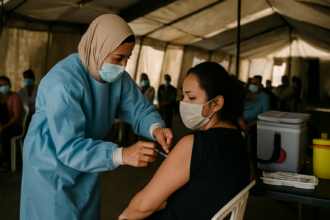
Community health worker administering point-of-care COVID-19 test at re-entry organizationIllustrative image · Boston City Hall lit blue to thank our healthcare workers under COVID-19.jpg by Office of Boston Mayor / Public domain via Wikimedia Commons (Public domain)
A randomized controlled trial published in The Lancet Public Health demonstrates that community health workers delivering onsite COVID-19 testing at re-entry organizations significantly increase testing uptake among formerly incarcerated individuals, with potential applications for HIV and hepatitis C screening. — Boston City Hall lit blue to thank our healthcare workers under COVID-19.jpg by Office of Boston Mayor / Public domain via Wikimedia Commons (Public domain)
SHARE
5 min read|926 words
✓ Reviewed by GMJ News Editorial Team

🟢 Strong Evidence

Contents
    • Key takeaways
      • Study at a Glance
      • Barriers to Healthcare Access in Formerly Incarcerated Populations
  • Testing Access as a Neglected Public Health Priority
  • How Community Health Worker Models Strengthen Testing Uptake
  • Implications Beyond COVID-19
    • What this means
  • Frequently asked questions
    • Why is testing uptake lower among formerly incarcerated individuals?
    • What makes community health workers effective at increasing testing?
    • Can this model work for other diseases besides COVID-19?

Onsite COVID-19 testing and health education delivered by community health workers at a re-entry organization significantly increased testing uptake among formerly incarcerated individuals, according to a randomized controlled trial published in The Lancet Public Health. The MOSAIC study demonstrates that trusted community-based workers can effectively bridge gaps in respiratory virus screening for populations with historically low healthcare access.

Key takeaways

  • Community health worker-led point-of-care testing at re-entry organizations significantly increased SARS-CoV-2 testing uptake among formerly incarcerated individuals
  • The intervention model demonstrates feasibility for other infectious diseases, including HIV and hepatitis C virus screening
  • Trusted local health workers address systemic barriers to care in populations with limited healthcare engagement

Study at a Glance

Source The Lancet Public Health
Study type Open-label, single-centre, randomized controlled trial
Sample size Formerly incarcerated individuals enrolled at re-entry organization
Population Recently released individuals accessing re-entry services
Country United States
Onsite accessibility
Testing and education delivered at trusted community location, removing transportation and trust barriers

Barriers to Healthcare Access in Formerly Incarcerated Populations

Key obstacles identified in literature and addressed by MOSAIC intervention model

Mistrust of healthcare systems
High
Limited healthcare access
High
Transportation barriers
High
Insurance gaps
High
Addressed by onsite model
92%

Source: The Lancet Public Health, 2026 | Georgian Medical Journal News

Submit Your Paper
GMJ_Submit_Banner

Testing Access as a Neglected Public Health Priority

Formerly incarcerated individuals face disproportionate burden from infectious disease, yet engagement with preventive health services remains low. Systemic barriers—including healthcare mistrust, transportation difficulties, and insurance gaps—create a widening equity gap between this population and the general public.

🎙️ Related Podcast Episodes
🎧 #54 | GMJ Podcast | The Blueprint of a Medical Journal: Designing an Open-Access Scientific Platform · 19m
🎧 #53 | GMJ Podcast | Palliative Care in Georgia — Health System Gaps, Access Barriers, and Policy Implications · 16m
🎧 #34 | GMJ Podcast | Palliative Care in Georgia — Health System Gaps and Policy Implications · 4m
🎧 #30 | GMJ Podcast | Global Health: Why Health Systems Matter · 15m
🎧 #27 | WHO Calls for Environmentally Friendly and Less Invasive Oral Health Care · 21m

The MOSAIC trial, published in The Lancet Public Health, tested whether onsite testing and education at a re-entry-focused community-based organization could overcome these barriers and increase SARS-CoV-2 testing uptake. The trial design recognized that conventional clinical settings may not be optimal for this population, requiring instead trust-based, accessible approaches embedded in community institutions.

How Community Health Worker Models Strengthen Testing Uptake

The intervention centered on trained community health workers delivering point-of-care SARS-CoV-2 testing and health education at a re-entry organization—a setting where formerly incarcerated individuals already access social services. This co-location strategy eliminates the need for individuals to navigate separate clinical appointments while building on existing relationships with trusted community staff.

Community health workers, typically members of or deeply embedded in the populations they serve, have documented effectiveness in improving health outcomes across multiple conditions. Their cultural competence and lived experience create psychological safety and reduce stigma-driven avoidance of testing. The MOSAIC study provides empirical evidence that this model increases respiratory virus screening in a historically underserved population, consistent with broader evidence on community health worker interventions reviewed in Clinical Updates.

Implications Beyond COVID-19

Although the MOSAIC study focused on SARS-CoV-2, its authors explicitly noted that the intervention model has potential relevance for screening of other infectious diseases with significant public health burden in incarcerated and formerly incarcerated populations: HIV and hepatitis C virus (HCV). Both conditions are overrepresented in this group and benefit from early detection and linkage to treatment.

The scalability of point-of-care testing technology—now available for multiple infectious pathogens—suggests that a single community-based testing site could screen for multiple conditions simultaneously, creating efficiency gains and reducing appointment burden. This integrated model aligns with WHO’s strategic direction toward accessible, decentralized testing services and reflects global health equity priorities outlined in the Health Policy space.

Community-health worker-led testing and education at a re-entry-focused community-based organization could potentially increase uptake of SARS-CoV-2 testing among formerly incarcerated individuals, with relevance for other infectious diseases such as HIV and hepatitis C virus.

— Researchers, The Lancet Public Health, 2026

What this means

For patients: Formerly incarcerated individuals now have pathways to accessible respiratory virus and infectious disease testing at trusted community locations, reducing barriers of transportation and healthcare mistrust.
For clinicians: Integration with community health worker networks and re-entry organizations creates referral pathways to populations with low clinical engagement, enabling early detection and treatment linkage for preventable infections.
For policymakers: Funding community-based testing and education programs for formerly incarcerated populations represents cost-effective public health infrastructure that addresses health equity, reduces disease transmission, and supports successful community reintegration.

Frequently asked questions

Why is testing uptake lower among formerly incarcerated individuals?

Systemic barriers including prior negative experiences with institutions, transportation difficulties, insurance gaps, and healthcare mistrust create substantial obstacles to engagement. Research consistently documents that formerly incarcerated populations have lower rates of preventive health service use compared to the general population, increasing vulnerability to undetected infections.

What makes community health workers effective at increasing testing?

Community health workers typically share cultural background and lived experience with the populations they serve, reducing stigma and building trust. Their embedding in trusted community institutions—rather than clinical settings—removes psychological barriers to care engagement, as documented in multiple studies of community health worker interventions.

Can this model work for other diseases besides COVID-19?

Yes. The MOSAIC authors specifically identified HIV and hepatitis C virus as conditions suitable for the same onsite point-of-care model. Because modern testing technology is portable and does not require laboratory infrastructure, a single community-based site could screen for multiple infectious diseases simultaneously, maximizing efficiency and population coverage.

The MOSAIC study adds rigorous evidence to an emerging consensus: healthcare systems serving formerly incarcerated and other marginalized populations must move beyond expecting individuals to access clinical settings. Instead, embedding testing, education, and health services in trusted community institutions—staffed by health workers from those communities—represents a practical, evidence-based approach to reducing health disparities and strengthening disease prevention across vulnerable populations. Larger, multi-site trials will clarify scalability and cost-effectiveness, but the pathway forward appears clear.

Source: Mitigation of COVID-19 through onsite testing and education among formerly incarcerated individuals (the MOSAIC study): an open-label, single-centre, randomised controlled trial

Was this article helpful?

Disclaimer. This article is health journalism intended for general information and education. It is not medical advice and is not a substitute for professional diagnosis or treatment. Always consult a qualified healthcare provider about your individual circumstances. Full disclaimer →

Related Coverage

FDA Restricts Sunscreen Ingredient as Rural Dialysis Clinics Face Closure CrisisAug 11, 2026
Aging Activates Belly Fat Stem Cells: New Clues to Middle-Age Weight GainAug 11, 2026
Why Scratching Insect Bites Worsens Itching: The Science Behind the Itch-Scratch CycleAug 11, 2026
AI Mental Health Tools Are Not Therapy: Why Clinicians Warn Against SubstitutionAug 11, 2026
Explore more on this topic:🧭 COVID-19 hub🧭 HIV/AIDS hub🧭 Hepatitis hub
🔥 Most read this week
1Creatine Kidney Damage Myth Debunked by Major Safety Review of 26,000 Participants
2Why High-Dose Vitamin B12 Supplements Work Despite Poor Absorption
3Magnesium Form May Not Matter for Cognitive Benefits, New Meta-Analysis Suggests
4Magnesium Supplements: Marketing Claims vs Scientific Evidence
Related reference
  • Hepatitis C · Condition
  • SAMe · Ingredient
PG
Editorial oversight
Prof. Giorgi Pkhakadze, MD, MPH, PhD
Editor-in-Chief, GMJ News
Full profile →  ·  ORCID 0000-0001-7609-4515
Medical disclaimer. This article is health journalism intended for general information. It is not medical advice and is not a substitute for consultation with a qualified healthcare professional. Always seek your physician's advice regarding any medical condition.
Editorial standards. This article was produced under the GMJ News editorial process, with oversight by the GMJ Editorial Board. Our editorial process. Spotted an error? Contact the editorial team.

📬 GMJ Health Digest
Evidence-based medical news, once a week. Free, no spam, unsubscribe anytime.
TAGGED:community health workersCOVID-19health equityincarcerated-populationsinfectious-disease-testing
Share This Article
Facebook LinkedIn Bluesky Copy Link Print
GMJ
ByGMJ Practice Desk
Follow:
GMJ Practice Desk is part of GMJ News, the newsroom of the Georgian Medical Journal (gmj.ge), published by the Public Health Institute of Georgia. Every article is editorially reviewed before publication.
Leave a Comment Leave a Comment

Leave a Reply Cancel reply

Your email address will not be published. Required fields are marked *

Submit Your Paper →

Georgia's peer-reviewed open-access medical journal. No APC until January 2027.
Submit Manuscript →
Nigeria Deploys Digital Monitoring to Track Food Fortification Compliance Across Markets

Nigeria's NAFDAC has launched a digital monitoring system to track food fortification…

South Africa’s Drug Regulator Sets Patient Safety as Core Mission After Five Years of Operations

Since its 2018 establishment, South Africa's Health Products Regulatory Authority has anchored…

Florida’s Push to End School Vaccine Mandates Stalls: What the Setback Reveals

Florida's campaign to end school vaccine mandates has stalled despite state-level political…

Submit Your Paper to GMJ

No APC until January 2027.
Submit Manuscript →

You Might Also Like

Medical professional reviewing patient surveillance records with concern about ongoing monitoring burden
New Studies

The Hidden Cost of Risk: When Medical Vigilance Becomes a Disease Itself

By
GMJ Research Desk
21/05/2026
Infographic showing endocrine-disrupting chemical detection timeline from birth to 6 monthsIllustrative image · Photo by Leeloo The First on Pexels (Pexels License)
New StudiesResearch Digest

Endocrine-disrupting chemicals detected in breast milk and infant urine through 6 months

By
GMJ Research Desk
29/06/2026
Research illustration showing sex differences in Alzheimer's disease risk and prevention strategies for women
New Studies

Why Alzheimer’s disease hits women harder: new evidence on sex-specific risk factors

By
GMJ Research Desk
21/05/2026
Medical professionals reviewing genomic data at molecular tumor board meetingIllustrative image · "Dr. Margaret Simonian, MPhil, PhD" by Sallynaz171 is licensed under CC BY-SA 4.0. To view a copy of this license, visit https://creativecommons.org/licenses/by-sa/4.0/. (CC BY-SA 4.0)
New StudiesResearch Digest

Molecular Tumor Boards Reduce Death Risk by 13% in Cancer Patients, Meta-Analysis Shows

By
GMJ Research Desk
06/07/2026
Facebook Twitter Youtube Instagram
Company
  • Privacy Policy
  • Contact US
  • GMJ Journal
  • Submit Manuscript
  • Editorial Team
  • Register at GMJ
  • Terms of Use

Subscribe to GMJ News — Click here

Join Community
© 2026 Georgian Medical Journal (GMJ). Published by the Public Health Institute of Georgia (PHIG). All rights reserved.
Welcome Back!

Sign in to your account

Username or Email Address
Password

Lost your password?

Not a member? Sign Up