World Health Organization · 1st edition, 2025 · 40 pages
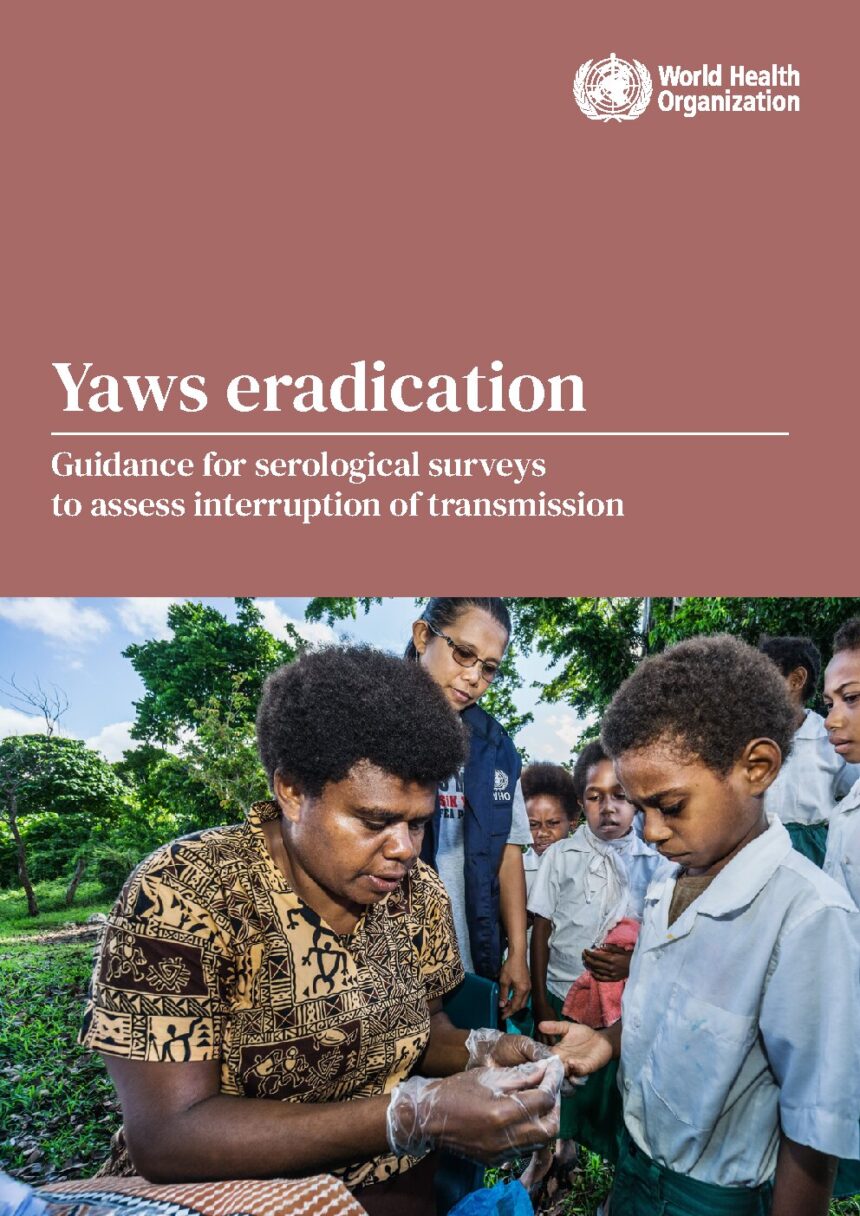
Survey design and decision-making guidance for national programmes assessing whether yaws transmission has been interrupted using serosurveys in children aged 1–5 years.
- Issuer
- World Health Organization
- Edition
- 1st edition, 2025
- Audience
- National yaws programme managers, epidemiologists, public health professionals, NTD technical advisory groups, field survey teams
- Evidence
- Expert consensus developed by Informal WHO Working Group on Yaws Survey Protocol Development, based on statistical and geostatistical principles, accepted best practice, and data/experience up to July 2024
- Reviewed
- 15 Oct 2026 · GMJ
What this guideline says
GMJ summary
This WHO guidance provides national programmes with detailed methodology for conducting serological surveys (serosurveys) to confirm interruption of yaws transmission. The document establishes that at least three serosurveys should be conducted among children aged 1–5 years, beginning at least 2 years after the last reported autochthonous yaws case, with at least one year between successive surveys. Each survey must estimate a seroprevalence below 1% to contribute evidence toward interruption of transmission.
The guidance covers all aspects of survey design: defining evaluation units (EUs) based on epidemiology and feasibility; determining sample sizes (ranging from 726 to 4740 children depending on EU population); selecting primary sampling units (PSUs) using probability-based methods; and choosing appropriate serological tests (sequential treponemal followed by non-treponemal testing). It emphasizes that surveys can be designed as standalone exercises or integrated with existing public health surveys for other NTDs, though integration requires careful consideration of sampling strategy and target population access.
The document stresses that no single survey can conclusively demonstrate interruption of transmission. Multiple lines of evidence are required, including robust passive and active surveillance systems documenting zero cases for at least 2 consecutive years, plus repeated serosurveys over 3–10 years showing sustained seroprevalence below threshold. Any positive test triggers specific follow-up protocols including confirmation testing, intensified local sampling, and active case searches with PCR confirmation where possible.
Key points
For clinicians — doses and thresholds as stated in the guideline
- Conduct at least three serosurveys in children aged 1–5 years, starting ≥ 2 years after the provisional transmission interruption date, with ≥ 1 year between successive surveys
- Each serosurvey must estimate seroprevalence < 1% (treponemal test positivity) to contribute evidence of interruption of transmission
- Define evaluation units (EUs) with population ≤ 500 000; smaller EUs (20 000–50 000) recommended in historically endemic areas to increase sampling density
- Sample sizes range from 726 children (for EUs with 1000–1999 children aged 1–5 years, all PSUs included) to 4740 (for EUs > 60 000 children, cluster-sampled design with design effect of 3)
- Use sequential testing: treponemal rapid diagnostic test first, followed by non-treponemal testing (DPP or RPR) only if treponemal test is positive
- High-titre non-treponemal reaction (RPR ≥ 1:8 or equivalent DPP NT value) indicates true current infection requiring treatment and intensified local surveillance
- Low-titre reaction (RPR ≤ 1:4) in children born after provisional transmission interruption date suggests recent infection; in those born before, may indicate serofast status from previous treatment
- Minimum 30 PSUs recommended for cluster-sampled surveys; use systematic sampling from geographically ordered lists with probability proportional to population size where possible
Number of children to be tested (sample size) in a yaws-specific serosurvey
Table extracted from the guideline
| Expected population size (number of 1–5-year-olds resident in EU) | All PSUs included: Required sample size (n) | Sampling of PSUs: Required sample size (n) |
|---|---|---|
| < 1000 | Census | NA |
| 1000–1999 | 726 | NA |
| 2000–4999 | 1034 | NA |
| 5000–7999 | 1370 | 4110 |
| 8000–13 999 | 1400 | 4200 |
| 14 000–29 999 | 1550 | 4650 |
| 30 000–59 999 | 1558 | 4674 |
| > 60 000 | 1580 | 4740 |
Source: World Health Organization, Yaws eradication: guidance for serological surveys to assess interruption of transmission. Reproduced in summary form.
From the guideline
Verbatim
“To assess the local interruption of yaws transmission, at least three serosurveys should be conducted serially among children aged 1–5 years, beginning at least 2 years after the last reported cases of autochthonous yaws.”
Editor’s perspective
Why this matters for Georgia and the region
Prof. Giorgi Pkhakadze, MD, MPH, PhD
Editor-in-Chief, Georgian Medical Journal · Chair, Public Health Institute of Georgia · WHO consultant, health and migration
As someone who has advised WHO on health systems strengthening in the European Region, I recognize that while yaws is not endemic in Georgia or the broader Caucasus, this guidance exemplifies rigorous epidemiological survey methodology that Georgian public health professionals should understand. The principles outlined here—defining evaluation units based on disease epidemiology, calculating sample sizes that account for spatial clustering, integrating surveillance across disease programmes, and establishing evidence-based thresholds for elimination—are directly applicable to Georgia's work on other communicable disease elimination targets, including our efforts toward hepatitis C elimination and maintaining measles-free status. I would particularly draw colleagues' attention to the model-based geostatistical approaches described in sections 3.6 and 8, which allow more precise prevalence estimates by incorporating spatial correlation and can inform our own surveillance strategies. One critical implementation lesson for any elimination programme is the document's emphasis that no single survey can confirm interruption of transmission; multiple lines of evidence over years are required, demanding sustained political commitment and funding even after zero cases are reported—a challenge we know well from our own vertical disease programmes transitioning to integrated approaches under universal health coverage.
ORCID 0000-0001-7609-4515 · Perspective written for the GMJ Guidelines Library, 15 Oct 2026
Applicability
Georgia and the South Caucasus
Georgia has no reported yaws endemicity and is not considered a yaws-affected country; this guidance is therefore not directly applicable to Georgian clinical practice. However, the document offers valuable methodological insights for Georgian public health professionals working on NTD surveillance more broadly, particularly those involved in elimination programmes for other communicable diseases or advising WHO and partner countries in endemic regions (sub-Saharan Africa, Pacific Islands, Southeast Asia). Georgian technical experts participating in international NTD elimination efforts, or designing serosurveys for other neglected infections, would benefit from the rigorous survey design principles, model-based geostatistical approaches, and integration strategies with existing health platforms outlined in this guidance. The framework for defining evaluation units, determining sample sizes accounting for clustering, and establishing thresholds for interruption of transmission could inform Georgian surveillance activities for vaccine-preventable diseases or other infections targeted for elimination in the Caucasus region.
Questions this guideline answers
Quick answers
Why focus serosurveys on children aged 1–5 years rather than the broader 2–15 year age group that is the main reservoir?
Children aged 2–15 years are the principal reservoir of yaws infection, but focusing on 1–5-year-olds allows assessment of recent transmission intensity. Because treponemal tests remain positive for life after infection even following successful treatment, testing younger children born after the provisional transmission interruption date provides a clearer signal of whether new transmission is occurring. Children born after transmission has ceased should not have been exposed to yaws and should test negative.
What is the rationale for the < 1% seroprevalence threshold?
The < 1% threshold is an arbitrary value based on expert opinion, as there are few empirical data to inform a minimum seroprevalence below which yaws transmission cannot be sustained. This threshold accounts for potential false-positive treponemal test results. The guidance acknowledges scientific uncertainty and notes the threshold may change as more evidence is generated from programmes implementing these surveys.
Can yaws serosurveys be integrated with surveys for other diseases like trachoma or lymphatic filariasis?
Yes, integration is encouraged to optimize resources. Suitable platforms include trachoma impact/surveillance surveys (TIS/TSS), household-based lymphatic filariasis transmission assessment surveys (TAS), and various other NTD surveys. However, integration requires that the parent survey: (1) provides access to 1–5-year-olds (not just school-age children); (2) includes ≥ 10 PSUs per EU (ideally ≥ 30); (3) uses household-based sampling; and (4) employs probability-based PSU selection (random, systematic, or stratified). School-based surveys are unsuitable because they typically do not include the 1–5-year target age group.
What follow-up is required when a child tests positive on both treponemal and non-treponemal tests during a serosurvey?
The response depends on titre level. High-titre reactions (RPR ≥ 1:8 or equivalent DPP NT) indicate true current infection and require: (1) clinical care and treatment of the individual; (2) exclusion of congenital syphilis; (3) intensified and sequential serological sampling in nearby households; (4) active case searches in the surrounding community; and (5) PCR testing from skin lesion swabs for any suspected active cases found. Low-titre reactions in children born after the provisional transmission interruption date also suggest recent infection and trigger similar follow-up. Low-titre in children born before may indicate serofast status from previous treatment; this requires detailed history and treatment if previously untreated.
Related on GMJ
Interconnected resources
Dictionary of Public Health
Drugs A–Z
GMJ News coverage
Quality & accreditation
- ASF PHC — Standard 4 — Acute & Same-Day Care · Primary Health Clinic
- ASF PHC — Standard 7 — Governance & Staffing · Primary Health Clinic
- ASF Hospital — Standard 5 — Safety & Emergency Preparedness
- ASF Hospital — Standard 11 — Critical Care
- ASF Medical Transport — Standard 6 — Emergency Response During Transport
Other guidelines on this topic
- Routine health information system and health facility data for neglected tropical diseases: Rabies
- Key criteria for the ethical acceptability of controlled human infection studies during public health emergencies
- Global guidance on monitoring public health and social measures policies during health emergencies
- Leishmaniasis: 20 years of progress towards elimination in the WHO African Region
- National Health Simulation Exercise Programme: implementation guidance to strengthen emergency preparedness, readiness and response
- Issuer
- World Health Organization
- Type
- Guidance (normative)
- Edition
- 1st edition, 2025
- Status
- Current
- Published
- 2025-09-08
- Languages
- English
- Scope
- Global, focused on yaws-endemic countries in sub-Saharan Africa, Pacific Islands, and Southeast Asia
- Audience
- National yaws programme managers, epidemiologists, public health professionals, NTD technical advisory groups, field survey teams
- Pages
- 40
- Licence
- CC BY-NC-SA 3.0 IGO
- Evidence
- Expert consensus developed by Informal WHO Working Group on Yaws Survey Protocol Development, based on statistical and geostatistical principles, accepted best practice, and data/experience up to July 2024
- Record history
- Created 15 Oct 2026 · updated 15 Oct 2026 · next check Apr 2027
World Health Organization. Yaws eradication: guidance for serological surveys to assess interruption of transmission. Geneva: World Health Organization; 2025. Licence: CC BY-NC-SA 3.0 IGO.GMJ Guidelines Library records are original summaries written by the GMJ editorial team from the issuer’s published document and reviewed by a physician. They do not replace the full guideline. The document is the copyright of its issuer and is linked, not hosted. Spotted an error or a newer edition? Tell the Guidelines Desk.
Was this article helpful?