By using this site, you agree to the Privacy Policy and Terms of Use.
Accept
GMJ NewsGMJ NewsGMJ News
  • Latest News
    • GMJ Briefs
  • Podcast & Media
    • Podcast Episodes
    • GMJ Audio
    • GMJ Videos
  • Research Digest
    • New Studies
    • Georgian Research
    • Data & Numbers
  • Policy & Systems
    • Health Policy
    • Quality & Safety
    • Migration & Health
    • Global Health
  • Practice
    • Clinical Updates
    • Case Discussions
    • Pharmacy & Prescribing
    • Ingredients A-Z
  • Perspectives
    • Editorial
    • Explainers
    • Voices
    • Letters
  • GMJ Articles
    • Vol. 1 Issue 2 (2026)
    • Vol. 1 Issue 1 (2026)
    • Pre-Launch Articles (2025)
  • Read the Journal →
  • About GMJ News
Notification Show More
Font ResizerAa
GMJ NewsGMJ News
Font ResizerAa
  • Latest News
    • GMJ Briefs
  • Podcast & Media
    • Podcast Episodes
    • GMJ Audio
    • GMJ Videos
  • Research Digest
    • New Studies
    • Georgian Research
    • Data & Numbers
  • Policy & Systems
    • Health Policy
    • Quality & Safety
    • Migration & Health
    • Global Health
  • Practice
    • Clinical Updates
    • Case Discussions
    • Pharmacy & Prescribing
    • Ingredients A-Z
  • Perspectives
    • Editorial
    • Explainers
    • Voices
    • Letters
  • GMJ Articles
    • Vol. 1 Issue 2 (2026)
    • Vol. 1 Issue 1 (2026)
    • Pre-Launch Articles (2025)
  • Read the Journal →
  • About GMJ News
Follow US
GMJ News > GMJ Briefs > 50 Million Americans at Risk: AI Offers New Hope for Undiagnosed Osteoporosis

50 Million Americans at Risk: AI Offers New Hope for Undiagnosed Osteoporosis

GMJ
Last updated: 14/06/2026 16:00
By
Prof. Giorgi Pkhakadze
Share
1 Min Read
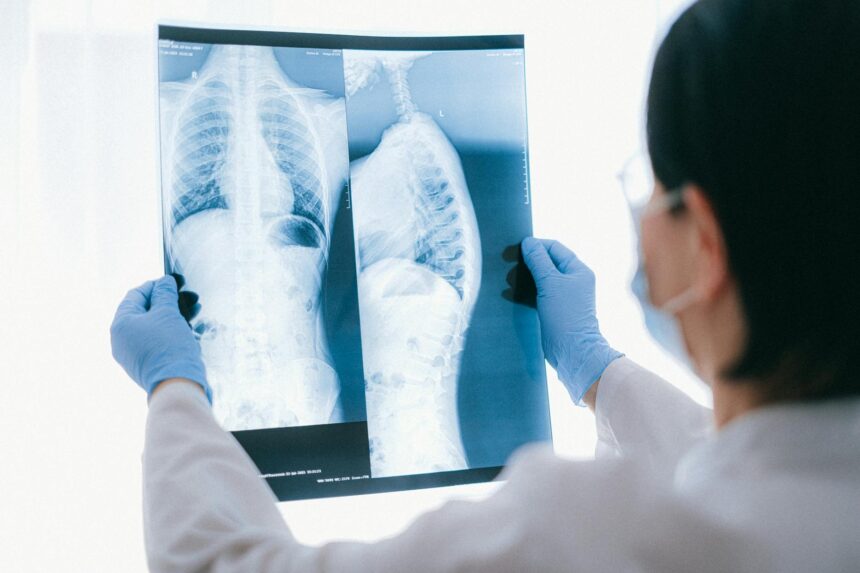
Medical professional reviewing chest X-ray with AI analysis highlighting bone density patterns
New AI technology can detect early bone loss from routine chest X-rays, potentially identifying millions of at-risk patients who fall outside current osteoporosis screening guidelines. The approach could transform preventive care for younger adults, men, and other underserved populations. — Photo: Anna Shvets / Pexels
SHARE
1 min read|132 words

The scope of osteoporosis in the United States is staggering: approximately 10.2 million Americans have active osteoporosis, while another 43.4 million live with low bone density that significantly increases fracture risk. Yet many remain unaware of their condition until a fracture occurs, often with devastating consequences.

A newly developed artificial intelligence system represents a potential breakthrough for these millions of at-risk individuals. By analyzing routine chest X-rays—imaging many patients already receive for other medical reasons—the technology can identify early bone loss before fractures develop.

This opportunistic screening approach is particularly valuable because it reaches populations traditionally excluded from standard guidelines: men under 70, younger women, and normal-weight individuals. Implementing this AI-driven detection could dramatically reduce the number of preventable osteoporosis-related fractures and transform population health outcomes.

Read the full article on GMJ Newsroom.

Submit Your Paper
GMJ_Submit_Banner

Was this article helpful?

GMJ Brief · Key Finding

📰 Read the full article: AI Tool Detects Silent Bone Loss from Routine Chest X-rays Before Fractures Strike →

Related reference
  • Osteoporosis · Condition
Share This Article
Facebook LinkedIn Bluesky Copy Link Print
GMJ
ByProf. Giorgi Pkhakadze
Follow:
Prof. Giorgi Pkhakadze, MD, MPH, PhD, is Editor-in-Chief of the Georgian Medical Journal and Chair of the Public Health Institute of Georgia (PHIG). He is Professor and Head of the Department of Social and Behavioural Sciences at David Tvildiani Medical University, and Secretary/Treasurer of the UEMS Section of Public Health. ORCID: 0000-0001-7609-4515.

Submit Your Paper →

Georgia's peer-reviewed open-access medical journal. No APC until January 2027.
Submit Manuscript →
Medical Experts Push to Rename PCOS as ‘Metabolic Reproductive Syndrome’

Healthcare professionals advocate renaming PCOS to "metabolic reproductive syndrome" to better reflect…

USC researchers identify enzyme target for reducing Alzheimer’s brain inflammation

USC researchers have identified a new approach to combat Alzheimer's by targeting…

Ceramide Metabolism May Explain Racial Disparities in Prostate Cancer Drug Response

New research reveals that differences in ceramide lipid metabolism between Black and…

Submit Your Paper to GMJ

No APC until January 2027.
Submit Manuscript →

You Might Also Like

Scientific illustration of protein wave patterns sweeping across fertilized egg surface

Three Critical Functions Drive Early Development Through Cellular Wave Patterns

By
Prof. Giorgi Pkhakadze
24/05/2026
Global HealthPolicy & Systems

WHO Declares Emergency as Ebola Outbreak Crosses DRC-Uganda Border

By
Prof. Giorgi Pkhakadze
31/05/2026
Medical chart showing STI prevalence rates among HIV-positive patients in China

China’s Largest HIV Study Uncovers Critical Care Gaps: 40% Face Recurrent STI Infections

By
Prof. Giorgi Pkhakadze
31/05/2026

SITUATION BRIEF: Ebola Cross-Border Transmission – DRC to Uganda (PHEIC Declared)

By
Prof. Giorgi Pkhakadze
31/05/2026
Facebook Twitter Youtube Instagram
Company
  • Privacy Policy
  • Contact US
  • GMJ Journal
  • Submit Manuscript
  • Editorial Team
  • Register at GMJ
  • Terms of Use

Subscribe to GMJ News — Click here

Join Community
© 2026 Georgian Medical Journal (GMJ). Published by the Public Health Institute of Georgia (PHIG). All rights reserved.
Welcome Back!

Sign in to your account

Username or Email Address
Password

Lost your password?

Not a member? Sign Up