By using this site, you agree to the Privacy Policy and Terms of Use.
Accept
GMJ NewsGMJ NewsGMJ News
  • Latest News
    • GMJ Briefs
  • Podcast & Media
    • Podcast Episodes
    • GMJ Audio
    • GMJ Videos
  • Research Digest
    • New Studies
    • Georgian Research
    • Data & Numbers
  • Policy & Systems
    • Health Policy
    • Quality & Safety
    • Migration & Health
    • Global Health
  • Practice
    • Clinical Updates
    • Case Discussions
    • Pharmacy & Prescribing
    • Ingredients A-Z
  • Perspectives
    • Editorial
    • Explainers
    • Voices
    • Letters
  • Health Topics
    • Diabetes
    • Cancer
    • Cardiovascular
    • Mental Health
    • Vaccines
    • Supplements
    • Migration & Health
    • Patient Safety & Accreditation
    • Occupational Safety and Health
  • GMJ Articles
    • Vol. 1 Issue 2 (2026)
    • Vol. 1 Issue 1 (2026)
    • Pre-Launch Articles (2025)
  • Read the Journal β†’
  • About GMJ News
Notification Show More
Font ResizerAa
GMJ NewsGMJ News
Font ResizerAa
  • Latest News
    • GMJ Briefs
  • Podcast & Media
    • Podcast Episodes
    • GMJ Audio
    • GMJ Videos
  • Research Digest
    • New Studies
    • Georgian Research
    • Data & Numbers
  • Policy & Systems
    • Health Policy
    • Quality & Safety
    • Migration & Health
    • Global Health
  • Practice
    • Clinical Updates
    • Case Discussions
    • Pharmacy & Prescribing
    • Ingredients A-Z
  • Perspectives
    • Editorial
    • Explainers
    • Voices
    • Letters
  • Health Topics
    • Diabetes
    • Cancer
    • Cardiovascular
    • Mental Health
    • Vaccines
    • Supplements
    • Migration & Health
    • Patient Safety & Accreditation
    • Occupational Safety and Health
  • GMJ Articles
    • Vol. 1 Issue 2 (2026)
    • Vol. 1 Issue 1 (2026)
    • Pre-Launch Articles (2025)
  • Read the Journal β†’
  • About GMJ News
Follow US
GMJ News > GMJ Briefs > Announcement: Heart’s First Beat Emerges From Collective Synchronisation, Not a Single ‘Starter Switch’

Announcement: Heart’s First Beat Emerges From Collective Synchronisation, Not a Single ‘Starter Switch’

GMJ
Last updated: 09/08/2026 05:30
By
Prof. Giorgi Pkhakadze
Share
1 Min Read
Diagram showing transition from individual electrically active heart cells to tissue-level synchronisation producing the first coordinated heartbeat
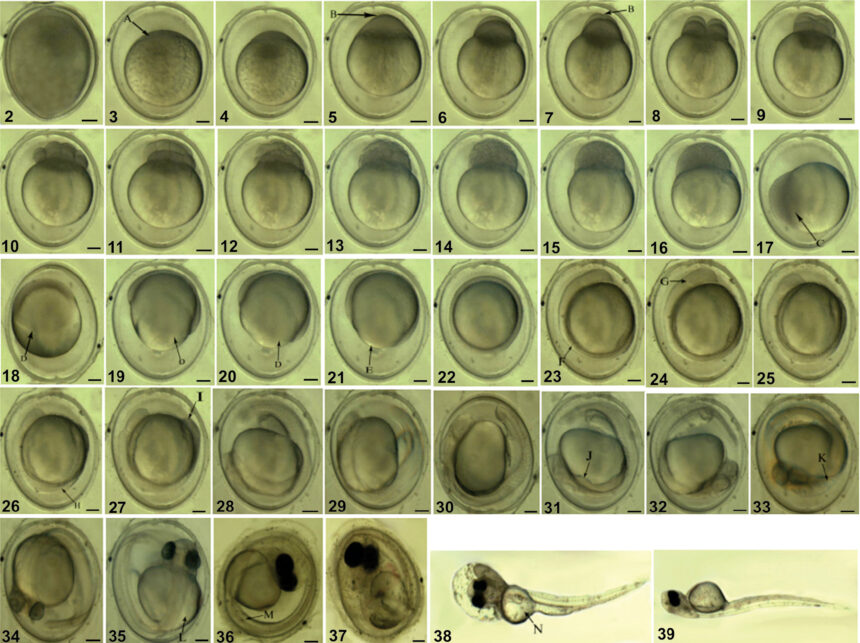
Scientists have identified that the heart's first beat emerges from collective electrical synchronisation of many cells crossing a critical threshold simultaneously, not from activation of a pre-existing pacemaker. The discovery, published in Nature (2023), reveals the initial heartbeat as a system-level phase transitionβ€”a fundamental example of emergence in biological tissue. β€” "Pseudorasbora parva (10.3897-zoologia.35.e22162) Figures 2–39" by Zhu D, Yang K, Sun N, Wang W, Zhou X (2018) Embryonic and larval development of the topmouth gudgeon, Pseudorasbora parva (Teleostei: Cyprinidae). Zoologia 35: 1-8. https://doi.org/10.3897/zoologia.35.e22162 is licensed under CC BY 4.0. To view a copy of this license, visit https://creativecommons.org/licenses/by/4.0/. (CC BY 4.0)
SHARE
1 min read|69 words

πŸ«€ NEW: Scientists have captured the exact moment a developing heart transitions from complete silence to its first beatβ€”and it's nothing like the textbooks say. Instead of a single pacemaker "switch," many heart cells slowly become electrically active until they synchronise together at a critical threshold. A stunning example of emergence in living tissue. Read the latest from Nature 2023.

Read the full article on GMJ Newsroom β†’

Was this article helpful?

GMJ Brief Β· Announcement

πŸ“° Read the full article: Heart’s First Beat Emerges From Collective Synchronisation, Not a Single β€˜Starter Switch’ β†’

Share This Article
Facebook LinkedIn Bluesky Copy Link Print
GMJ
ByProf. Giorgi Pkhakadze
Follow:
Prof. Giorgi Pkhakadze, MD, MPH, PhD, is Editor-in-Chief of the Georgian Medical Journal and Chair of the Public Health Institute of Georgia (PHIG). He is Professor and Head of the Department of Social and Behavioural Sciences at David Tvildiani Medical University, and Secretary/Treasurer of the UEMS Section of Public Health. ORCID: 0000-0001-7609-4515.

Submit Your Paper β†’

Georgia's peer-reviewed open-access medical journal. No APC until January 2027.
Submit Manuscript β†’
Heat stress affects women more severely than men, research suggests

Women experience greater physiological strain during heat exposure than men, driven by…

Federal Judge Blocks Subpoenas Targeting Transgender Patient Records at New York Hospitals

A federal judge temporarily blocked prosecutors from accessing transgender patient medical records…

U.S. Healthcare Spending Surged 7.3% in 2025, Driven by GLP-1 Adoption and Increased Care Utilization

U.S. healthcare spending surged 7.3% to approximately $6 trillion in 2025, driven…

Submit Your Paper to GMJ

No APC until January 2027.
Submit Manuscript β†’

You Might Also Like

Medical illustration showing geographic map with lung transplant access indicators across US regions

What Transplant Candidates Should Know About Geographic Access Disparities

By
Prof. Giorgi Pkhakadze
01/07/2026
Medical nasal spray device representing breakthrough pediatric anaphylaxis treatment option

What Clinicians Need to Know About the New Pediatric Needle-Free Adrenaline Option

By
Prof. Giorgi Pkhakadze
04/08/2026
Brain energy consumption chart showing metabolic demands across different age groups

Three Essential Insights Into Brain Nutrition and Cognitive Protection

By
Prof. Giorgi Pkhakadze
27/06/2026
Community health worker conducting voluntary blood donation in rural Sierra Leone

Local Leadership Transforms Blood Supply: Sierra Leone’s Community-Driven Model Succeeds Where Conventional Approaches Fall Short

By
Prof. Giorgi Pkhakadze
17/07/2026
Facebook Twitter Youtube Instagram
Company
  • Privacy Policy
  • Contact US
  • GMJ Journal
  • Submit Manuscript
  • Editorial Team
  • Register at GMJ
  • Terms of Use

Subscribe to GMJ News β€” Click here

Join Community
Β© 2026 Georgian Medical Journal (GMJ). Published by the Public Health Institute of Georgia (PHIG). All rights reserved.
Welcome Back!

Sign in to your account

Username or Email Address
Password

Lost your password?

Not a member? Sign Up