By using this site, you agree to the Privacy Policy and Terms of Use.
Accept
GMJ NewsGMJ NewsGMJ News
  • Latest News
    • GMJ Briefs
  • Podcast & Media
    • Podcast Episodes
    • GMJ Audio
    • GMJ Videos
  • Research Digest
    • New Studies
    • Georgian Research
    • Data & Numbers
  • Policy & Systems
    • Health Policy
    • Quality & Safety
    • Migration & Health
    • Global Health
  • Practice
    • Clinical Updates
    • Case Discussions
    • Pharmacy & Prescribing
    • Ingredients A-Z
  • Perspectives
    • Editorial
    • Explainers
    • Voices
    • Letters
  • GMJ Articles
    • Vol. 1 Issue 2 (2026)
    • Vol. 1 Issue 1 (2026)
    • Pre-Launch Articles (2025)
  • Read the Journal →
  • About GMJ News
Notification Show More
Font ResizerAa
GMJ NewsGMJ News
Font ResizerAa
  • Latest News
    • GMJ Briefs
  • Podcast & Media
    • Podcast Episodes
    • GMJ Audio
    • GMJ Videos
  • Research Digest
    • New Studies
    • Georgian Research
    • Data & Numbers
  • Policy & Systems
    • Health Policy
    • Quality & Safety
    • Migration & Health
    • Global Health
  • Practice
    • Clinical Updates
    • Case Discussions
    • Pharmacy & Prescribing
    • Ingredients A-Z
  • Perspectives
    • Editorial
    • Explainers
    • Voices
    • Letters
  • GMJ Articles
    • Vol. 1 Issue 2 (2026)
    • Vol. 1 Issue 1 (2026)
    • Pre-Launch Articles (2025)
  • Read the Journal →
  • About GMJ News
Follow US
GMJ News > GMJ Briefs > Black Tea Emerges as Strongest Iron Absorption Inhibitor in Beverage Study

Black Tea Emerges as Strongest Iron Absorption Inhibitor in Beverage Study

GMJ
Last updated: 10/06/2026 11:40
By
Prof. Giorgi Pkhakadze
Share
1 Min Read
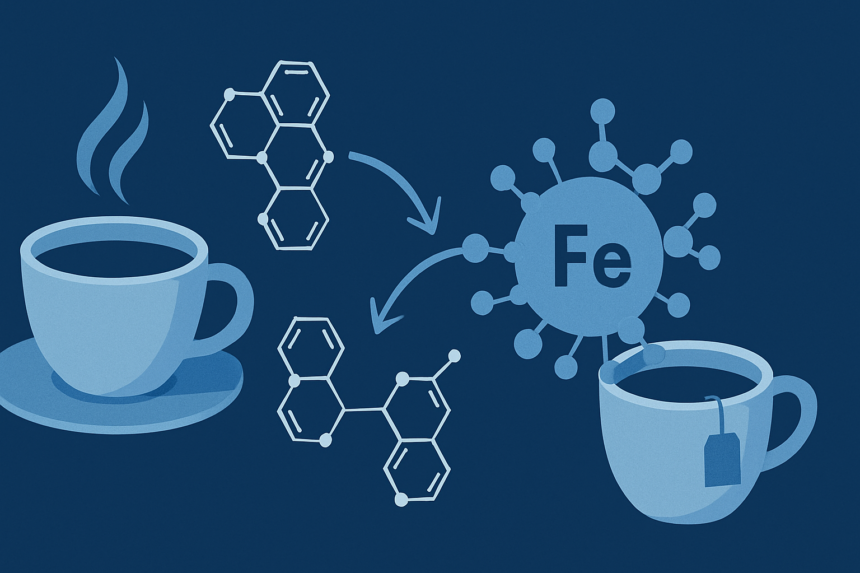
Scientific illustration showing polyphenol molecules binding to iron in digestive system
New research reveals how coffee and tea reduce iron absorption by up to 94% through polyphenol binding. Study identifies vitamin C as effective counteraction strategy.
SHARE
1 min read|115 words

A comprehensive analysis of beverage-iron interactions reveals striking differences in absorption reduction across common drinks. Black tea demonstrated the most potent inhibitory effect, reducing iron absorption by 79-94% when consumed with meals, followed by peppermint tea at 84% and cocoa at 71%. Chamomile tea showed the mildest effect at 47% reduction.

This variation correlates directly with polyphenol concentration, with beverages containing 100-400 mg of polyphenols producing absorption reductions of 60-90%. The mechanism involves polyphenol compounds binding non-heme iron in the digestive tract, rendering it unavailable for absorption. Research published in the British Journal of Nutrition used radio-labeled iron tracers to measure these interactions in controlled human studies, establishing a clear dose-dependent relationship between polyphenol content and iron inhibition.

Was this article helpful?

GMJ Brief · Key Finding

📰 Read the full article: How Coffee and Tea Reduce Iron Absorption by Up to 94% Through Polyphenol Binding →

Related reference
  • Iron · Ingredient
Share This Article
Facebook LinkedIn Bluesky Copy Link Print
GMJ
ByProf. Giorgi Pkhakadze
Follow:
Prof. Giorgi Pkhakadze, MD, MPH, PhD, is Editor-in-Chief of the Georgian Medical Journal and Chair of the Public Health Institute of Georgia (PHIG). He is Professor and Head of the Department of Social and Behavioural Sciences at David Tvildiani Medical University, and Secretary/Treasurer of the UEMS Section of Public Health. ORCID: 0000-0001-7609-4515.

Submit Your Paper →

Georgia's peer-reviewed open-access medical journal. No APC until January 2027.
Submit Manuscript →
NHS Satisfaction Rises to 26% After Historic Low Despite Persistent Public Concerns

NHS satisfaction rose 6% to 26% in 2024 after historic lows, but…

Triple Hormone Obesity Drug Shows Promise in Early Safety Data at ADA 2026

Early safety data for triple hormone receptor obesity drugs presented at ADA…

Medical Dosing Based on Race Lacks Scientific Evidence and May Harm Patients, NEJM Analysis Warns

New NEJM analysis challenges race-based medication dosing, arguing it lacks scientific foundation…

Submit Your Paper to GMJ

No APC until January 2027.
Submit Manuscript →

You Might Also Like

SITUATION BRIEF: Ebola Outbreak – DRC/Uganda Cross-Border Transmission with WHO PHEIC Declaration

By
Prof. Giorgi Pkhakadze
31/05/2026

SITUATION BRIEF: Ebola Cross-Border Transmission DRC-Uganda with WHO PHEIC Declaration

By
Prof. Giorgi Pkhakadze
31/05/2026
Illustration of research ethics framework for vulnerable patients

Three Essential Safeguards for Critically Ill Patient Research Outlined in New GMJ Framework

By
Prof. Giorgi Pkhakadze
07/06/2026
Data visualization showing fiber intake mortality benefits across population studies

3.5 Million-Person Study Establishes Fiber as Powerful Mortality Intervention

By
Prof. Giorgi Pkhakadze
03/06/2026
Facebook Twitter Youtube Instagram
Company
  • Privacy Policy
  • Contact US
  • GMJ Journal
  • Submit Manuscript
  • Editorial Team
  • Register at GMJ
  • Terms of Use

Subscribe to GMJ News — Click here

Join Community
© 2026 Georgian Medical Journal (GMJ). Published by the Public Health Institute of Georgia (PHIG). All rights reserved.
Welcome Back!

Sign in to your account

Username or Email Address
Password

Lost your password?

Not a member? Sign Up