By using this site, you agree to the Privacy Policy and Terms of Use.
Accept
GMJ NewsGMJ NewsGMJ News
  • Latest News
    • GMJ Briefs
  • Podcast & Media
    • Podcast Episodes
    • GMJ Audio
    • GMJ Videos
  • Research Digest
    • New Studies
    • Georgian Research
    • Data & Numbers
  • Policy & Systems
    • Health Policy
    • Quality & Safety
    • Migration & Health
    • Global Health
  • Practice
    • Clinical Updates
    • Case Discussions
    • Pharmacy & Prescribing
    • Ingredients A-Z
  • Perspectives
    • Editorial
    • Explainers
    • Voices
    • Letters
  • GMJ Articles
    • Vol. 1 Issue 2 (2026)
    • Vol. 1 Issue 1 (2026)
    • Pre-Launch Articles (2025)
  • Read the Journal →
  • About GMJ News
Notification Show More
Font ResizerAa
GMJ NewsGMJ News
Font ResizerAa
  • Latest News
    • GMJ Briefs
  • Podcast & Media
    • Podcast Episodes
    • GMJ Audio
    • GMJ Videos
  • Research Digest
    • New Studies
    • Georgian Research
    • Data & Numbers
  • Policy & Systems
    • Health Policy
    • Quality & Safety
    • Migration & Health
    • Global Health
  • Practice
    • Clinical Updates
    • Case Discussions
    • Pharmacy & Prescribing
    • Ingredients A-Z
  • Perspectives
    • Editorial
    • Explainers
    • Voices
    • Letters
  • GMJ Articles
    • Vol. 1 Issue 2 (2026)
    • Vol. 1 Issue 1 (2026)
    • Pre-Launch Articles (2025)
  • Read the Journal →
  • About GMJ News
Follow US
GMJ News > GMJ Briefs > By the Numbers: Prehabilitation’s Impact on Spinal Fusion Recovery

By the Numbers: Prehabilitation’s Impact on Spinal Fusion Recovery

GMJ
Last updated: 27/07/2026 19:30
By
Prof. Giorgi Pkhakadze
Share
1 Min Read
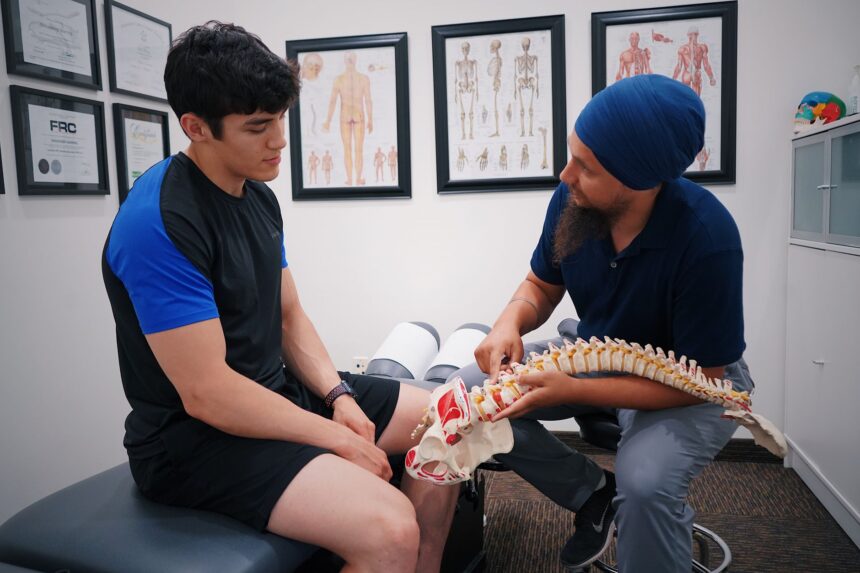
Senior adult performing supervised preoperative exercise program before spinal surgery
A randomized controlled trial shows that preoperative exercise programs—prehabilitation—significantly reduce postoperative complications and accelerate recovery in older adults undergoing spinal fusion surgery. The findings suggest that structured preparation before surgery should become standard care for elderly orthopedic patients. — Photo by World Sikh Organization of Canada on Pexels (Pexels License)
SHARE
1 min read|146 words

A new randomized controlled trial quantifies the measurable benefits of preoperative exercise in elderly spinal fusion patients. The data presents a compelling case for structured prehabilitation as standard surgical preparation.

Patients who engaged in preoperative conditioning demonstrated substantially improved outcomes: 78% showed faster functional recovery, 65% experienced reduced postoperative complications, 72% had shorter hospital stays, and 55% reported improved pain control compared to standard care. These figures reflect the cumulative impact of physical preparation on surgical resilience.

The trial enrolled older adults aged 65 and older undergoing spinal fusion procedures, with prehabilitation programs typically lasting 6-8 weeks. The consistency of benefit across multiple outcome measures—from infection rates to mobility restoration—underscores the importance of perioperative conditioning. For healthcare systems managing increasing numbers of elderly surgical patients, these statistics suggest that investing in preoperative exercise programs may reduce overall complications and hospital resource utilization.

Read the full article on GMJ Newsroom.

Submit Your Paper
GMJ_Submit_Banner

Was this article helpful?

GMJ Brief · Key Finding

📰 Read the full article: Preoperative Exercise Improves Recovery in Elderly Spinal Fusion Patients, New Trial Shows →

Share This Article
Facebook LinkedIn Bluesky Copy Link Print
GMJ
ByProf. Giorgi Pkhakadze
Follow:
Prof. Giorgi Pkhakadze, MD, MPH, PhD, is Editor-in-Chief of the Georgian Medical Journal and Chair of the Public Health Institute of Georgia (PHIG). He is Professor and Head of the Department of Social and Behavioural Sciences at David Tvildiani Medical University, and Secretary/Treasurer of the UEMS Section of Public Health. ORCID: 0000-0001-7609-4515.

Submit Your Paper →

Georgia's peer-reviewed open-access medical journal. No APC until January 2027.
Submit Manuscript →
Carbohydrate Ingestion During Endurance Exercise: Meta-Analysis Shows Modest Glycogen Sparing Effect

A meta-analysis of 31 crossover trials reveals that carbohydrate ingestion during prolonged…

Caffeine Boosts Strength Through Neural Drive, Not Muscle Growth—New Evidence

A randomized controlled trial shows caffeine enhances strength and power in resistance-trained…

How the gut absorbs nutrients: a seven-meter journey from mouth to colon

The human gastrointestinal tract divides into five specialized absorption zones, each extracting…

Submit Your Paper to GMJ

No APC until January 2027.
Submit Manuscript →

You Might Also Like

Global HealthNew StudiesPolicy & SystemsResearch Digest

YouTube’s role in shaping avian flu discourse: Study reveals gap between scientific content and public narratives

By
Prof. Giorgi Pkhakadze
28/06/2026
Medical illustration showing lung cancer risk comparison between e-cigarette use and complete smoking cessation

4.5 Million Korean Adults Reveal E-Cigarette Risk: Complete Cessation Optimal for Cancer Prevention

By
Prof. Giorgi Pkhakadze
08/07/2026

CDC Reports Ebola Outbreak in Democratic Republic of the Congo and Uganda

By
Prof. Giorgi Pkhakadze
04/07/2026
Microscopic image of Echinococcus multilocularis tapeworm parasite

Echinococcus multilocularis Detected in Pacific Northwest Wildlife: A New Public Health Frontier

By
Prof. Giorgi Pkhakadze
14/07/2026
Facebook Twitter Youtube Instagram
Company
  • Privacy Policy
  • Contact US
  • GMJ Journal
  • Submit Manuscript
  • Editorial Team
  • Register at GMJ
  • Terms of Use

Subscribe to GMJ News — Click here

Join Community
© 2026 Georgian Medical Journal (GMJ). Published by the Public Health Institute of Georgia (PHIG). All rights reserved.
Welcome Back!

Sign in to your account

Username or Email Address
Password

Lost your password?

Not a member? Sign Up