By using this site, you agree to the Privacy Policy and Terms of Use.
Accept
GMJ NewsGMJ NewsGMJ News
  • Latest News
    • GMJ Briefs
  • Podcast & Media
    • Podcast Episodes
    • GMJ Audio
    • GMJ Videos
  • Research Digest
    • New Studies
    • Georgian Research
    • Data & Numbers
  • Policy & Systems
    • Health Policy
    • Quality & Safety
    • Migration & Health
    • Global Health
  • Practice
    • Clinical Updates
    • Case Discussions
    • Pharmacy & Prescribing
    • Ingredients A-Z
  • Perspectives
    • Editorial
    • Explainers
    • Voices
    • Letters
  • GMJ Articles
    • Vol. 1 Issue 2 (2026)
    • Vol. 1 Issue 1 (2026)
    • Pre-Launch Articles (2025)
  • Read the Journal →
  • About GMJ News
Notification Show More
Font ResizerAa
GMJ NewsGMJ News
Font ResizerAa
  • Latest News
    • GMJ Briefs
  • Podcast & Media
    • Podcast Episodes
    • GMJ Audio
    • GMJ Videos
  • Research Digest
    • New Studies
    • Georgian Research
    • Data & Numbers
  • Policy & Systems
    • Health Policy
    • Quality & Safety
    • Migration & Health
    • Global Health
  • Practice
    • Clinical Updates
    • Case Discussions
    • Pharmacy & Prescribing
    • Ingredients A-Z
  • Perspectives
    • Editorial
    • Explainers
    • Voices
    • Letters
  • GMJ Articles
    • Vol. 1 Issue 2 (2026)
    • Vol. 1 Issue 1 (2026)
    • Pre-Launch Articles (2025)
  • Read the Journal →
  • About GMJ News
Follow US
GMJ News > GMJ Briefs > By the Numbers: South Sudan’s Food Crisis Reaches Historic Proportions

By the Numbers: South Sudan’s Food Crisis Reaches Historic Proportions

GMJ
Last updated: 06/07/2026 03:07
By
Prof. Giorgi Pkhakadze
Share
1 Min Read
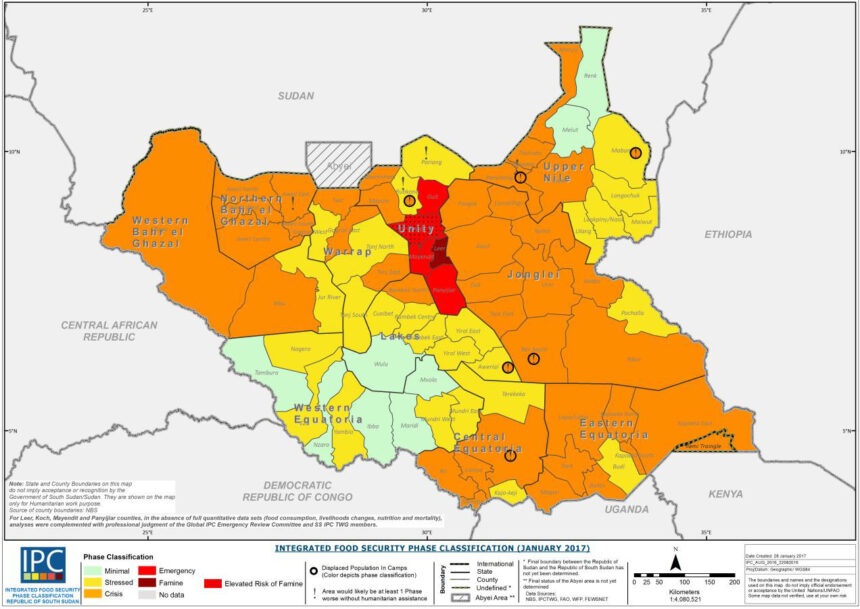
Humanitarian crisis in South Sudan showing statistics on food insecurity and child malnutrition
South Sudan faces severe humanitarian crisis with 7.8 million people experiencing acute food insecurity and 2.2 million children suffering malnutrition. UNICEF data reveals crisis affects nearly two-thirds of population. — SouthSudan.jpg by United Nations Integrated Food Security Phase Classification / Public domain via Wikimedia Commons (Public domain)
SHARE
1 min read|124 words

New data from UNICEF quantifies the severity of South Sudan’s ongoing humanitarian emergency with stark precision. Approximately 7.8 million people currently face acute food insecurity—a figure representing 63 percent of the country’s total population. This makes South Sudan one of the world’s most severe food crises according to current international assessments.

The scale of malnutrition among children compounds the emergency. With 2.2 million children suffering from acute malnutrition, the crisis has surpassed established emergency thresholds recognized by international humanitarian protocols. The World Health Organization’s Grade 3 classification underscores the urgency, indicating conditions that demand immediate global response. These statistics reflect not temporary food shortages but structural collapse across food security systems, requiring sustained international humanitarian intervention to prevent further deterioration.

Read the full article on GMJ Newsroom.

Was this article helpful?

GMJ Brief · Key Finding

📰 Read the full article: South Sudan Food Crisis: 7.8 Million Face Acute Hunger as Child Malnutrition Reaches Critical Levels →

Share This Article
Facebook LinkedIn Bluesky Copy Link Print
GMJ
ByProf. Giorgi Pkhakadze
Follow:
Prof. Giorgi Pkhakadze, MD, MPH, PhD, is Editor-in-Chief of the Georgian Medical Journal and Chair of the Public Health Institute of Georgia (PHIG). He is Professor and Head of the Department of Social and Behavioural Sciences at David Tvildiani Medical University, and Secretary/Treasurer of the UEMS Section of Public Health. ORCID: 0000-0001-7609-4515.

Submit Your Paper →

Georgia's peer-reviewed open-access medical journal. No APC until January 2027.
Submit Manuscript →
Teen Drug Use and Binge Drinking Linked to Severe Mental Health Crisis

UCLA research reveals dangerous links between teen substance use and mental health…

PFAS ‘Forever Chemicals’ Persist in Ski Wax Rooms Despite Regulatory Bans

New research reveals PFAS 'forever chemicals' persist in ski wax facilities years…

Community Walking Groups Show Mental Health Benefits for Bereaved Adults

A community walking group in Darwen demonstrates how peer-supported physical activity provides…

Submit Your Paper to GMJ

No APC until January 2027.
Submit Manuscript →

You Might Also Like

PET brain scan showing alpha-synuclein detection in Parkinson's disease patient

What Clinicians Need to Know About Alpha-Synuclein PET Imaging

By
Prof. Giorgi Pkhakadze
28/06/2026
Infographic showing declining birth rates in England and Wales from 1977 to 2023

2023 Birth Figures Expose Demographic Crisis Below Population Replacement Level

By
Prof. Giorgi Pkhakadze
11/06/2026
Wearable device on wrist displaying health monitoring data for personalized depression treatment

Three Critical Insights on Machine Learning’s Role in Personalizing Depression Care

By
Prof. Giorgi Pkhakadze
27/06/2026
Laboratory testing omega-3 supplement capsules for oxidation levels

85% of Omega-3 Supplements Fail Lab Tests, Yet Show Minimal Human Health Impact

By
Prof. Giorgi Pkhakadze
24/05/2026
Facebook Twitter Youtube Instagram
Company
  • Privacy Policy
  • Contact US
  • GMJ Journal
  • Submit Manuscript
  • Editorial Team
  • Register at GMJ
  • Terms of Use

Subscribe to GMJ News — Click here

Join Community
© 2026 Georgian Medical Journal (GMJ). Published by the Public Health Institute of Georgia (PHIG). All rights reserved.
Welcome Back!

Sign in to your account

Username or Email Address
Password

Lost your password?

Not a member? Sign Up