By using this site, you agree to the Privacy Policy and Terms of Use.
Accept
GMJ NewsGMJ NewsGMJ News
  • Latest News
    • GMJ Briefs
  • Podcast & Media
    • Podcast Episodes
    • GMJ Audio
    • GMJ Videos
  • Research Digest
    • New Studies
    • Georgian Research
    • Data & Numbers
  • Policy & Systems
    • Health Policy
    • Quality & Safety
    • Migration & Health
    • Global Health
  • Practice
    • Clinical Updates
    • Case Discussions
    • Pharmacy & Prescribing
    • Ingredients A-Z
  • Perspectives
    • Editorial
    • Explainers
    • Voices
    • Letters
  • GMJ Articles
    • Vol. 1 Issue 2 (2026)
    • Vol. 1 Issue 1 (2026)
    • Pre-Launch Articles (2025)
  • Read the Journal →
  • About GMJ News
Notification Show More
Font ResizerAa
GMJ NewsGMJ News
Font ResizerAa
  • Latest News
    • GMJ Briefs
  • Podcast & Media
    • Podcast Episodes
    • GMJ Audio
    • GMJ Videos
  • Research Digest
    • New Studies
    • Georgian Research
    • Data & Numbers
  • Policy & Systems
    • Health Policy
    • Quality & Safety
    • Migration & Health
    • Global Health
  • Practice
    • Clinical Updates
    • Case Discussions
    • Pharmacy & Prescribing
    • Ingredients A-Z
  • Perspectives
    • Editorial
    • Explainers
    • Voices
    • Letters
  • GMJ Articles
    • Vol. 1 Issue 2 (2026)
    • Vol. 1 Issue 1 (2026)
    • Pre-Launch Articles (2025)
  • Read the Journal →
  • About GMJ News
Follow US
GMJ News > Policy & Systems > Global Health > South Sudan Food Crisis: 7.8 Million Face Acute Hunger as Child Malnutrition Reaches Critical Levels
Global HealthPolicy & Systems

South Sudan Food Crisis: 7.8 Million Face Acute Hunger as Child Malnutrition Reaches Critical Levels

GMJ
Last updated: 20/06/2026 11:06
By
GMJ Policy Desk
Share
6 Min Read
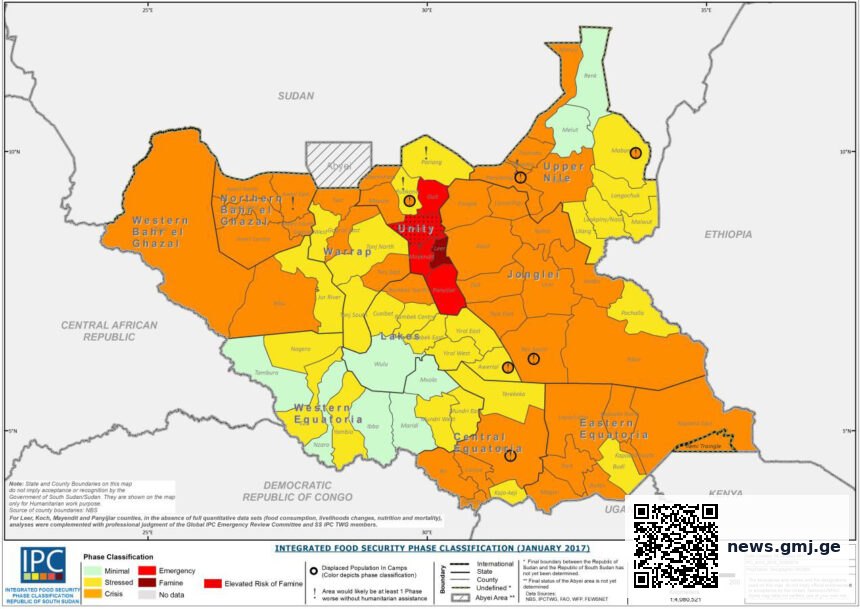
Humanitarian crisis in South Sudan showing statistics on food insecurity and child malnutritionIllustrative image · SouthSudan.jpg by United Nations Integrated Food Security Phase Classification / Public domain via Wikimedia Commons (Public domain)
South Sudan faces severe humanitarian crisis with 7.8 million people experiencing acute food insecurity and 2.2 million children suffering malnutrition. UNICEF data reveals crisis affects nearly two-thirds of population. — SouthSudan.jpg by United Nations Integrated Food Security Phase Classification / Public domain via Wikimedia Commons (Public domain)
SHARE
4 min read|701 words

South Sudan’s humanitarian crisis has reached alarming proportions, with 7.8 million people—nearly two-thirds of the population—facing high levels of acute food insecurity, according to the latest UNICEF assessment. The situation has deteriorated significantly, with 2.2 million children now suffering from acute malnutrition in what represents one of the world’s most severe humanitarian emergencies.

Contents
      • South Sudan Hunger Crisis by the Numbers
  • Crisis Reaches Two-Thirds of Population
  • Child Malnutrition Reaches Critical Threshold
  • Humanitarian Response Challenges
  • Climate and Conflict Compound Crisis
    • Key takeaways
  • Frequently asked questions
    • What defines acute food insecurity?
    • How is child malnutrition measured?
    • What factors drive South Sudan’s food crisis?
7.8 million
people facing acute food insecurity in South Sudan

South Sudan Hunger Crisis by the Numbers

Population facing acute food insecurity and malnutrition, 2024

7.8m
people facing acute
food insecurity
2.2m
children with acute
malnutrition
12.4m
total population
affected

Source: UNICEF, 2024 | Georgian Medical Journal News

Crisis Reaches Two-Thirds of Population

The World Health Organization has classified South Sudan’s situation as a Grade 3 emergency, the highest level in the UN system. The 7.8 million people facing acute food insecurity represent approximately 63% of the country’s total population, making this one of the most severe food crises globally.

Submit Your Paper
GMJ_Submit_Banner

UNICEF’s data reveals that the situation has worsened compared to previous assessments, with conflict, climate shocks, and economic instability driving the escalation. The organization emphasizes that immediate intervention is required to prevent further deterioration into famine conditions.

🎙️ Related Podcast Episodes
🎧 #11 | WHO Urges Schools Worldwide to Promote Healthy Eating for Children · 20m
🎧 #51 | GMJ Podcast | Global Health, Migration, and Health Systems Resilience · 14m
🎧 #54 | GMJ Podcast | The Blueprint of a Medical Journal: Designing an Open-Access Scientific Platform · 19m
🎧 #53 | GMJ Podcast | Palliative Care in Georgia — Health System Gaps, Access Barriers, and Policy Implications · 16m
🎧 #44 | GMJ Podcast | Infant Formula Contamination — Global Food Safety Failure and the Cereulide Outbreak · 21m

Related coverage of global food security challenges can be found in our global health section, which tracks humanitarian crises affecting public health outcomes worldwide.

Child Malnutrition Reaches Critical Threshold

The 2.2 million children suffering from acute malnutrition represents a public health emergency within the broader crisis. According to UNICEF’s nutrition standards, this figure indicates that child malnutrition has surpassed emergency thresholds established by international humanitarian protocols.

Acute malnutrition in children under five years of age is measured using standardized anthropometric indicators. When prevalence exceeds 15% of the child population, it triggers emergency response protocols under WHO guidelines.

The Georgian Medical Journal has previously published research on malnutrition’s long-term developmental impacts, highlighting how early childhood nutritional deficits can affect cognitive development and immune system function throughout life.

Humanitarian Response Challenges

Access constraints continue to hamper relief efforts, with security concerns limiting humanitarian organizations’ ability to reach affected populations. The UN Office for the Coordination of Humanitarian Affairs reports that several regions remain inaccessible due to ongoing conflict.

Funding gaps also threaten response capacity, with humanitarian appeals consistently underfunded. The complex emergency requires coordinated intervention across multiple sectors, including health, nutrition, water sanitation, and food security.

Our migration and health coverage examines similar challenges in other displacement contexts, where populations face barriers to essential health services.

Climate and Conflict Compound Crisis

South Sudan’s food security crisis reflects the intersection of multiple risk factors, including recurring droughts, flooding, and protracted conflict since 2013. These compound emergencies create particularly challenging conditions for sustaining agricultural production and maintaining basic health services.

The Food and Agriculture Organization has documented how climate variability disrupts seasonal farming patterns, reducing local food production capacity. This environmental vulnerability intersects with conflict-related displacement, creating complex humanitarian needs.

7.8 million people in South Sudan face high levels of acute food insecurity, with 2.2 million children suffering from acute malnutrition, representing one of the world’s most severe humanitarian crises.

— UNICEF South Sudan Crisis Assessment (2024)

Key takeaways

  • 7.8 million people (63% of population) face acute food insecurity in South Sudan
  • 2.2 million children suffer from acute malnutrition, exceeding emergency thresholds
  • Complex emergency combines conflict, climate shocks, and economic instability
  • Access constraints and funding gaps limit humanitarian response capacity

Frequently asked questions

What defines acute food insecurity?

Acute food insecurity occurs when people cannot meet minimum food needs for survival and livelihood protection. It requires immediate humanitarian intervention to prevent malnutrition and death.

How is child malnutrition measured?

Acute malnutrition in children is measured using weight-for-height ratios and mid-upper arm circumference. Severe acute malnutrition affects children who fall below critical anthropometric thresholds.

What factors drive South Sudan’s food crisis?

The crisis results from protracted conflict since 2013, climate variability including droughts and floods, economic collapse, and limited agricultural production capacity. These factors create compound humanitarian emergencies.

The scale of South Sudan’s humanitarian crisis demands sustained international attention and coordinated response efforts. As 7.8 million people face acute food insecurity and 2.2 million children suffer malnutrition, the situation represents a critical test of global humanitarian systems’ capacity to respond to complex emergencies that combine conflict, climate, and economic shocks.

Source: Hunger intensifies in South Sudan as 7.8 million people face high acute food insecurity and 2.2 million children suffer acute malnutrition

Was this article helpful?

Disclaimer. This article is health journalism intended for general information and education. It is not medical advice and is not a substitute for professional diagnosis or treatment. Always consult a qualified healthcare provider about your individual circumstances. Full disclaimer →

Related Coverage

UNICEF calls for child-focused migration policies as 50 million children migrate globallyJun 22, 2026
UNICEF Demands Protection for Mali's Children After Deadly School and Hospital AttacksJun 21, 2026
Child Poverty Rises in Wealthy Nations Despite Economic Growth, UNICEF Analysis ShowsJun 21, 2026
Gaza Children Face Educational Crisis as 625,000 Students Lose Access to SchoolingJun 21, 2026
Related reference
  • Iron · Ingredient
PG
Written by
Prof. Giorgi Pkhakadze, MD, MPH, PhD
Editor-in-Chief, GMJ News
Full profile →  ·  ORCID 0000-0001-7609-4515
Medical disclaimer. This article is health journalism intended for general information. It is not medical advice and is not a substitute for consultation with a qualified healthcare professional. Always seek your physician's advice regarding any medical condition.
Medically reviewed by Prof. Giorgi Pkhakadze, MD, MPH, PhD. Spotted an error? Contact the editorial team.

Get the GMJ News digest
Evidence-based health journalism in your inbox. No spam; unsubscribe anytime.
TAGGED:food insecurityhumanitarian crisismalnutritionSouth SudanUNICEF
Share This Article
Facebook LinkedIn Bluesky Copy Link Print
GMJ
ByGMJ Policy Desk
Follow:
GMJ Policy Desk is part of GMJ News, the newsroom of the Georgian Medical Journal (gmj.ge), published by the Public Health Institute of Georgia. Every article is editorially reviewed before publication.
Leave a Comment Leave a Comment

Leave a Reply Cancel reply

Your email address will not be published. Required fields are marked *

Submit Your Paper →

Georgia's peer-reviewed open-access medical journal. No APC until January 2027.
Submit Manuscript →
NF1 pain may start before tumors develop, driven by abnormal Schwann cell signaling

New research suggests NF1 chronic pain begins before tumors develop, driven by…

UNICEF calls for child-focused migration policies as 50 million children migrate globally

UNICEF calls for child-focused migration policies as 50 million children migrate globally,…

UNICEF Demands Protection for Mali’s Children After Deadly School and Hospital Attacks

UNICEF demands protection for 2.3 million children in Mali following deadly attacks…

Submit Your Paper to GMJ

No APC until January 2027.
Submit Manuscript →

You Might Also Like

Chart showing declining STI trends among different population groups in England
Global HealthPolicy & Systems

Syphilis Among Gay and Bisexual Men Falls to Decade Low in England

By
GMJ Policy Desk
02/06/2026
Children receiving nutrition assistance at a Yemen healthcare facility
Global HealthPolicy & Systems

Yemen Food Crisis: 11.2 Million Face Acute Hunger as International Aid Funding Cuts Continue

By
GMJ Policy Desk
11/06/2026
UK medicines regulatory authority building with EU and UK flags representing post-Brexit pharmaceutical trade
Health PolicyPolicy & Systems

UK approves 342 parallel drug import licences in 2026 amid post-Brexit medicine access challenges

By
GMJ Policy Desk
08/06/2026
Chart showing US dietary guidelines recommendations evolution from 2010-2030Illustrative image · EatRealFood2025.webp by Unknown authorUnknown author / Public domain via Wikimedia Commons (Public domain)
Health PolicyPolicy & Systems

US Dietary Guidelines 2025-2030: Mixed Progress on Nutrition as Implementation Challenges Persist

By
GMJ Policy Desk
18/06/2026
Facebook Twitter Youtube Instagram
Company
  • Privacy Policy
  • Contact US
  • GMJ Journal
  • Submit Manuscript
  • Editorial Team
  • Register at GMJ
  • Terms of Use

Subscribe to GMJ News — Click here

Join Community
© 2026 Georgian Medical Journal (GMJ). Published by the Public Health Institute of Georgia (PHIG). All rights reserved.
Welcome Back!

Sign in to your account

Username or Email Address
Password

Lost your password?

Not a member? Sign Up