By using this site, you agree to the Privacy Policy and Terms of Use.
Accept
GMJ NewsGMJ NewsGMJ News
  • Latest News
    • GMJ Briefs
  • Podcast & Media
    • Podcast Episodes
    • GMJ Audio
    • GMJ Videos
  • Research Digest
    • New Studies
    • Georgian Research
    • Data & Numbers
  • Policy & Systems
    • Health Policy
    • Quality & Safety
    • Migration & Health
    • Global Health
  • Practice
    • Clinical Updates
    • Case Discussions
    • Pharmacy & Prescribing
    • Ingredients A-Z
  • Perspectives
    • Editorial
    • Explainers
    • Voices
    • Letters
  • GMJ Articles
    • Vol. 1 Issue 2 (2026)
    • Vol. 1 Issue 1 (2026)
    • Pre-Launch Articles (2025)
  • Read the Journal →
  • About GMJ News
Notification Show More
Font ResizerAa
GMJ NewsGMJ News
Font ResizerAa
  • Latest News
    • GMJ Briefs
  • Podcast & Media
    • Podcast Episodes
    • GMJ Audio
    • GMJ Videos
  • Research Digest
    • New Studies
    • Georgian Research
    • Data & Numbers
  • Policy & Systems
    • Health Policy
    • Quality & Safety
    • Migration & Health
    • Global Health
  • Practice
    • Clinical Updates
    • Case Discussions
    • Pharmacy & Prescribing
    • Ingredients A-Z
  • Perspectives
    • Editorial
    • Explainers
    • Voices
    • Letters
  • GMJ Articles
    • Vol. 1 Issue 2 (2026)
    • Vol. 1 Issue 1 (2026)
    • Pre-Launch Articles (2025)
  • Read the Journal →
  • About GMJ News
Follow US
GMJ News > GMJ Briefs > COVID-19 Revealed a Hidden Crisis: The Vulnerability of Healthcare Workers Worldwide

COVID-19 Revealed a Hidden Crisis: The Vulnerability of Healthcare Workers Worldwide

GMJ
Last updated: 18/06/2026 20:19
By
Prof. Giorgi Pkhakadze
Share
1 Min Read
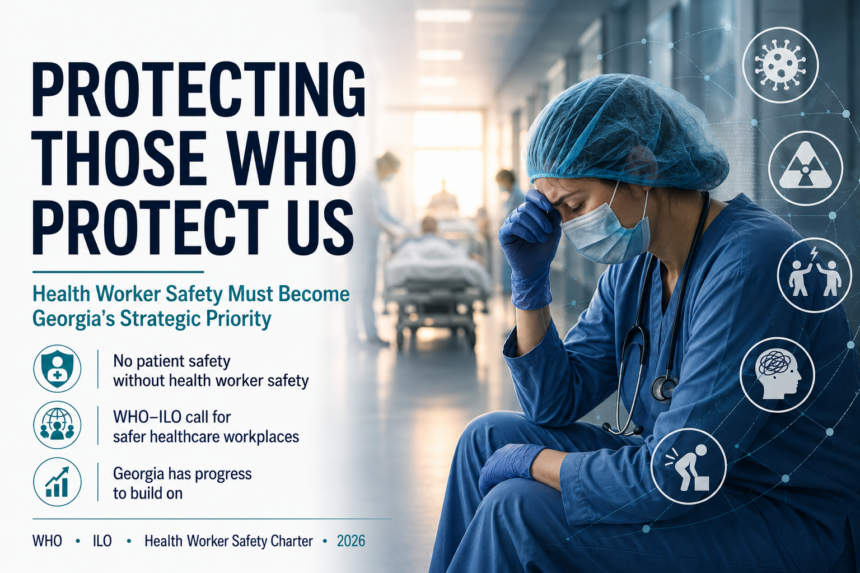
Healthcare worker experiencing occupational stress in a hospital setting, illustrating the importance of occupational safety and health, burnout prevention, infection control, workplace violence prevention, and health worker wellbeing in Georgia.
There is no patient safety without health worker safety. Editorial illustration accompanying the GMJ News article on occupational safety and health for healthcare workers in Georgia.
SHARE
1 min read|143 words

New data from the World Health Organization underscores the magnitude of health worker vulnerability globally. During the first 18 months of the COVID-19 pandemic, an estimated 115,500 health and care workers lost their lives to the disease—a stark reminder that those who protect patient safety face extraordinary occupational hazards.

The pandemic also exposed fundamental gaps in basic infection prevention infrastructure. More than one in three health facilities worldwide lacked hand-hygiene stations at the point of care, while fewer than one in six countries had any national policy addressing safe and healthy working environments in the health sector.

These figures transcend pandemic response—they reflect how systematically the world has underinvested in health worker safety. For Georgia, this data serves as a critical benchmark for evaluating current protections and identifying urgent gaps in occupational health policy and infrastructure. Read the full article on GMJ Newsroom.

Was this article helpful?

Related reference
  • Iron · Ingredient
Share This Article
Facebook LinkedIn Bluesky Copy Link Print
GMJ
ByProf. Giorgi Pkhakadze
Follow:
Prof. Giorgi Pkhakadze, MD, MPH, PhD, is Editor-in-Chief of the Georgian Medical Journal and Chair of the Public Health Institute of Georgia (PHIG). He is Professor and Head of the Department of Social and Behavioural Sciences at David Tvildiani Medical University, and Secretary/Treasurer of the UEMS Section of Public Health. ORCID: 0000-0001-7609-4515.

Submit Your Paper →

Georgia's peer-reviewed open-access medical journal. No APC until January 2027.
Submit Manuscript →
High Tyrosine Levels Linked to Reduced Life Expectancy in Men, Large Study Suggests

A large-scale epidemiological study has found that men with higher circulating levels…

Calcium and Vitamin D Supplements Show Limited Benefit for Fracture Prevention in Older Adults, Major Review Finds

A comprehensive systematic review of nearly 154,000 older adults challenges decades of…

Nasal spray reaches women’s brains differently across menstrual cycle, new study reveals

Research shows that nasal sprays penetrate women's brains at different rates depending…

Submit Your Paper to GMJ

No APC until January 2027.
Submit Manuscript →

You Might Also Like

Scientific chart showing creatine safety data from clinical trials

Three Essential Facts About Creatine and Kidney Health Every Patient Should Understand

By
Prof. Giorgi Pkhakadze
27/06/2026

PHEIC Declaration: Cross-Border Ebola Outbreak DRC-Uganda

By
Prof. Giorgi Pkhakadze
31/05/2026
Wearable ultrasound patch for continuous pregnancy monitoring technology

Soft Wearable Ultrasound Patch Enables Extended Fetal Monitoring Without Mobility Restrictions

By
Prof. Giorgi Pkhakadze
26/06/2026
Portrait of Dr. James Phillip Luby in laboratory setting with medical equipment

The Numbers Behind Hospital Safety: Dr. Luby’s 40% Reduction in Pneumonia Rates

By
Prof. Giorgi Pkhakadze
19/06/2026
Facebook Twitter Youtube Instagram
Company
  • Privacy Policy
  • Contact US
  • GMJ Journal
  • Submit Manuscript
  • Editorial Team
  • Register at GMJ
  • Terms of Use

Subscribe to GMJ News — Click here

Join Community
© 2026 Georgian Medical Journal (GMJ). Published by the Public Health Institute of Georgia (PHIG). All rights reserved.
Welcome Back!

Sign in to your account

Username or Email Address
Password

Lost your password?

Not a member? Sign Up