By using this site, you agree to the Privacy Policy and Terms of Use.
Accept
GMJ NewsGMJ NewsGMJ News
  • Latest News
    • GMJ Briefs
  • Podcast & Media
    • Podcast Episodes
    • GMJ Audio
    • GMJ Videos
  • Research Digest
    • New Studies
    • Georgian Research
    • Data & Numbers
  • Policy & Systems
    • Health Policy
    • Quality & Safety
    • Migration & Health
    • Global Health
  • Practice
    • Clinical Updates
    • Case Discussions
    • Pharmacy & Prescribing
    • Ingredients A-Z
  • Perspectives
    • Editorial
    • Explainers
    • Voices
    • Letters
  • Health Topics
  • GMJ Articles
    • Vol. 1 Issue 2 (2026)
    • Vol. 1 Issue 1 (2026)
    • Pre-Launch Articles (2025)
  • Read the Journal →
  • About GMJ News
Notification Show More
Font ResizerAa
GMJ NewsGMJ News
Font ResizerAa
  • Latest News
    • GMJ Briefs
  • Podcast & Media
    • Podcast Episodes
    • GMJ Audio
    • GMJ Videos
  • Research Digest
    • New Studies
    • Georgian Research
    • Data & Numbers
  • Policy & Systems
    • Health Policy
    • Quality & Safety
    • Migration & Health
    • Global Health
  • Practice
    • Clinical Updates
    • Case Discussions
    • Pharmacy & Prescribing
    • Ingredients A-Z
  • Perspectives
    • Editorial
    • Explainers
    • Voices
    • Letters
  • Health Topics
  • GMJ Articles
    • Vol. 1 Issue 2 (2026)
    • Vol. 1 Issue 1 (2026)
    • Pre-Launch Articles (2025)
  • Read the Journal →
  • About GMJ News
Follow US
GMJ News > GMJ Briefs > Prehabilitation Before Spine Surgery: What Patients and Providers Need to Know

Prehabilitation Before Spine Surgery: What Patients and Providers Need to Know

GMJ
Last updated: 13/08/2026 19:30
By
Prof. Giorgi Pkhakadze
Share
1 Min Read
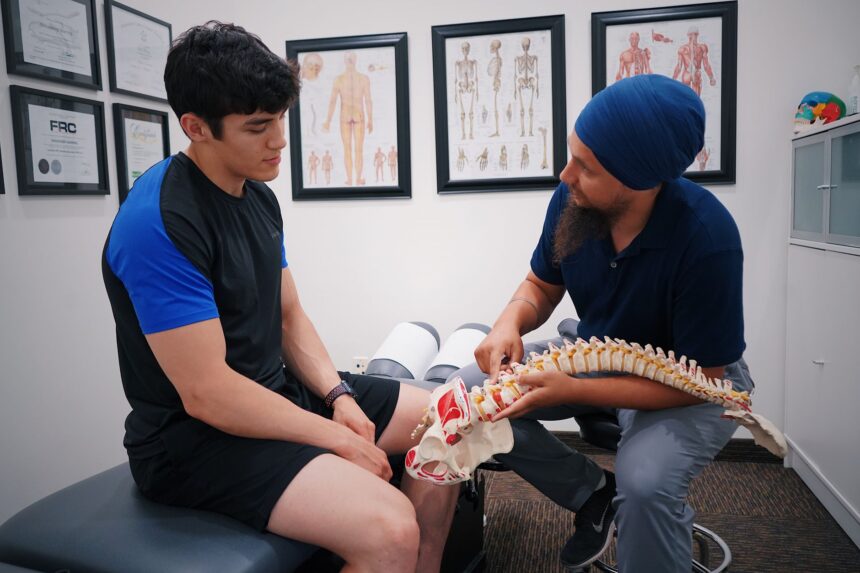
Senior adult performing supervised preoperative exercise program before spinal surgery
A randomized controlled trial shows that preoperative exercise programs—prehabilitation—significantly reduce postoperative complications and accelerate recovery in older adults undergoing spinal fusion surgery. The findings suggest that structured preparation before surgery should become standard care for elderly orthopedic patients. — Photo by World Sikh Organization of Canada on Pexels (Pexels License)
SHARE
1 min read|152 words

A new clinical trial offers three critical insights for optimizing surgical preparation in older adults facing spinal fusion procedures. First, structured preoperative exercise programs meaningfully reduce postoperative complications in patients aged 65 and older—a finding that positions prehabilitation as an essential component of surgical planning rather than an optional enhancement.

Second, patients who complete prehabilitation experience faster functional recovery and shorter hospital stays, translating to improved quality of life and reduced healthcare burden. Third, and perhaps most practically, these programs can be delivered through primary care settings, making evidence-based prehabilitation accessible to most patients scheduled for elective spine surgery.

The implications are significant: surgical preparation need not be expensive or specialized. Primary care physicians can implement structured exercise protocols 6-8 weeks before planned procedures, empowering patients to optimize their physical status. This approach transforms surgical outcomes while remaining practical and feasible within existing healthcare infrastructure.

Read the full article on GMJ Newsroom.

Submit Your Paper
GMJ_Submit_Banner

Was this article helpful?

GMJ Brief · Takeaway

📰 Read the full article: Preoperative Exercise Improves Recovery in Elderly Spinal Fusion Patients, New Trial Shows →

Share This Article
Facebook LinkedIn Bluesky Copy Link Print
GMJ
ByProf. Giorgi Pkhakadze
Follow:
Prof. Giorgi Pkhakadze, MD, MPH, PhD, is Editor-in-Chief of the Georgian Medical Journal and Chair of the Public Health Institute of Georgia (PHIG). He is Professor and Head of the Department of Social and Behavioural Sciences at David Tvildiani Medical University, and Secretary/Treasurer of the UEMS Section of Public Health. ORCID: 0000-0001-7609-4515.

Submit Your Paper →

Georgia's peer-reviewed open-access medical journal. No APC until January 2027.
Submit Manuscript →
What makes prostate cancer aggressive? Biology, genetics, and clinical grading explained

Prostate cancer aggressiveness is determined by histological grade (Gleason score), genetic mutations…

UK childhood vaccination coverage holds steady at high levels, latest quarterly data shows

The UK's Cover of Vaccination Evaluated Rapidly (COVER) programme reports sustained high…

EMA Launches Email Notifications for Clinical Trial Information System

The European Medicines Agency has rolled out email notification subscriptions in CTIS,…

Submit Your Paper to GMJ

No APC until January 2027.
Submit Manuscript →

You Might Also Like

Ophthalmologic image showing diabetic retinopathy neovascularization of optic disk

NEJM Clinical Images Illuminate Diabetic Retinopathy Progression and Treatment Outcomes

By
Prof. Giorgi Pkhakadze
20/06/2026
Chart showing Amish population growth projection from 400,000 to 2 million by 2075

Three Critical Challenges Facing Public Health as Amish Population Doubles Every 25 Years

By
Prof. Giorgi Pkhakadze
13/07/2026
Medical chart showing fracture risk reduction across weight-loss medications; semaglutide demonstrates lowest fracture incidence despite greatest weight loss

Three Critical Insights: Why Semaglutide Changes Bone Health Strategy in Diabetes Care

By
Prof. Giorgi Pkhakadze
09/08/2026
AI-powered drug development laboratory with molecular visualization screens

$12 Billion Investment in AI Drug Development Could Accelerate Medication Discovery by 30 Percent

By
Prof. Giorgi Pkhakadze
18/07/2026
Facebook Twitter Youtube Instagram
Company
  • Privacy Policy
  • Contact US
  • GMJ Journal
  • Submit Manuscript
  • Editorial Team
  • Register at GMJ
  • Terms of Use

Subscribe to GMJ News — Click here

Join Community
© 2026 Georgian Medical Journal (GMJ). Published by the Public Health Institute of Georgia (PHIG). All rights reserved.
Welcome Back!

Sign in to your account

Username or Email Address
Password

Lost your password?

Not a member? Sign Up