By using this site, you agree to the Privacy Policy and Terms of Use.
Accept
GMJ NewsGMJ NewsGMJ News
  • Latest News
    • GMJ Briefs
  • Podcast & Media
    • Podcast Episodes
    • GMJ Audio
    • GMJ Videos
  • Research Digest
    • New Studies
    • Georgian Research
    • Data & Numbers
  • Policy & Systems
    • Health Policy
    • Quality & Safety
    • Migration & Health
    • Global Health
  • Practice
    • Clinical Updates
    • Case Discussions
    • Pharmacy & Prescribing
    • Ingredients A-Z
  • Perspectives
    • Editorial
    • Explainers
    • Voices
    • Letters
  • GMJ Articles
    • Vol. 1 Issue 2 (2026)
    • Vol. 1 Issue 1 (2026)
    • Pre-Launch Articles (2025)
  • Read the Journal →
  • About GMJ News
Notification Show More
Font ResizerAa
GMJ NewsGMJ News
Font ResizerAa
  • Latest News
    • GMJ Briefs
  • Podcast & Media
    • Podcast Episodes
    • GMJ Audio
    • GMJ Videos
  • Research Digest
    • New Studies
    • Georgian Research
    • Data & Numbers
  • Policy & Systems
    • Health Policy
    • Quality & Safety
    • Migration & Health
    • Global Health
  • Practice
    • Clinical Updates
    • Case Discussions
    • Pharmacy & Prescribing
    • Ingredients A-Z
  • Perspectives
    • Editorial
    • Explainers
    • Voices
    • Letters
  • GMJ Articles
    • Vol. 1 Issue 2 (2026)
    • Vol. 1 Issue 1 (2026)
    • Pre-Launch Articles (2025)
  • Read the Journal →
  • About GMJ News
Follow US
GMJ News > GMJ Briefs > Semaglutide’s Unexpected Benefit: Lower Fracture Risk Amid Greater Weight Loss

Semaglutide’s Unexpected Benefit: Lower Fracture Risk Amid Greater Weight Loss

GMJ
Last updated: 16/07/2026 10:35
By
Prof. Giorgi Pkhakadze
Share
1 Min Read
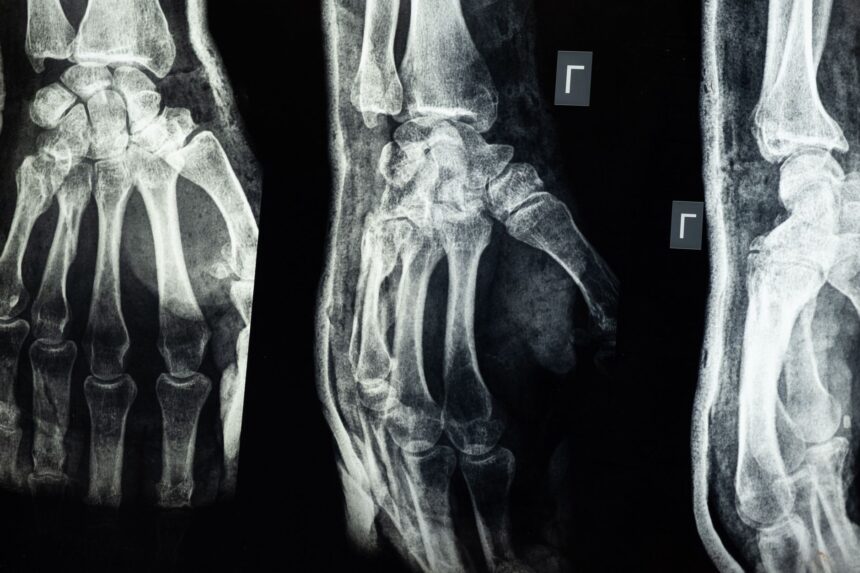
Medical chart showing fracture risk reduction across weight-loss medications; semaglutide demonstrates lowest fracture incidence despite greatest weight loss
A real-world analysis of 60,000 adults with type 2 diabetes shows semaglutide users experienced 15% fewer bone fractures than those on other weight-loss medications, despite losing more weight—suggesting an unexpected skeletal protective benefit. — Photo by cottonbro studio on Pexels (Pexels License)
SHARE
1 min read|120 words

New real-world evidence from nearly 60,000 adults with type 2 diabetes reveals a paradoxical clinical advantage of semaglutide therapy. Patients treated with this GLP-1 receptor agonist experienced 15% fewer bone fractures compared to those on alternative weight-loss medications, despite achieving substantially greater weight reduction.

This finding challenges conventional understanding of rapid weight loss, which typically increases fracture vulnerability through bone density compromise. The protective effect persisted even after statistical adjustment for weight loss magnitude and other confounding variables, suggesting an intrinsic bone-preserving mechanism inherent to GLP-1 signalling.

The analysis, derived from routine clinical practice records, adds an important safety and efficacy dimension to semaglutide’s established cardiovascular and metabolic benefits. These results may particularly benefit patients with concurrent osteoporosis risk or elevated fracture history.

Was this article helpful?

GMJ Brief · Announcement

📰 Read the full article: Semaglutide Linked to Fewer Bone Fractures Despite Greater Weight Loss in Type 2 Diabetes →

Related reference
  • Type 2 Diabetes · Condition
  • Osteoporosis · Condition
  • Semaglutide · Drug
Share This Article
Facebook LinkedIn Bluesky Copy Link Print
GMJ
ByProf. Giorgi Pkhakadze
Follow:
Prof. Giorgi Pkhakadze, MD, MPH, PhD, is Editor-in-Chief of the Georgian Medical Journal and Chair of the Public Health Institute of Georgia (PHIG). He is Professor and Head of the Department of Social and Behavioural Sciences at David Tvildiani Medical University, and Secretary/Treasurer of the UEMS Section of Public Health. ORCID: 0000-0001-7609-4515.

Submit Your Paper →

Georgia's peer-reviewed open-access medical journal. No APC until January 2027.
Submit Manuscript →
How the gut absorbs nutrients: a seven-meter journey from mouth to colon

The human gastrointestinal tract divides into five specialized absorption zones, each extracting…

Post-exercise brain signal may be key to fitness gains, mouse study suggests

Researchers at Jackson Laboratory and University of Pennsylvania identified brain neurons that…

High-Carbohydrate Breakfast Fails to Boost Glycogen in Well-Trained Cyclists

A new study found that a large carbohydrate breakfast did not increase…

Submit Your Paper to GMJ

No APC until January 2027.
Submit Manuscript →

You Might Also Like

Dual immune and targeted therapy mechanism in bladder cancer treatment pathway

Dual-Mechanism Immunotherapy Emerges as Game-Changer in Bladder Cancer Surgery

By
Prof. Giorgi Pkhakadze
19/07/2026
Microscopic view of uniform nanometer-scale membrane pores for water filtration

Nature-Inspired Nanomembrane Technology Poised to Transform Healthcare Water Treatment

By
Prof. Giorgi Pkhakadze
05/07/2026
Medical professional discussing opioid treatment medication policy

What Clinicians and Patients Need to Know About Opioid Treatment Policy Changes

By
Prof. Giorgi Pkhakadze
25/07/2026

Magnitude 6.4 Earthquake Strikes South Sandwich Islands Region

By
Prof. Giorgi Pkhakadze
11/07/2026
Facebook Twitter Youtube Instagram
Company
  • Privacy Policy
  • Contact US
  • GMJ Journal
  • Submit Manuscript
  • Editorial Team
  • Register at GMJ
  • Terms of Use

Subscribe to GMJ News — Click here

Join Community
© 2026 Georgian Medical Journal (GMJ). Published by the Public Health Institute of Georgia (PHIG). All rights reserved.
Welcome Back!

Sign in to your account

Username or Email Address
Password

Lost your password?

Not a member? Sign Up