By using this site, you agree to the Privacy Policy and Terms of Use.
Accept
GMJ NewsGMJ NewsGMJ News
  • Latest News
    • GMJ Briefs
  • Podcast & Media
    • Podcast Episodes
    • GMJ Audio
    • GMJ Videos
  • Research Digest
    • New Studies
    • Georgian Research
    • Data & Numbers
  • Policy & Systems
    • Health Policy
    • Quality & Safety
    • Migration & Health
    • Global Health
  • Practice
    • Clinical Updates
    • Case Discussions
    • Pharmacy & Prescribing
    • Ingredients A-Z
  • Perspectives
    • Editorial
    • Explainers
    • Voices
    • Letters
  • GMJ Articles
    • Vol. 1 Issue 2 (2026)
    • Vol. 1 Issue 1 (2026)
    • Pre-Launch Articles (2025)
  • Read the Journal →
  • About GMJ News
Notification Show More
Font ResizerAa
GMJ NewsGMJ News
Font ResizerAa
  • Latest News
    • GMJ Briefs
  • Podcast & Media
    • Podcast Episodes
    • GMJ Audio
    • GMJ Videos
  • Research Digest
    • New Studies
    • Georgian Research
    • Data & Numbers
  • Policy & Systems
    • Health Policy
    • Quality & Safety
    • Migration & Health
    • Global Health
  • Practice
    • Clinical Updates
    • Case Discussions
    • Pharmacy & Prescribing
    • Ingredients A-Z
  • Perspectives
    • Editorial
    • Explainers
    • Voices
    • Letters
  • GMJ Articles
    • Vol. 1 Issue 2 (2026)
    • Vol. 1 Issue 1 (2026)
    • Pre-Launch Articles (2025)
  • Read the Journal →
  • About GMJ News
Follow US
GMJ News > GMJ Briefs > Three Essential Steps to Protect Georgia’s Health Workforce

Three Essential Steps to Protect Georgia’s Health Workforce

GMJ
Last updated: 04/07/2026 21:05
By
Prof. Giorgi Pkhakadze
Share
1 Min Read
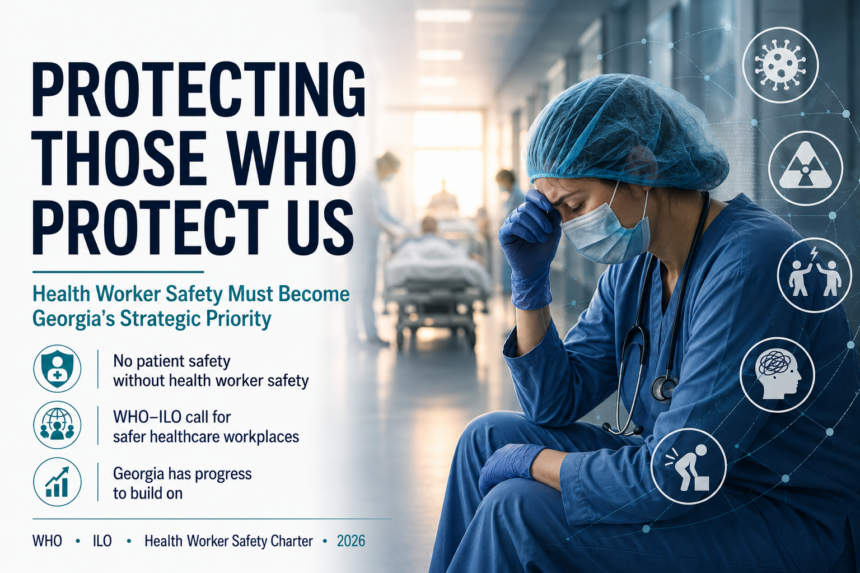
Healthcare worker experiencing occupational stress in a hospital setting, illustrating the importance of occupational safety and health, burnout prevention, infection control, workplace violence prevention, and health worker wellbeing in Georgia.
There is no patient safety without health worker safety. Editorial illustration accompanying the GMJ News article on occupational safety and health for healthcare workers in Georgia.
SHARE
1 min read|134 words

Translating international health worker safety commitments into Georgian action requires three concrete priorities. First, Georgia must establish comprehensive surveillance systems to track occupational health incidents, exposures, and near-misses across all healthcare settings. This data foundation enables evidence-based policy and identifies emerging threats.

Second, dedicated occupational health services must be integrated into every healthcare facility, not treated as optional additions. These services should address infection prevention, violence prevention, mental health support, and injury management. Third, health worker safety must become a measurable component of healthcare accreditation standards, signaling that excellence encompasses workforce protection alongside patient outcomes.

These steps represent not burden, but investment. When health workers feel protected and supported, patient care improves, staff retention increases, and health system resilience strengthens. Georgia has the opportunity to position worker safety as a cornerstone of healthcare quality.

Was this article helpful?

Share This Article
Facebook LinkedIn Bluesky Copy Link Print
GMJ
ByProf. Giorgi Pkhakadze
Follow:
Prof. Giorgi Pkhakadze, MD, MPH, PhD, is Editor-in-Chief of the Georgian Medical Journal and Chair of the Public Health Institute of Georgia (PHIG). He is Professor and Head of the Department of Social and Behavioural Sciences at David Tvildiani Medical University, and Secretary/Treasurer of the UEMS Section of Public Health. ORCID: 0000-0001-7609-4515.

Submit Your Paper →

Georgia's peer-reviewed open-access medical journal. No APC until January 2027.
Submit Manuscript →
Why the ‘2pm coffee cutoff’ is a myth: genetics and lifestyle create a 15-fold range in caffeine metabolism

A new systematic review reveals that caffeine half-life varies 15- to 40-fold…

Resistant Starch and Gut Health: Why Fiber Type Matters More Than You Think

Resistant starch works through a specific bacterial fermentation pathway that other fibers…

The 30-gram protein myth: why recent evidence challenges the fitness industry’s most durable claim

For over a decade, the fitness industry has promoted a rule: your…

Submit Your Paper to GMJ

No APC until January 2027.
Submit Manuscript →

You Might Also Like

Medical researchers analyzing viral genomic sequences in laboratory setting

Complete Genomic Characterization Sets New Standard for Filovirus Case Documentation

By
Prof. Giorgi Pkhakadze
11/07/2026
CAR-T cell attacking autoimmune B cells under microscope

CAR-T Cell Therapy Emerges as Game-Changer for Autoimmune Disease Treatment

By
Prof. Giorgi Pkhakadze
03/06/2026
Brain health and economic charts showing global impact data

$4 Trillion Economic Burden Drives New Brain Health Commission

By
Prof. Giorgi Pkhakadze
10/07/2026
Medical chart showing increased mortality and cancer risks in coeliac disease patients

Non-Hodgkin Lymphoma Risk More Than Doubles in Coeliac Disease Patients

By
Prof. Giorgi Pkhakadze
26/06/2026
Facebook Twitter Youtube Instagram
Company
  • Privacy Policy
  • Contact US
  • GMJ Journal
  • Submit Manuscript
  • Editorial Team
  • Register at GMJ
  • Terms of Use

Subscribe to GMJ News — Click here

Join Community
© 2026 Georgian Medical Journal (GMJ). Published by the Public Health Institute of Georgia (PHIG). All rights reserved.
Welcome Back!

Sign in to your account

Username or Email Address
Password

Lost your password?

Not a member? Sign Up