Pan American Health Organization · 2022 edition
Comprehensive guidance for establishing and implementing ESAVI surveillance systems for clinicians, public-health professionals, and national immunization programmes.
- Issuer
- Pan American Health Organization
- Edition
- 2022 edition
- Audience
- National immunization programme managers, regulatory authorities, epidemiologists, clinicians administering vaccines, public health professionals
- Evidence
- Expert consensus based on WHO Global Vaccine Safety Initiative framework and Brighton Collaboration case definitions
- Reviewed
- 18 Oct 2026 · GMJ
What this guideline says
GMJ summary
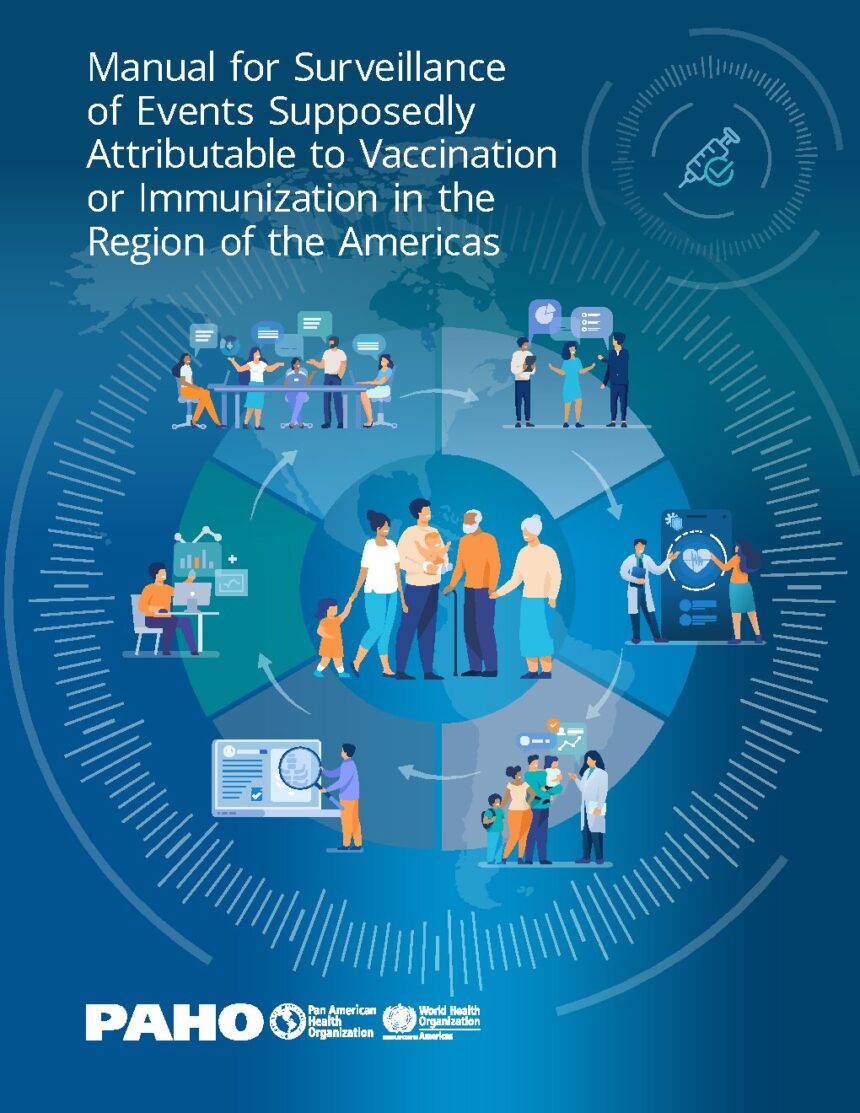
This manual provides standardised procedures for surveillance of events supposedly attributable to vaccination or immunization (ESAVI) across the Americas. It establishes a two-tier model: national passive surveillance for all events, with mandatory reporting of serious ESAVI within 48 hours and non-serious within 7 days; and regional active surveillance networks to detect rare adverse events and monitor vaccine safety across populations. The manual covers the complete surveillance cycle from detection and reporting through investigation, causality assessment using structured algorithms, and risk communication.
The document emphasises that ESAVI surveillance must differentiate between five categories: vaccine product-related events, quality deviation-related events, programmatic errors (handling/administration), stress-related events, and coincidental events. Serious ESAVI require complete investigation including clinical review, vaccine traceability (lot number, storage conditions, cold chain verification), timeline establishment, and assessment by a national committee on safe vaccination. The causality assessment follows a four-step process: eligibility evaluation, verification checklist, algorithm application, and final classification.
The manual stresses that vaccine safety depends on integrated activities across the supply chain: good manufacturing practices, national regulatory authority oversight, cold chain maintenance, safe injection practices, ESAVI surveillance, and proactive risk communication. It includes special provisions for monitoring vaccines in pregnant women, investigating death cases, managing clusters, and communication during crises. The system prioritises the affected person, focuses on identifying system failures rather than assigning blame, and requires coordination between national immunization programmes, regulatory authorities, and epidemiology offices.
Key points
For clinicians — doses and thresholds as stated in the guideline
- Report all serious ESAVI (death, life-threatening, hospitalization, persistent disability, congenital abnormality, or abortion) within 48 hours; non-serious ESAVI within 7 days
- All ESAVI reports must include minimum 25 key variables: patient identifiers, vaccine details (type, manufacturer, lot number, expiration date), administration date/time/site, clinical description, and outcome
- Conduct complete investigation for all serious ESAVI including: verification of cold chain records, vaccine lot traceability, review of reconstitution procedure (for freeze-dried vaccines), interview of vaccinating staff, and environmental inspection
- Classify ESAVI by causality using four-step algorithm: (1) eligibility check, (2) event verification checklist, (3) application of Bradford Hill criteria (temporality, strength, consistency, biological plausibility), (4) final classification as consistent/indeterminate/inconsistent
- Establish national committee on safe vaccination to review serious cases, case clusters, events with new vaccines, potential media crises, and suspected lot withdrawals; committee must include conflict-of-interest declarations
- Quarantine remaining vaccine vials and collect samples for laboratory testing only when: investigation indicates lot association with similar events, no storage deviations found, reconstitution was correct, and manufacturing deviation suspected
- Implement active surveillance for vaccines in pregnant women, monitoring: adverse events by gestational age, fetal/newborn outcomes, congenital abnormalities using GAIA definitions, and outcomes in unintended pregnancies
- Follow special procedures for death investigation: immediate autopsy with specified tissue sampling (brain, liver, spleen, kidney, heart, injection site), viral genome identification, and review by forensic pathology expert on national committee
Characterization of certain ESAVI based on vaccine, severity, risk period, and incidence
Table extracted from the guideline
| Classification by severity | Reaction | Vaccine | Risk period | Incidence rate (%) |
|---|---|---|---|---|
| Non-serious | Fever | Hepatitis B | 1-2 days | 1-6 |
| Non-serious | Fever | DTP | 1-2 days | 50 |
| Non-serious | Fever | MMR | 1-2 days | 10.5 |
| Non-serious | Fever | Influenza | 6-12 hours | 12 |
| Non-serious | Local redness/pain | Pneumococcus (PCV) | Minutes to few hours | 10 |
| Non-serious | Irritability | DTP | 1-2 days | ≤60 |
| Serious | Aseptic meningitis | MMR | 2-3 weeks | 1-10/100,000 vaccinated |
| Serious | Neurotropic disease | Yellow fever 17D-204 | 3-18 days | 4-8/1,000,000 vaccinated |
| Serious | Viscerotropic disease | Yellow fever 17D-204 | 3-60 days | 3.1-3.9/1,000,000 vaccinated |
| Serious | Thrombocytopenia | MMR | 8-9 days | 1/30,000 vaccinated |
| Serious | Anaphylaxis | Hepatitis B | First hour | 1-2/1,000,000 vaccinated |
| Serious | Anaphylaxis | MMR | First hour | 1-2/1,000,000 vaccinated |
| Serious | Febrile seizures | DPT | 3 days | 60/100,000 vaccinated |
| Serious | Vaccine-associated polio | OPV | 4-30 days | 1.4-3.4/1,000,000 vaccinated |
Source: Pan American Health Organization, Manual for Surveillance of Events Supposedly Attributable to Vaccination or Immunization in the Region of the Americas. Reproduced in summary form.
From the guideline
Verbatim
“The general objective of ESAVI surveillance at the national level consists of early detection, and reporting and analysis of events supposedly attributable to vaccination or immunization, so that a rapid and effective response can be organized to minimize the negative impact on individuals' health and on the immunization program, as well as to prevent additional or recurring events.”
Editor’s perspective
Why this matters for Georgia and the region
Prof. Giorgi Pkhakadze, MD, MPH, PhD
Editor-in-Chief, Georgian Medical Journal · Chair, Public Health Institute of Georgia · WHO consultant, health and migration
As Chair of Georgia's Public Health Institute and having supported our national immunization programme's expansion under universal health coverage since 2013, I recognise this manual addresses a critical gap in our pharmacovigilance infrastructure. While Georgia has achieved excellent routine vaccine coverage exceeding 95% for pentavalent vaccine and successfully introduced rotavirus and pneumococcal vaccines, our ESAVI surveillance remains predominantly passive with limited standardisation between the National Centre for Disease Control and the Medicines Agency. The manual's most actionable recommendation for Georgian clinicians is the 48-hour reporting requirement for serious events with the minimum 25 variables—this would require adapting our current communicable disease surveillance forms and training primary care physicians who administer most vaccines. The realistic implementation challenge is establishing the national committee on safe vaccination with genuine independence and multidisciplinary expertise including forensic pathology for death investigations, particularly given our small specialist workforce. Georgia should prioritise implementing the active surveillance platform for pregnant women using our existing maternal-child health information system, as we expand influenza and Tdap vaccination in pregnancy—this aligns with our established perinatal surveillance through the Reproductive Health Centre and could leverage the GAIA definitions already validated internationally.
ORCID 0000-0001-7609-4515 · Perspective written for the GMJ Guidelines Library, 18 Oct 2026
Applicability
Georgia and the South Caucasus
Georgia’s national immunization programme, which achieved high coverage (>95% for DTP3) and introduced rotavirus vaccine in 2013, would benefit from implementing this standardised ESAVI surveillance framework. The manual’s emphasis on interagency coordination between the National Immunization Programme, National Regulatory Authority (currently the Medicines and Medical Devices Agency), and National Centre for Disease Control would align with Georgia’s existing public health infrastructure. Given Georgia’s participation in WHO prequalification systems through PAHO Revolving Fund mechanisms for some vaccines, adopting the 25 minimum reporting variables and 48-hour serious event reporting would harmonise with regional and global surveillance networks. The manual’s provisions for active surveillance in pregnant women are particularly relevant as Georgia expands maternal immunization (influenza, Td) within its universal health coverage programme established in 2013. National programmes would need to adapt the two-tier model (national passive surveillance plus regional multicenter active surveillance) to the South Caucasus context, potentially through collaboration with neighbouring Armenia and Azerbaijan for rare event detection across the subregion’s approximately 16 million population.
Questions this guideline answers
Quick answers
Which ESAVI must be investigated and how quickly must they be reported?
All serious ESAVI (causing death, life-threatening, requiring hospitalization, causing persistent disability, congenital abnormality, or abortion) require complete investigation and must be reported within 48 hours. Non-serious ESAVI should be reported within 7 days but require investigation only in special cases: case clusters (≥2 cases), frequency higher than expected, new/unexpected events, or suspected programmatic error or quality deviation.
What information must be collected when investigating a serious ESAVI?
Complete investigation requires: (1) clinical data including timeline of symptoms, prior medical/vaccination history, treatment and outcome; (2) vaccine data including lot number, manufacturer, expiration date, storage conditions throughout cold chain with temperature records, reconstitution procedure for freeze-dried vaccines; (3) vaccination process details including date/time, anatomical site, technique, staff credentials; (4) epidemiological data identifying all persons vaccinated from same vial/lot and checking for similar events; (5) environmental inspection of vaccination facility including refrigeration equipment, work surfaces, and storage conditions.
When should vaccine samples be sent for laboratory testing?
Laboratory testing should NOT be routine but only when: (1) investigation indicates the lot may be associated with similar events; (2) storage conditions show no deviations; (3) reconstitution was performed correctly with proper diluent; (4) manufacturing deviation is suspected after reviewing production records; (5) no falsified/substandard product suspected. Send the vial used for the patient (minimum 1 mL at -70°C if reconstituted, 4°C if unreconstituted) plus an unopened vial from the same lot. Tests may take >3 months for some vaccines.
How is causality assessed for an ESAVI case?
Causality assessment follows four steps: (1) Eligibility—verify the case meets ESAVI definition and has minimum required information; (2) Checklist—systematically verify vaccine product, quality deviation, immunization error, and coincidental event criteria; (3) Algorithm—apply Bradford Hill criteria including temporal relationship, strength of association, consistency with known effects, biological plausibility, and alternative explanations; (4) Classification—categorize as consistent with vaccine/vaccination (vaccine product-related, quality deviation, programmatic error, or immunization stress), indeterminate (insufficient evidence), or inconsistent (coincidental event). National committee on safe vaccination reviews all serious cases.
Related on GMJ
Interconnected resources
Dictionary of Public Health
Conditions A–Z
GMJ News coverage
Quality & accreditation
- ASF PHC — Standard 4 — Acute & Same-Day Care · Primary Health Clinic
- ASF PHC — Standard 7 — Governance & Staffing · Primary Health Clinic
- ASF Hospital — Standard 4 — Care & Treatment
- ASF Hospital — Standard 7 — Governance & Management
- ASF Hospital — Standard 5 — Safety & Emergency Preparedness
- ASF Hospital — Standard 11 — Critical Care
- ASF Medical Transport — Standard 6 — Emergency Response During Transport
Other guidelines on this topic
- Silence can be damaging: How to talk about monkeypox without doing harm
- Guidance on Clinical Suspicion and Differential Diagnosis of Monkeypox
- Recommendations for Adapting Emergency Medical Teams (EMTs) at Temporary COVID-19 Vaccination Sites
- Prevention of re-establishment of malaria transmission: global guidance
- Monitoring and epidemiological assessment of mass drug administration in the global programme to eliminate lymphatic filariasis: a manual for national elimination programmes, 2nd ed
- Issuer
- Pan American Health Organization
- Type
- Procedures, manuals, guidelines
- Edition
- 2022 edition
- Replaces
- Adapted from WHO Global manual on surveillance of adverse events following immunization, 2016
- Status
- Current
- Published
- 2022-01-01
- Languages
- Spanish; English translation
- Scope
- Regional (Americas)
- Audience
- National immunization programme managers, regulatory authorities, epidemiologists, clinicians administering vaccines, public health professionals
- Licence
- CC BY-NC-SA 3.0 IGO
- ISBN
- 978-92-75-12386-7 (PDF)
- Evidence
- Expert consensus based on WHO Global Vaccine Safety Initiative framework and Brighton Collaboration case definitions
- Record history
- Created 18 Oct 2026 · updated 18 Oct 2026 · next check Apr 2027
Pan American Health Organization. Manual for Surveillance of Events Supposedly Attributable to Vaccination or Immunization in the Region of the Americas. Washington, D.C.: PAHO; 2022. Available from: https://doi.org/10.37774/9789275123867GMJ Guidelines Library records are original summaries written by the GMJ editorial team from the issuer’s published document and reviewed by a physician. They do not replace the full guideline. The document is the copyright of its issuer and is linked, not hosted. Spotted an error or a newer edition? Tell the Guidelines Desk.
Was this article helpful?