The possibility of growing a third set of adult teeth has periodically captured public attention, but the biological reality remains constrained by fundamental developmental limitations. A BBC examination of this question reveals that while some rare cases of supernumerary teeth (extra teeth beyond the normal set) do occur in humans, the prospect of reliably regenerating an entire functional third dentition remains outside current biological possibilities.
Key takeaways
- Humans naturally develop only two sets of teeth: primary (baby) teeth and permanent adult teeth, determined by developmental genetics
- Supernumerary teeth (extra teeth) occur rarely in humans, but represent isolated developmental variations, not a pathway to full third dentition
- Some animal species, including certain sharks and reptiles, continuously replace teeth throughout life—a capacity humans lack
- Current dental research focuses on regenerative approaches, but no clinically proven method yet produces functional replacement teeth at scale
Why humans stop at two sets of teeth
The human dentition develops through precisely orchestrated genetic and molecular signals during embryonic development and childhood. Unlike sharks, which evolved continuous tooth replacement as an adaptive advantage, humans—like most mammals—possess only two generations of teeth encoded in our developmental blueprint. The permanent teeth emerge after primary teeth are shed, but no genetic programming calls for a third set to develop.
This two-set limitation reflects our evolutionary history. Primates and other mammals with similar lifespans evolved efficient masticatory systems adequate for their natural survival period. Humans’ extended lifespan, however, has created a modern challenge: our permanent teeth must function for 70+ years, and wear, disease, or loss creates significant practical problems that evolution did not anticipate.
Supernumerary teeth: rare variations, not a solution
Tooth Development: Two Generations by Design
Human dental development across the lifespan—primary teeth followed by permanent dentition, with no third generation encoded genetically

Source: Human dental anatomy, developmental biology | Georgian Medical Journal News
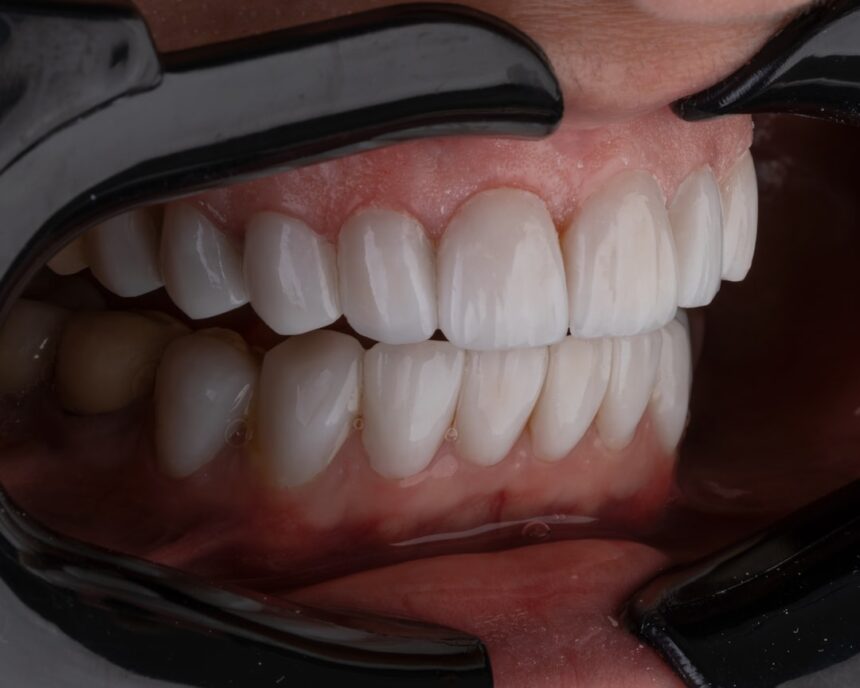
Some humans are born with supernumerary teeth—extra teeth beyond the normal complement of 32 permanent teeth. These occur in approximately 1–4% of the population in developed nations, according to orthodontic literature, but they represent isolated developmental anomalies rather than evidence of a latent capacity for third-set generation. Supernumerary teeth emerge unpredictably, often in abnormal positions, and frequently require extraction to prevent crowding or misalignment.
The presence of these rare extra teeth does not indicate that humans possess dormant tooth-generating capacity. Rather, they result from variations in the signaling pathways that normally limit tooth bud formation to two generations. Understanding the genetic mechanisms behind supernumerary teeth may inform regenerative research, but the teeth themselves offer no clinical pathway to reliable third-set growth.
Continuous tooth replacement in other species
Sharks, crocodilians, and some reptiles possess functional systems for lifelong tooth replacement, evolving specialized stem cell populations that continuously generate new teeth throughout their lives. These animals replaced worn or lost teeth without surgery or intervention—a biological solution refined over hundreds of millions of years of evolution. Humans never developed such machinery.
The research community studying regenerative dentistry has examined how other vertebrates maintain tooth-generating capacity in hopes of unlocking similar mechanisms in humans. However, the molecular and genetic requirements for continuous replacement appear deeply embedded in species-specific developmental pathways. Simply transplanting shark-like tooth regeneration into human tissue has proven far more complex than early optimistic rhetoric suggested.
Humans possess only two sets of teeth—primary and permanent—because our developmental genetics encode exactly two generations of tooth formation. No latent third set lies waiting to emerge.
— Human dental developmental biology consensus, supported by decades of embryological research
Regenerative dentistry: current state and future directions
Contemporary dental research pursues several promising but still-experimental avenues for tooth regeneration, including stem cell-based approaches, scaffold technologies, and gene therapy strategies. Scientists at major institutions are working to understand how to coax dormant epithelial and mesenchymal cells into building functional tooth structures outside the body and within the oral cavity.
However, no clinically established method yet produces whole, functional replacement teeth that integrate seamlessly into the jaw, achieve proper occlusion (bite alignment), and maintain longevity comparable to natural teeth. Recent clinical updates in regenerative dentistry show incremental progress—lab-grown tooth structures, bioprinted scaffolds, and enhanced biomimetic materials—but the leap from laboratory promise to routine clinical application remains several years distant.
The practical alternative for tooth loss remains dental implants, bridges, and dentures. While not biological replacements, modern implant dentistry has achieved high success rates (90–95% long-term survival, according to clinical implant research) and provides functional restoration that serves most patients well for decades.
What this means
Frequently asked questions
Can supernumerary teeth grow into a full third set?
No. Supernumerary teeth are random developmental variations affecting 1–4% of people. They are isolated anomalies, not the beginning of a third dentition. Most require removal to prevent crowding or misalignment.
Do some humans naturally have genes for a third set of teeth?
Human developmental genetics encode exactly two tooth generations. No known human genotype carries instructions for a functional third set. Ongoing research into tooth development may eventually inform regenerative approaches, but no dormant third-set capacity has been identified.
When will scientists be able to grow replacement teeth?
Regenerative dentistry shows promise in laboratory and early clinical settings, but no clinically proven whole-tooth regeneration technology is yet routine. Current best practices—implants and prosthetics—remain the standard. Advances may accelerate in the next 5–10 years, but timelines remain uncertain.
The question of a third set of teeth reflects a deep human desire to overcome biological limits. While modern medicine has extended lifespans and improved quality of life in countless ways, we remain bound by the developmental decisions evolution made for our species millions of years ago. Rather than await a biological third set, investing in preventive oral health, early intervention for decay or loss, and adoption of proven replacement technologies offers the most reliable path to lasting dental health across the human lifespan. As new studies in regenerative medicine progress, clinicians and patients should remain informed but realistic about timelines and clinical applicability.
Source: BBC: Can we grow a third set of teeth? Dr Oscar examines the truth behind the headlines
Was this article helpful?
Disclaimer. This article is health journalism intended for general information and education. It is not medical advice and is not a substitute for professional diagnosis or treatment. Always consult a qualified healthcare provider about your individual circumstances. Full disclaimer →
Related Coverage



Medically reviewed by Prof. Giorgi Pkhakadze, MD, MPH, PhD. Spotted an error? Contact the editorial team.