🟡 Preliminary Evidence
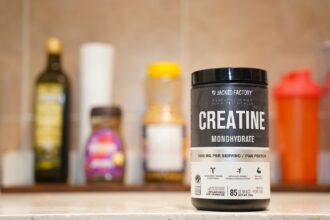
The human brain consumes approximately 20% of the body’s energy at rest, relying on a rapid phosphate-shuttling system to regenerate ATP on a millisecond timescale. Researchers at Forschungszentrum Jülich have demonstrated that a single high-dose oral administration of creatine monohydrate can partially preserve cognitive performance during acute sleep deprivation, with improvements of up to 12% on standardised tests compared to placebo.
Key takeaways
- The brain consumes approximately 20% of resting energy expenditure, primarily to maintain the phosphocreatine (PCr) shuttle that regenerates ATP
- A single 14-gram oral dose of creatine monohydrate improved performance on logic, numerical, and language-processing tasks during 21 hours of sleep deprivation, with peak improvements of up to 12% at critical timepoints
- Sleep deprivation increases brain energy demand sharply, creating favourable conditions for acute creatine uptake across the blood-brain barrier despite its normally limited permeability
- Female participants in the study benefited more than males across several cognitive domains
How the brain’s energy crisis unfolds under sleep deprivation
The brain’s energy metabolism operates on a finely calibrated system. Under normal conditions, neurons rely on the phosphocreatine (PCr) shuttle—a phosphate-buffering mechanism that allows rapid ATP regeneration in milliseconds when energy demand spikes. This is critical for maintaining neural firing, synaptic transmission, and cognitive function.
Sleep deprivation depletes this buffer. As ATP stores drop and the brain’s energy demand intensifies, cognitive performance deteriorates across multiple domains: attention, processing speed, logical reasoning, and psychomotor control all suffer measurably. The question researchers at Forschungszentrum Jülich posed was whether acute, high-dose creatine supplementation could replenish this depleted phosphocreatine reserve rapidly enough to mitigate cognitive decline.

Brain energy consumption and creatine’s protective effect
Cognitive domain performance preservation during sleep deprivation with single-dose creatine supplementation
Source: Forschungszentrum Jülich sleep deprivation–creatine study | Georgian Medical Journal News
Study design and key findings
The research team enrolled 29 healthy adults in a randomised, controlled trial. Participants received either a single oral dose of creatine monohydrate at 0.2 g/kg body weight (approximately 14 grams for a 70 kg adult) or placebo, then underwent 21 hours of continuous sleep deprivation with cognitive testing at baseline, 3 hours, 5.5 hours, and 7.5 hours post-dose.
Across multiple standardised cognitive domains—logic, numerical reasoning, language-related processing speed, and the Psychomotor Vigilance Test—the creatine group demonstrated significantly better performance than placebo. At the worst timepoints during sleep deprivation, performance deterioration was up to 12% less severe in the creatine group. A notable sex difference emerged: female participants benefited more substantially than males across several cognitive domains, suggesting potential sex-specific pharmacokinetics or metabolic responsiveness to acute creatine supplementation.
A single 14-gram dose of creatine monohydrate preserved cognitive function across logic, language processing, and psychomotor vigilance during acute sleep deprivation, with peak preservation of up to 12% at critical fatigue timepoints, and greater benefit in female participants.
— Research team, Forschungszentrum Jülich
Why acute dosing works when chronic supplementation normally requires weeks
Creatine’s blood-brain barrier (BBB) penetration is normally limited, which is why chronic oral supplementation requires weeks of daily dosing to meaningfully elevate brain phosphocreatine stores. However, the Jülich team identified a unique metabolic window: during sleep deprivation, the brain’s acute energy demand increases sharply, fundamentally changing the uptake dynamics at the BBB.
When a high-dose bolus of creatine is administered during this energy-depleted state, two opposing forces work in concert. First, the steep concentration gradient of creatine in the blood pushes the molecule across the BBB more efficiently. Second, the brain’s accelerated ATP turnover and phosphocreatine depletion create a metabolic pull—the tissue is literally burning through energy reserves faster than usual, favouring rapid uptake. This is distinct from the chronic supplementation model, where creatine uptake is rate-limited by transporter saturation and BBB permeability.
The team’s 2024 mechanistic study, which used 31P magnetic resonance spectroscopy to directly measure brain phosphocreatine and ATP levels, confirmed that a 0.35 g/kg dose during sleep deprivation produced measurable changes in phosphocreatine-to-inorganic phosphate (PCr/Pi) ratios and ATP availability. This biochemical evidence corroborates the cognitive findings and indicates that the protective effect is real, not merely an artifact of subjective performance variation.
Limitations and clinical context
This is a small, acute-intervention study (n=29) conducted under the extreme metabolic stress of 21 hours of complete sleep deprivation. Whether the same protective effect applies under normal sleep conditions, partial sleep restriction, or chronic fatigue remains unknown. The dose tested (0.2–0.35 g/kg) is substantially higher than typical daily supplementation protocols and was given as a single bolus, not a loading regimen.
Additionally, this research provides no guidance on the safety or efficacy of creatine supplementation for occupational or military personnel performing sleep-deprived tasks in real-world settings, nor does it establish whether repeated dosing would maintain protection or produce diminishing returns. The sex differences observed are intriguing but require replication and mechanistic investigation before clinical recommendations can be stratified by sex.
Readers interested in clinical updates on neuroprotection and cognitive enhancement may find related evidence on other interventions in the New Studies section.
What this means
Frequently asked questions
Can I use creatine as a substitute for sleep?
No. This study shows that a single high dose of creatine can partially mitigate cognitive decline during acute sleep deprivation, but it does not restore normal cognitive function or replace the restorative functions of sleep (memory consolidation, glymphatic clearance, immune regulation). Sleep remains non-negotiable for long-term health and performance.
Is 14 grams of creatine safe?
A single 14-gram dose is well within established safety parameters for creatine supplementation in healthy adults. The most common side effect is minor gastrointestinal discomfort. However, individuals with kidney disease, those taking nephrotoxic medications, or those with a family history of kidney disease should consult a physician before supplementing. Chronic daily loading protocols (20 grams/day for 5–7 days, followed by maintenance) require similar medical clearance.
Why did women in the study benefit more than men?
The mechanism is unknown and requires replication. Potential explanations include sex-specific differences in creatine transporter expression in the brain, baseline phosphocreatine stores, or metabolic response to sleep deprivation. This finding underscores the importance of sex-stratified analysis in neuropharmacology and should prompt future mechanistic studies.
The implications of this research extend beyond athletic performance or shift-work fatigue. As understanding of brain energy metabolism deepens, acute metabolic interventions targeting specific states—such as sleep deprivation, post-stroke recovery, or critical illness—may become increasingly precise and personalised. The Jülich team’s work demonstrates that the blood-brain barrier, long viewed as an insurmountable obstacle to acute CNS intervention, can be partially bypassed when metabolic conditions create the right gradient. Future research should examine whether similar acute-dosing strategies could protect cognition or neuronal survival in other acute brain energy crises, such as anoxia or hypoglycaemia, and whether the sex-specific benefits observed here hold true in larger, more diverse populations.
Source: Forschungszentrum Jülich sleep deprivation and creatine research programme
Was this article helpful?
Disclaimer. This article is health journalism intended for general information and education. It is not medical advice and is not a substitute for professional diagnosis or treatment. Always consult a qualified healthcare provider about your individual circumstances. Full disclaimer →
Related Coverage


Medically reviewed by Prof. Giorgi Pkhakadze, MD, MPH, PhD. Spotted an error? Contact the editorial team.