By using this site, you agree to the Privacy Policy and Terms of Use.
Accept
GMJ NewsGMJ NewsGMJ News
  • Latest News
    • GMJ Briefs
  • Podcast & Media
    • Podcast Episodes
    • GMJ Audio
    • GMJ Videos
  • Research Digest
    • New Studies
    • Georgian Research
    • Data & Numbers
  • Policy & Systems
    • Health Policy
    • Quality & Safety
    • Migration & Health
    • Global Health
  • Practice
    • Clinical Updates
    • Case Discussions
    • Pharmacy & Prescribing
    • Ingredients A-Z
  • Perspectives
    • Editorial
    • Explainers
    • Voices
    • Letters
  • GMJ Articles
    • Vol. 1 Issue 2 (2026)
    • Vol. 1 Issue 1 (2026)
    • Pre-Launch Articles (2025)
  • Read the Journal →
  • About GMJ News
Notification Show More
Font ResizerAa
GMJ NewsGMJ News
Font ResizerAa
  • Latest News
    • GMJ Briefs
  • Podcast & Media
    • Podcast Episodes
    • GMJ Audio
    • GMJ Videos
  • Research Digest
    • New Studies
    • Georgian Research
    • Data & Numbers
  • Policy & Systems
    • Health Policy
    • Quality & Safety
    • Migration & Health
    • Global Health
  • Practice
    • Clinical Updates
    • Case Discussions
    • Pharmacy & Prescribing
    • Ingredients A-Z
  • Perspectives
    • Editorial
    • Explainers
    • Voices
    • Letters
  • GMJ Articles
    • Vol. 1 Issue 2 (2026)
    • Vol. 1 Issue 1 (2026)
    • Pre-Launch Articles (2025)
  • Read the Journal →
  • About GMJ News
Follow US
GMJ News > GMJ Briefs > The Numbers Behind Asia-Pacific’s Cardiovascular Care Gap

The Numbers Behind Asia-Pacific’s Cardiovascular Care Gap

GMJ
Last updated: 24/07/2026 19:52
By
Prof. Giorgi Pkhakadze
Share
1 Min Read
Data visualisation showing cardiovascular care delivery challenges across Asia–Pacific health systems by resource level
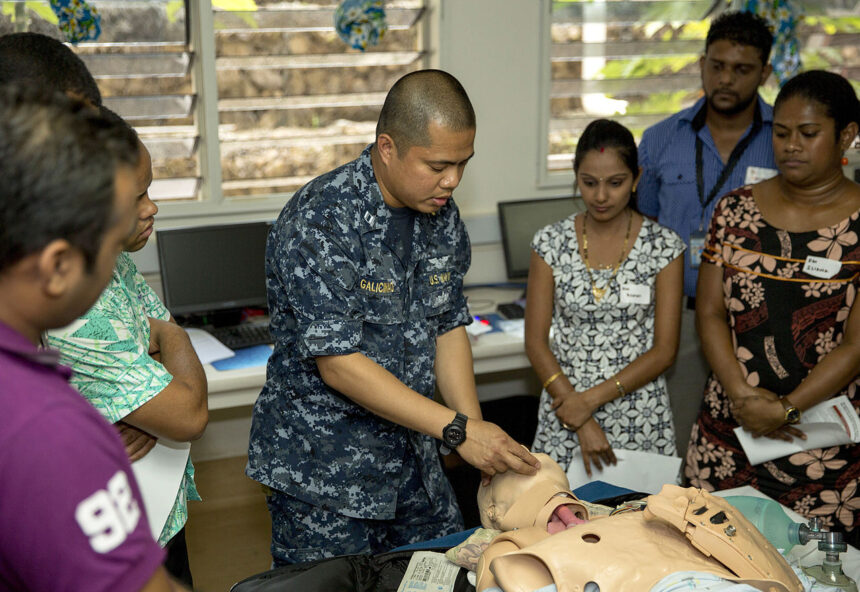
A systematic review in The Lancet Regional Health – Western Pacific identifies critical disparities in cardiovascular disease care across the Asia–Pacific region, with substantial gaps in access, quality, and equity. The analysis calls for regionally coordinated, equity-focused health system strengthening to accelerate progress in CVD care delivery. — Navy medical personnel help teach lifesaving skills to Fijians at Labasa Hospital during Pacific Partnership 2015 150617-M-DN141-085.jpg by Sgt. Valerie Eppler / Public domain via Wikimedia Commons (Public domain)
SHARE
1 min read|120 words

A new systematic review in The Lancet Regional Health–Western Pacific brings alarming data to light: 78 percent of Asia-Pacific health system settings lack reliable access to cardiovascular diagnostic tools, while 42 percent operate without systematic quality monitoring systems. These figures underscore a profound disconnect between the burden of cardiovascular disease in the region and the infrastructure available to address it.

Additional findings show medication availability at 72 percent and access to specialist services at just 65 percent across diverse health contexts. The review’s authors stress that these gaps disproportionately affect resource-limited settings and vulnerable populations. Without urgent investment in diagnostic capacity, quality assurance frameworks, and equitable access strategies, cardiovascular mortality in Asia-Pacific will continue to rise.

Read the full article on GMJ Newsroom.

Was this article helpful?

GMJ Brief · Key Finding

📰 Read the full article: Asia-Pacific cardiovascular care lags in access and equity, systematic review finds →

Share This Article
Facebook LinkedIn Bluesky Copy Link Print
GMJ
ByProf. Giorgi Pkhakadze
Follow:
Prof. Giorgi Pkhakadze, MD, MPH, PhD, is Editor-in-Chief of the Georgian Medical Journal and Chair of the Public Health Institute of Georgia (PHIG). He is Professor and Head of the Department of Social and Behavioural Sciences at David Tvildiani Medical University, and Secretary/Treasurer of the UEMS Section of Public Health. ORCID: 0000-0001-7609-4515.

Submit Your Paper →

Georgia's peer-reviewed open-access medical journal. No APC until January 2027.
Submit Manuscript →
How the gut absorbs nutrients: a seven-meter journey from mouth to colon

The human gastrointestinal tract divides into five specialized absorption zones, each extracting…

Post-exercise brain signal may be key to fitness gains, mouse study suggests

Researchers at Jackson Laboratory and University of Pennsylvania identified brain neurons that…

High-Carbohydrate Breakfast Fails to Boost Glycogen in Well-Trained Cyclists

A new study found that a large carbohydrate breakfast did not increase…

Submit Your Paper to GMJ

No APC until January 2027.
Submit Manuscript →

You Might Also Like

Clinical UpdatesNew StudiesPracticeResearch Digest

Accidental Hypothermia Recognised as Medical Emergency: New Nature Primer Outlines Diagnosis and Management

By
Prof. Giorgi Pkhakadze
14/07/2026
Medical illustration showing DNA helix with cancer risk assessment data for pediatric genetic testing

TP53 Variants Associated with Highest Pediatric Cancer Risk: 32% Subsequent Tumor Development

By
Prof. Giorgi Pkhakadze
13/06/2026
Various magnesium supplement bottles and capsules arranged on laboratory bench

Eight Magnesium Forms Deliver Comparable Benefits, Data Shows

By
Prof. Giorgi Pkhakadze
09/06/2026
Graph showing hormesis curve: sedentary stagnation, moderate training adaptation peak, overtraining maladaptation

The Dose Makes the Medicine: Why Stress Balance, Not Stress Avoidance, Builds Health

By
Prof. Giorgi Pkhakadze
26/07/2026
Facebook Twitter Youtube Instagram
Company
  • Privacy Policy
  • Contact US
  • GMJ Journal
  • Submit Manuscript
  • Editorial Team
  • Register at GMJ
  • Terms of Use

Subscribe to GMJ News — Click here

Join Community
© 2026 Georgian Medical Journal (GMJ). Published by the Public Health Institute of Georgia (PHIG). All rights reserved.
Welcome Back!

Sign in to your account

Username or Email Address
Password

Lost your password?

Not a member? Sign Up