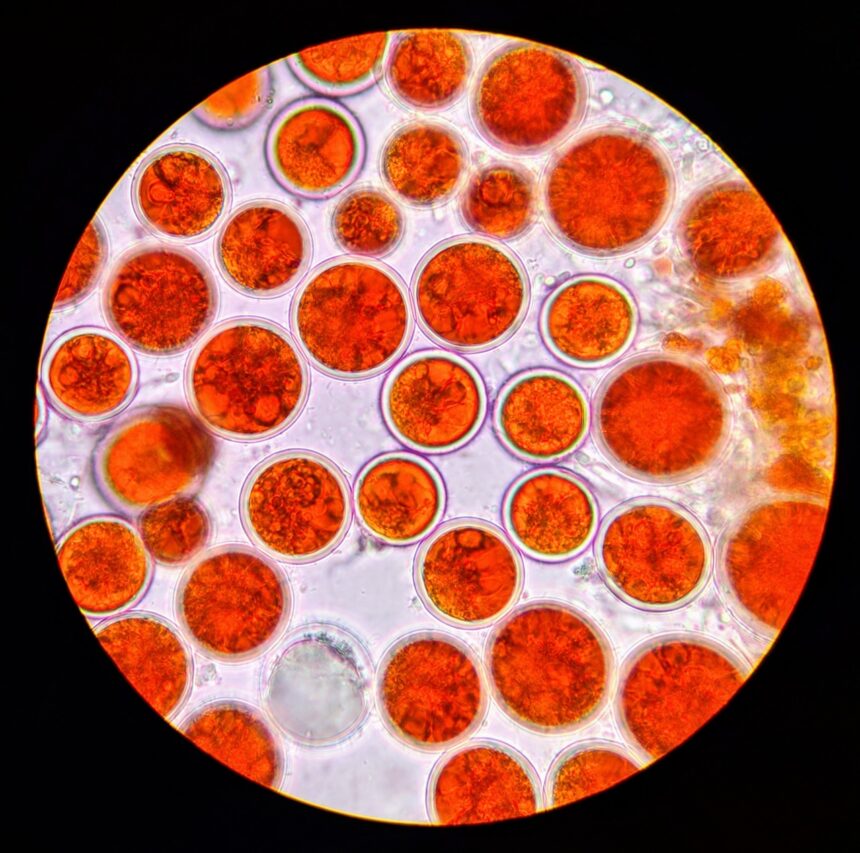
Astaxanthin is the deep-red carotenoid that the freshwater microalga Haematococcus pluvialis produces under stress — and that colours salmon, krill and flamingos pink through the food chain. Its molecular structure lets it span the full width of cell membranes, positioning antioxidant activity precisely where UV-generated free radicals attack membrane lipids. That mechanism is the basis of an unusually consistent body of small human trials in dermatology.
- Elasticity and wrinkle evidence
- Hydration and barrier function
- UV protection: measurable but modest
- Form matters: natural esters vs synthetic
- How skin trials measure anything at all
- Dose–response and time-course across the trials
- Oral, topical, or both
- The limitations, stated plainly
- The clinical bottom line
- Primary sources
Elasticity and wrinkle evidence
Randomised controlled trials in both Japanese and Caucasian populations — typically using 4–12 mg natural astaxanthin daily for 8–16 weeks — have reported measurable improvements in skin elasticity (cutometry), wrinkle depth at the eye corner, and age-spot appearance versus placebo. A frequently cited pair of studies by Tominaga and colleagues combined oral supplementation with topical application and documented improvements across elasticity, wrinkle parameters and moisture in middle-aged subjects. A 2021 systematic review and meta-analysis of eleven randomised trials concluded astaxanthin supplementation was associated with statistically significant improvement in skin moisture and elasticity outcomes, while noting the trials were small and often industry-funded — the standard caveat for this literature.
Hydration and barrier function
Trials measuring transepidermal water loss (TEWL) and corneocyte condition have reported reduced water loss and improved moisture in supplemented groups, consistent with astaxanthin’s membrane-protective role in the skin barrier. Effects appear over weeks, not days — reflecting carotenoid accumulation kinetics in skin tissue.
UV protection: measurable but modest
The most objectively quantifiable finding: a randomised placebo-controlled study found oral astaxanthin (4 mg/day, 9 weeks) significantly increased the minimal erythema dose — the UV exposure needed to redden skin — and reduced moisture loss in irradiated areas. This positions astaxanthin as systemic photo-support, not sunscreen: the effect size is a modest raising of the burn threshold, complementing rather than replacing topical UV protection.

Form matters: natural esters vs synthetic
Natural H. pluvialis astaxanthin occurs largely as fatty-acid esters, which is what makes it genuinely oil-soluble and is the form used in essentially all positive dermatology trials; synthetic astaxanthin (free, unesterified, produced for aquaculture pigmentation) has a different stereoisomer profile and no meaningful human skin-trial record.
How skin trials measure anything at all
Reading this literature requires knowing its instruments. Cutometry applies calibrated suction to a few millimetres of skin and measures deformation and rebound — the elasticity parameters (R2 and friends) behind every “firmness improved” claim. Corneometry measures electrical capacitance of the stratum corneum as a hydration proxy. TEWL (transepidermal water loss) quantifies barrier integrity by measuring water vapour escaping the skin — lower is better. Wrinkle analysis uses replica imaging or 3-D profilometry of the crow’s-foot area, computing average and maximum depth. And minimal erythema dose testing exposes small skin fields to graded UV and records the lowest dose producing redness at 24 hours — the objective endpoint behind “raised the burn threshold.” These are established dermatology instruments, which is what separates this evidence base from cosmetic marketing: the endpoints are measured, blinded and statistically compared, however small the samples.
Dose–response and time-course across the trials
Mapping the RCTs, effects cluster with remarkable consistency: doses of 4–12 mg/day, first statistically detectable changes around 6–8 weeks, fuller effects by 12–16 weeks — matching carotenoid accumulation kinetics in skin, where levels build over one to two epidermal turnover cycles. Within the studied range, higher doses shorten time-to-effect more than they raise the ceiling; nothing credible supports mega-dosing beyond 12 mg for skin endpoints. The practical translation: astaxanthin for skin is a 3-month commitment evaluated at week 12, not a two-week experiment.
Oral, topical, or both
The Tominaga research line is instructive because it tested combined oral + topical against each alone: the combination outperformed either monotherapy, oral supplementation showing systemic effects (it reaches all skin, not just treated areas) while topical application concentrated benefit locally. Mechanistically the routes are complementary — oral delivery builds dermal reservoirs from within; topical addresses the outermost layers directly. For product strategy, this is why oral astaxanthin pairs naturally with, rather than competes against, topical skincare.
The limitations, stated plainly
Honest accounting: trials are small (tens of participants), often Japanese populations (generalisation to other skin phototypes assumed rather than shown), frequently industry-funded (a bias risk the 2021 meta-analysis flags explicitly), and heterogeneous in formulations. The meta-analytic signal for moisture and elasticity survives these caveats, which is why a B-grade — “consistent small-trial evidence” — is the defensible position: strong enough to justify use and further research, not strong enough for drug-style claims. That is exactly how we phrase it, and why.
The clinical bottom line
For a cosmetic-adjacent supplement, astaxanthin’s dermatology file is unusually real: repeated small RCTs and a supportive meta-analysis for elasticity, hydration and UV threshold at 4–12 mg/day of the natural esterified form. The honest framing is “consistent small-trial evidence,” not “proven anti-aging drug.”
Primary sources
- Zhou X, et al. Systematic review and meta-analysis: effects of astaxanthin on skin. 2021
- Tominaga K, et al. Cosmetic benefits of astaxanthin on human subjects. Acta Biochim Pol. 2012
- Ito N, et al. Effects of composite supplement containing astaxanthin on UV-induced skin deterioration: RCT. Nutrients. 2018
Was this article helpful?
Disclaimer. This article is health journalism intended for general information and education. It is not medical advice and is not a substitute for professional diagnosis or treatment. Always consult a qualified healthcare provider about your individual circumstances. Full disclaimer →
Related Coverage

Editorial standards. This article was produced under the GMJ News editorial process, with oversight by the GMJ Editorial Board. Our editorial process. Spotted an error? Contact the editorial team.