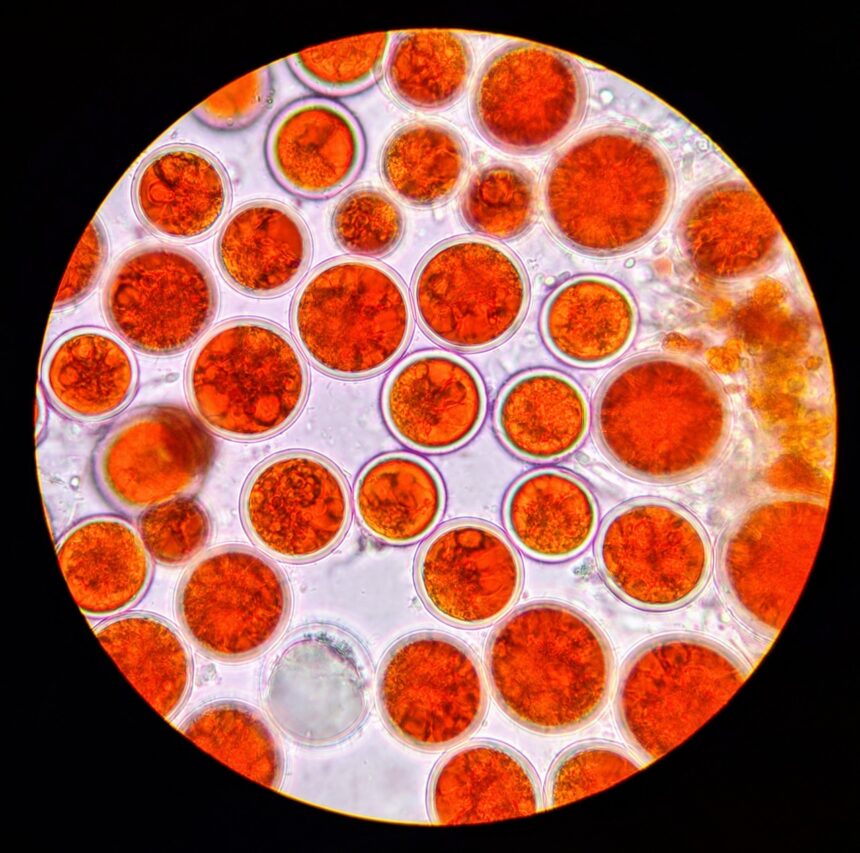
Astaxanthin has an unusually good mechanistic story — a carotenoid that spans the cell membrane and quenches radicals on both faces at once (the membrane-spanning mechanism). Good mechanistic stories are exactly where supplement marketing tends to outrun supplement evidence, so it is worth asking a narrower question: in human beings, at the doses actually sold — 4, 6, 8, 12 mg a day — what did the randomised trials find? The answer is a set of modest, repeatable signals in specific domains, a number of null results, and a safety record that is reassuring. None of it justifies the word “miracle.” Some of it justifies the word “promising.”
Lipids: the clearest dose-response signal
The most cited study randomised 61 non-obese adults with mild hyperlipidaemia to placebo or 6, 12 or 18 mg/day of natural astaxanthin for 12 weeks. Triglycerides fell significantly at 12 and 18 mg (by about 25% and 24%), HDL-cholesterol rose at 6 and 12 mg (by about 10–15%), and serum adiponectin — an anti-inflammatory adipokine — increased at 12 and 18 mg; LDL and total cholesterol did not change (Yoshida et al. 2010). This is a single, modestly sized, 12-week trial; it has not been replicated at the same scale, and its lipid effects are smaller than those of any prescription agent. But it is the best human dose-ranging data available, and it places the apparent threshold for metabolic effects at around 12 mg rather than 6.
Oxidative stress and immune markers: 2 and 8 mg
A placebo-controlled trial in 42 healthy young women compared 0, 2 and 8 mg/day for eight weeks. Both doses reduced a DNA-damage marker (8-hydroxy-2′-deoxyguanosine) and C-reactive protein at 8 mg; the higher dose also increased lymphocyte proliferation and natural-killer cell activity in laboratory assays (Park et al. 2010). These are biomarker outcomes in healthy people — they show that the molecule is biologically active at supplemental doses, not that it prevents any disease. Biomarker changes of this kind are a necessary first step; they are routinely overstated as if they were clinical endpoints.
Skin: the 6 mg studies
Several small Japanese trials examined skin parameters. In one, 30 women took 6 mg/day orally combined with a topical preparation for eight weeks, and 36 men took 6 mg/day orally alone for six weeks; both groups showed measurable improvements in skin elasticity, wrinkle depth, moisture and texture compared with baseline or placebo (Tominaga et al. 2012). The sample sizes are small, the outcomes are instrumental measurements of limited clinical meaning, and the women’s arm confounds oral and topical use. What the studies establish is a consistent direction of effect at 6 mg in skin, which is at least coherent with the membrane-antioxidant mechanism and with astaxanthin’s accumulation in skin tissue.

Exercise: mostly null in humans
Here the animal data and the human data diverge sharply. Rodent studies showed striking effects on endurance and fat oxidation; human trials largely did not. A rigorous 4-week trial of 20 mg/day in 32 trained cyclists found no effect on fat oxidation, time-trial performance or oxidative-stress markers (Res et al. 2013). An earlier, smaller study of 4 mg/day for 28 days in 21 cyclists did report improved 20 km time-trial performance and power output, but without the physiological changes that would explain it, and it has not been convincingly replicated (Earnest et al. 2011). Reviews of the exercise literature conclude that any ergogenic effect in humans is small, inconsistent and not dose-dependent — which is the pattern one expects when an effect is either absent or too small to matter.
What the trials did not show
An honest inventory of absences is as important as the list of findings. There is no randomised trial with a hard clinical endpoint — no reduction in heart attacks, strokes, cancers, fractures or deaths. There is no trial longer than a few months, so nothing is known about sustained benefit or about whether biomarker changes persist. Most trials are small (20–60 participants), many are industry-funded, and several important ones come from a single country’s research groups with limited independent replication. The evidence on eye fatigue, cognition, fertility and joint pain consists of small, heterogeneous studies that a 2021 evidence-based review judged insufficient for any clinical recommendation (Donoso et al. 2021). Claims that astaxanthin “treats” or “prevents” any condition are not supported, and in the EU no health claim for astaxanthin has been authorised (what EFSA health claims mean).
Safety and the regulatory ceiling
Safety is the strongest part of the record. A 2019 review of human studies at doses up to 40 mg/day for up to 12 weeks — and higher in short studies — found no serious adverse events; the occasional reports are of mild gastrointestinal symptoms and a harmless reddish tint to stools at high dose (Brendler & Williamson 2019). The European Food Safety Authority, evaluating astaxanthin-rich oleoresin from Haematococcus pluvialis (the microalgal source) as a novel food in 2020, set an acceptable daily intake of 0.2 mg per kg body weight — about 14 mg/day for a 70 kg adult — and concluded that a supplemental intake of 8 mg/day is safe for adults including pregnant and lactating women, when combined with typical dietary intake from fish (EFSA 2020). That number is why responsible European products sit at or below 8 mg: the 12 mg that showed the clearest lipid effect is above the EFSA-endorsed supplemental level, and the gap between them is the honest state of the evidence.
The clinical bottom line
At 6–12 mg/day, randomised trials show modest, short-term improvements in triglycerides and HDL (threshold around 12 mg), reductions in oxidative-stress and inflammatory biomarkers (from 2–8 mg), and small instrumental improvements in skin parameters (6 mg); exercise effects in humans are largely absent. No trial has shown a hard clinical outcome, none exceeds a few months, and most are small. Safety is excellent, with EFSA endorsing 8 mg/day supplemental intake. Astaxanthin is a biologically active, well-tolerated antioxidant with early signals worth studying — not a proven therapy for anything.
Primary sources
- Yoshida H, Yanai H, Ito K, et al. Administration of natural astaxanthin increases serum HDL-cholesterol and adiponectin in subjects with mild hyperlipidemia. Atherosclerosis. 2010;209(2):520–523. doi:10.1016/j.atherosclerosis.2009.10.012
- Park JS, Chyun JH, Kim YK, Line LL, Chew BP. Astaxanthin decreased oxidative stress and inflammation and enhanced immune response in humans. Nutr Metab (Lond). 2010;7:18. doi:10.1186/1743-7075-7-18
- Tominaga K, Hongo N, Karato M, Yamashita E. Cosmetic benefits of astaxanthin on humans subjects. Acta Biochim Pol. 2012;59(1):43–47. doi:10.18388/abp.2012_2168
- Res PT, Cermak NM, Stinkens R, et al. Astaxanthin supplementation does not augment fat use or improve endurance performance. Med Sci Sports Exerc. 2013;45(6):1158–1165. doi:10.1249/MSS.0b013e31827fddc4
- Earnest CP, Lupo M, White KM, Church TS. Effect of astaxanthin on cycling time trial performance. Int J Sports Med. 2011;32(11):882–888. doi:10.1055/s-0031-1280779
- Donoso A, González-Durán J, Muñoz AA, González PA, Agurto-Muñoz C. Therapeutic uses of natural astaxanthin: an evidence-based review focused on human clinical trials. Pharmacol Res. 2021;166:105479. doi:10.1016/j.phrs.2021.105479
- Brendler T, Williamson EM. Astaxanthin: how much is too much? A safety review. Phytother Res. 2019;33(12):3090–3111. doi:10.1002/ptr.6514
- EFSA Panel on Nutrition, Novel Foods and Food Allergens. Safety of astaxanthin for its use as a novel food in food supplements. EFSA J. 2020;18(2):e05993. doi:10.2903/j.efsa.2020.5993
Educational information on supplement quality and consumer protection, not medical advice.
Was this article helpful?
Related Coverage



Editorial standards. This article was produced under the GMJ News editorial process, with oversight by the GMJ Editorial Board. Our editorial process. Spotted an error? Contact the editorial team.