By using this site, you agree to the Privacy Policy and Terms of Use.
Accept
GMJ NewsGMJ NewsGMJ News
  • Latest News
    • GMJ Briefs
  • Podcast & Media
    • Podcast Episodes
    • GMJ Audio
    • GMJ Videos
  • Research Digest
    • New Studies
    • Georgian Research
    • Data & Numbers
  • Policy & Systems
    • Health Policy
    • Quality & Safety
    • Migration & Health
    • Global Health
  • Practice
    • Clinical Updates
    • Case Discussions
    • Pharmacy & Prescribing
    • Ingredients A-Z
  • Perspectives
    • Editorial
    • Explainers
    • Voices
    • Letters
  • GMJ Articles
    • Vol. 1 Issue 2 (2026)
    • Vol. 1 Issue 1 (2026)
    • Pre-Launch Articles (2025)
  • Read the Journal →
  • About GMJ News
Notification Show More
Font ResizerAa
GMJ NewsGMJ News
Font ResizerAa
  • Latest News
    • GMJ Briefs
  • Podcast & Media
    • Podcast Episodes
    • GMJ Audio
    • GMJ Videos
  • Research Digest
    • New Studies
    • Georgian Research
    • Data & Numbers
  • Policy & Systems
    • Health Policy
    • Quality & Safety
    • Migration & Health
    • Global Health
  • Practice
    • Clinical Updates
    • Case Discussions
    • Pharmacy & Prescribing
    • Ingredients A-Z
  • Perspectives
    • Editorial
    • Explainers
    • Voices
    • Letters
  • GMJ Articles
    • Vol. 1 Issue 2 (2026)
    • Vol. 1 Issue 1 (2026)
    • Pre-Launch Articles (2025)
  • Read the Journal →
  • About GMJ News
Follow US
GMJ News > GMJ Briefs > Understanding Ebola Bundibugyo: What Healthcare Providers and Public Health Officials Need to Know

Understanding Ebola Bundibugyo: What Healthcare Providers and Public Health Officials Need to Know

GMJ
Last updated: 24/06/2026 17:32
By
Prof. Giorgi Pkhakadze
Share
1 Min Read
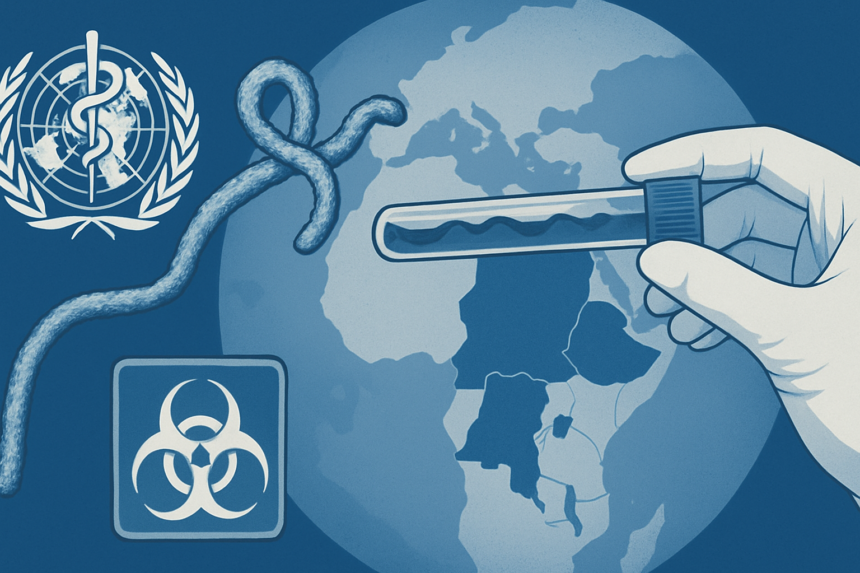
WHO Emergency Committee meeting on Ebola Bundibugyo outbreak response
WHO declares Ebola Bundibugyo outbreak in DRC and Uganda a public health emergency of international concern but stops short of pandemic emergency status. Emergency Committee issues temporary recommendations to member states.
SHARE
1 min read|140 words

Healthcare providers and public health officials should understand key epidemiological features of the Ebola Bundibugyo strain now affecting the Democratic Republic of the Congo and Uganda. This viral strain carries a case fatality rate between 25 percent and 39 percent based on historical outbreak data, making it lower than the Zaire ebolavirus responsible for the 2014-2016 West African epidemic but still representing a serious public health threat requiring immediate clinical attention and infection control measures. The PHEIC declaration does not constitute a pandemic emergency determination, reflecting the Committee’s assessment that current transmission patterns remain geographically contained despite cross-border spread. However, the cross-border nature of confirmed cases necessitates enhanced surveillance, laboratory diagnostic capacity, and coordinated response protocols across affected nations. Healthcare facilities should implement appropriate biosafety measures and maintain awareness of clinical presentation patterns to facilitate early case identification and prevent nosocomial transmission.

Was this article helpful?

GMJ Brief · Takeaway

📰 Read the full article: WHO Declares Ebola Bundibugyo Outbreak in DRC and Uganda a Public Health Emergency →

Share This Article
Facebook LinkedIn Bluesky Copy Link Print
GMJ
ByProf. Giorgi Pkhakadze
Follow:
Prof. Giorgi Pkhakadze, MD, MPH, PhD, is Editor-in-Chief of the Georgian Medical Journal and Chair of the Public Health Institute of Georgia (PHIG). He is Professor and Head of the Department of Social and Behavioural Sciences at David Tvildiani Medical University, and Secretary/Treasurer of the UEMS Section of Public Health. ORCID: 0000-0001-7609-4515.

Submit Your Paper →

Georgia's peer-reviewed open-access medical journal. No APC until January 2027.
Submit Manuscript →
Post-exercise brain signal may be key to fitness gains, mouse study suggests

Researchers at Jackson Laboratory and University of Pennsylvania identified brain neurons that…

High-Carbohydrate Breakfast Fails to Boost Glycogen in Well-Trained Cyclists

A new study found that a large carbohydrate breakfast did not increase…

Beyond the Vitamin List: How Nutrients Work as Interconnected Biological Systems

Conventional nutrition presents vitamins and minerals as isolated nutrients, but biochemical evidence…

Submit Your Paper to GMJ

No APC until January 2027.
Submit Manuscript →

You Might Also Like

EBOLA OUTBREAK – DRC/UGANDA BORDER CROSSING – PHEIC DECLARED

By
Prof. Giorgi Pkhakadze
31/05/2026
Medical chart showing beta blocker outcomes data from international heart attack study

Four Decades of Cardiac Protocol Under Review: International Trial Questions Beta Blocker Use Post-Heart Attack

By
Prof. Giorgi Pkhakadze
26/06/2026

PHEIC Declaration: Ebola Cross-Border Transmission DRC-Uganda

By
Prof. Giorgi Pkhakadze
31/05/2026
Diagram of insulin receptor signalling pathway highlighting magnesium's role as essential cofactor in kinase activation

Announcement: Magnesium’s Hidden Role in Insulin Signalling: Why the Mineral Matters More Than We Thought

By
Prof. Giorgi Pkhakadze
26/07/2026
Facebook Twitter Youtube Instagram
Company
  • Privacy Policy
  • Contact US
  • GMJ Journal
  • Submit Manuscript
  • Editorial Team
  • Register at GMJ
  • Terms of Use

Subscribe to GMJ News — Click here

Join Community
© 2026 Georgian Medical Journal (GMJ). Published by the Public Health Institute of Georgia (PHIG). All rights reserved.
Welcome Back!

Sign in to your account

Username or Email Address
Password

Lost your password?

Not a member? Sign Up