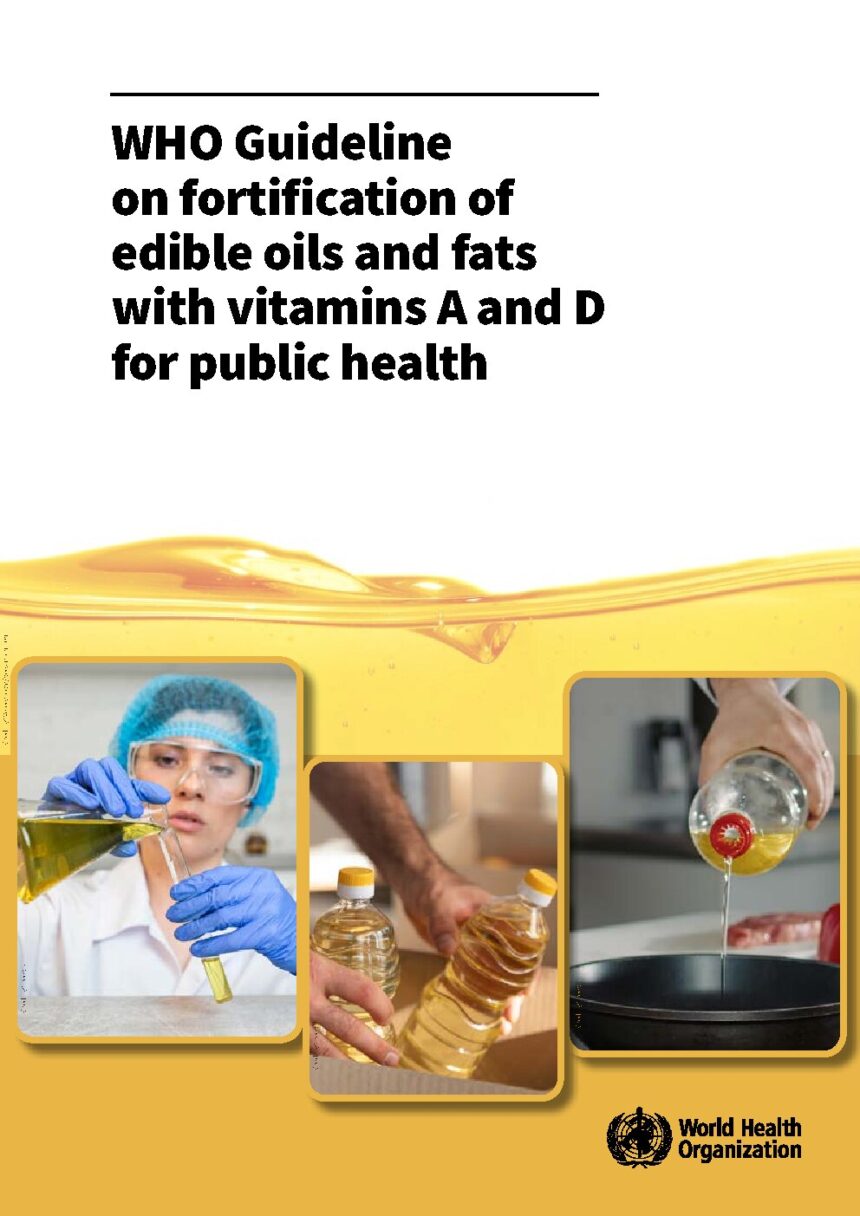
World Health Organization · 1st edition, 2025 · 90 pages
Evidence-informed recommendations on fortifying oils and fats with vitamins A and D to address micronutrient deficiencies in populations.
- Issuer
- World Health Organization
- Edition
- 1st edition, 2025
- Audience
- Policy-makers, programme managers, ministries of health, technical staff involved in nutrition programmes, food fortification regulators, and oil/fat industry stakeholders
- Evidence
- GRADE-rated systematic review evidence (low to very low certainty) plus pre-post programme data from Indonesia, Malawi, and Oman; evidence-to-decision frameworks considering benefits, harms, equity, acceptability, feasibility, and cost
- Reviewed
- 14 Oct 2026 · GMJ
What this guideline says
GMJ summary
This 2025 WHO guideline provides global recommendations on fortifying edible oils and fats with vitamins A and D as a public health strategy to improve micronutrient status in populations. Vitamin A deficiency affects approximately 29% of pre-school children globally (down from 39% in 1991) and 15% of pregnant women, causing preventable blindness and increased mortality from infections. Vitamin D deficiency, estimated to affect up to 1 billion people worldwide, causes rickets in children and osteomalacia in adults.
Based on systematic review evidence (low to very low certainty), the guideline strongly recommends fortification with vitamin A to prevent subclinical deficiency in at-risk populations, and conditionally recommends vitamin D fortification. Recommended fortification levels are 12–26 mg/kg for vitamin A (as retinyl palmitate or acetate) and 0.20–0.43 mg/kg for vitamin D (as cholecalciferol or ergocalciferol). As of 2024, 39 countries mandate or allow voluntary fortification of oils with vitamin A, and 13 with both vitamins A and D.
The guideline emphasizes that oils and fats are energy-dense macronutrients; their selection as fortification vehicles requires balancing public health benefits against noncommunicable disease risks. Countries should limit fortification of oils high in saturated or trans fats and promote consumption of healthier oils. Implementation requires consideration of industry consolidation, regulatory frameworks, consumption patterns, coexisting interventions, and monitoring systems that address equity, gender equality, and human rights.
Key points
For clinicians — doses and thresholds as stated in the guideline
- Fortification of edible oils/fats with vitamin A is <strong>strongly recommended</strong> to prevent subclinical vitamin A deficiency (serum retinol ≤0.70 µmol/L) in at-risk populations
- Fortification with vitamin D <strong>may be considered</strong> (conditional recommendation) to prevent vitamin D deficiency
- Recommended vitamin A fortification levels: <strong>12–26 mg/kg oil or fat</strong> (as retinyl palmitate or retinyl acetate)
- Recommended vitamin D fortification levels: <strong>0.20–0.43 mg/kg oil or fat</strong> (as vitamin D₃ cholecalciferol or D₂ ergocalciferol)
- Countries must adapt levels based on consumption patterns, prevalence of deficiency, coexisting interventions, and compliance with WHO guidelines limiting saturated and trans fats
- Fortification should prioritize healthier oils (lower in saturated/trans fats) and not increase total fat consumption beyond 30% of energy intake
- Implementation requires consolidated industry, regulatory monitoring, stability testing under local storage/cooking conditions, and prevention of excessive intake through monitoring multiple interventions
- Cost is low: median US$0.03 per capita for oil fortification programmes, with cost per DALY averted estimated at US$23 for refined oil
Amounts of vitamins A and D to consider adding to oils and fats
Table extracted from the guideline
| Nutrient | Chemical form | Minimum (mg/kg) | Maximum (mg/kg) |
|---|---|---|---|
| Vitamin A | Retinyl palmitate or Retinyl acetate | 12 | 26 |
| Vitamin D | Vitamin D₃ (cholecalciferol) or Vitamin D₂ (ergocalciferol) | 0.20 | 0.43 |
Source: World Health Organization, Guideline on fortification of edible oils and fats with vitamins A and D for public health. Reproduced in summary form.
From the guideline
Verbatim
“Fortification of edible oils and/or fats with vitamin A is recommended as a public health intervention to prevent subclinical vitamin A deficiency in populations at risk of vitamin A deficiency.”
Editor’s perspective
Why this matters for Georgia and the region
Prof. Giorgi Pkhakadze, MD, MPH, PhD
Editor-in-Chief, Georgian Medical Journal · Chair, Public Health Institute of Georgia · WHO consultant, health and migration
As Editor-in-Chief of the Georgian Medical Journal and Chair of the Public Health Institute, I see this guideline as timely for Georgia, where the nutrition transition has brought both progress and new challenges. Our 2009 national micronutrient survey documented deficiencies, but we lack recent population-level data on vitamin A and D status using standardized biomarkers—a critical first step before implementing fortification. The strong recommendation for vitamin A fortification aligns with regional needs, given that South Caucasus countries share similar dietary patterns with increasing reliance on vegetable oils. However, I would stress to Georgian clinicians and policy-makers the guideline's central caveat: fortification must not promote increased consumption of oils high in saturated fats, which contradicts our ongoing efforts to prevent cardiovascular disease. The realistic implementation challenge for Georgia is our fragmented edible oil market, with substantial bulk/unbranded sales in rural areas and border regions, requiring significant investment in regulatory monitoring infrastructure and laboratory capacity before mandatory fortification can achieve equitable population coverage.
ORCID 0000-0001-7609-4515 · Perspective written for the GMJ Guidelines Library, 14 Oct 2026
Applicability
Georgia and the South Caucasus
For Georgia and the South Caucasus, this guideline is directly relevant given the region’s documented micronutrient deficiencies and ongoing nutrition transition. National programmes would need to assess: (1) prevalence of vitamin A and D deficiencies in children and women through population surveys using standardized biomarkers adjusted for inflammation; (2) actual consumption patterns of edible oils and fats, including the proportion sold in bulk/unbranded formats versus packaged industrially processed forms; (3) consolidation of the oil industry and capacity for fortification and quality control; (4) alignment with ongoing efforts to reduce saturated fat intake and eliminate industrial trans fats; (5) coordination with existing vitamin A supplementation programmes for children and any other fortified foods; and (6) establishment of regulatory monitoring systems with risk-based enforcement targeting high-risk bulk oil markets. The relatively low cost (US$0.03 per capita) makes this intervention feasible, but effective implementation requires strong governance and laboratory capacity for compliance testing.
Questions this guideline answers
Quick answers
When should fortification of oils and fats be considered?
When vitamin A or D deficiency is a public health problem in multiple age groups; oils and fats are regularly and sufficiently consumed by large population groups; and the industry is reasonably consolidated to reach large segments of the population with fortification. Fortification should not increase total fat consumption.
How do I choose between vitamin A and vitamin D fortification?
The recommendation for vitamin A is strong (based on evidence for preventing subclinical deficiency), while for vitamin D it is conditional (may be considered). Decision depends on local prevalence of deficiency, consumption patterns, coexisting interventions, and feasibility. Both can be added simultaneously if both deficiencies are present.
What types of oils should be fortified?
Prioritize oils lower in saturated and trans fats, consistent with WHO recommendations to limit saturated fat to <10% of energy and trans fat to <1%. Avoid fortifying oils high in saturated fats (palm, coconut) or containing industrial trans fats. Consider availability, consumer preference, regulatory requirements, and industry capacity.
How do I prevent excessive vitamin intake when multiple fortified foods exist?
Model nutrient intakes from all sources including other fortified foods and supplementation programmes. Calculate the proportion of population above the Upper Limit (UL) for different fortification levels. Coordinate fortification standards across food vehicles. Monitor multiple micronutrient interventions in the same population groups regularly.
Related on GMJ
Interconnected resources
Dictionary of Public Health
GMJ News coverage
- Bangladesh's Measles Crisis: How a Vaccination Success Turned Into 120,000 CasesOct 2026
- Vitamin D Deficiency Affects 40–97% of Populations; Latitude and Skin Tone Drive RiskOct 2026
- Vitamin D Deficiency Links to Multiple Chronic Diseases, New Review ShowsJul 2026
- Why Every Vitamin Matters: A Clinical Guide to Deficiency and FunctionOct 2026
Quality & accreditation
Other guidelines on this topic
- Guidelines on lenacapavir for HIV prevention and testing strategies for long-acting injectable pre-exposure prophylaxis
- Policies and interventions to create healthy school food environments
- Consolidated operational handbook on sexually transmitted infections
- Consolidated guidance on hepatitis B and C prevention, testing, treatment, service delivery and monitoring
- Guideline for screening and treatment of cervical pre-cancer lesions for cervical cancer prevention: use of HPV DNA genotyping
- Issuer
- World Health Organization
- Type
- Guideline
- Edition
- 1st edition, 2025
- Status
- Current
- Published
- 2025-11-03
- Languages
- English
- Scope
- Global; all settings; general population with focus on populations at risk of vitamin A or D deficiency
- Audience
- Policy-makers, programme managers, ministries of health, technical staff involved in nutrition programmes, food fortification regulators, and oil/fat industry stakeholders
- Pages
- 90
- Licence
- CC BY-NC-SA 3.0 IGO
- ISBN
- 978-92-4-011510-1
- Evidence
- GRADE-rated systematic review evidence (low to very low certainty) plus pre-post programme data from Indonesia, Malawi, and Oman; evidence-to-decision frameworks considering benefits, harms, equity, acceptability, feasibility, and cost
- Next review
- Not specified; WHO will monitor research developments, particularly for low-certainty evidence areas
- Record history
- Created 14 Oct 2026 · updated 14 Oct 2026 · next check Apr 2027
WHO guideline on fortification of edible oils and fats with vitamins A and D for public health. Geneva: World Health Organization; 2025. Licence: CC BY-NC-SA 3.0 IGO.GMJ Guidelines Library records are original summaries written by the GMJ editorial team from the issuer’s published document and reviewed by a physician. They do not replace the full guideline. The document is the copyright of its issuer and is linked, not hosted. Spotted an error or a newer edition? Tell the Guidelines Desk.
Was this article helpful?