World Health Organization · 1st edition, 2025 · 37 pages
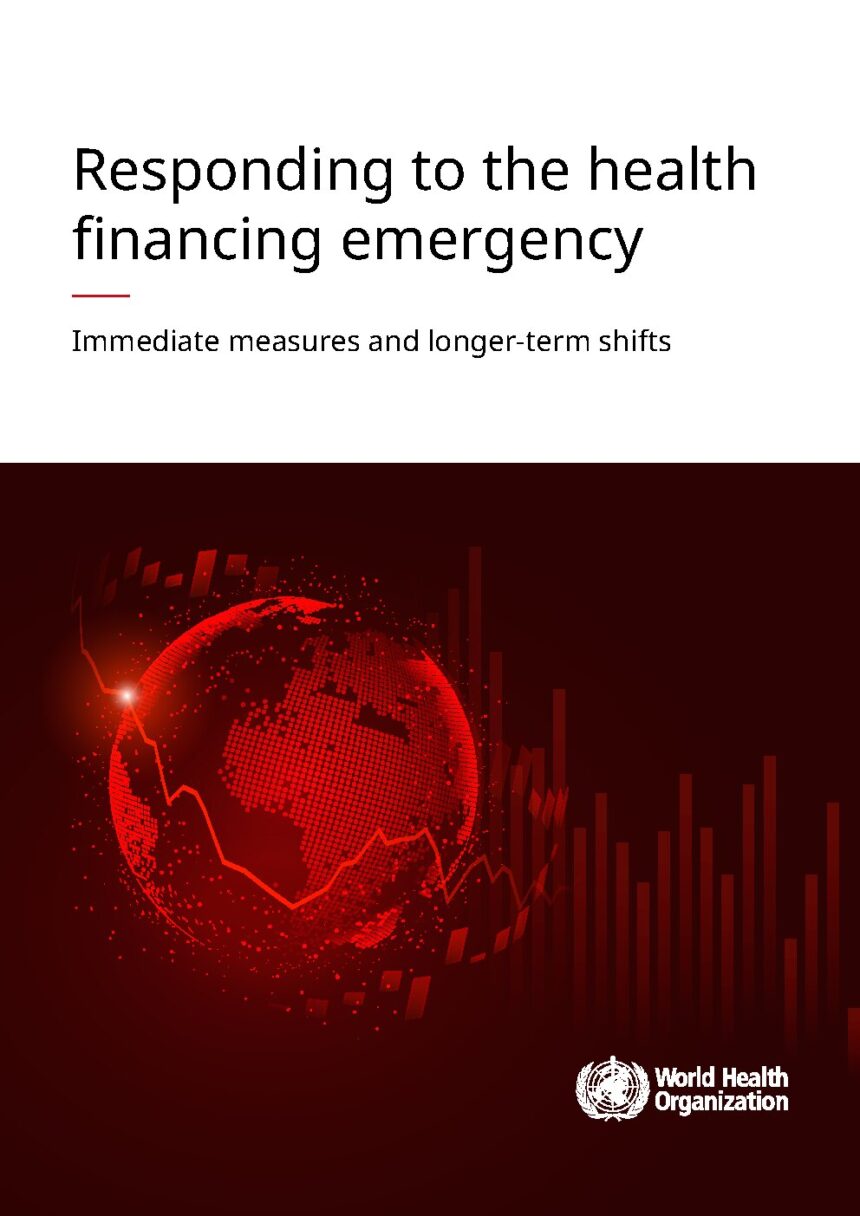
WHO guidance for ministries of health on mitigating external aid cuts and building sustainable domestic health financing for UHC.
- Issuer
- World Health Organization
- Edition
- 1st edition, 2025
- Audience
- Ministry of health officials engaged in health financing policy decision-making and analysis; finance authorities; external funding partners
- Evidence
- Evidence-based guidance drawing on WHO normative frameworks, donor transition literature, and responses to severe macroeconomic crises; validated through consultations with WHO global, regional and country-based experts and external reviewers
- Reviewed
- 15 Oct 2026 · GMJ
What this guideline says
GMJ summary
This WHO guidance addresses the unprecedented reduction in external health aid that began in January 2025—with estimates suggesting over 30% cuts globally—and its immediate impact on health systems in low- and middle-income countries. The document provides a two-part framework: immediate emergency measures (within 12 months) to protect priority services and populations, and medium- to longer-term structural shifts to build sustainable, equity-oriented health financing systems aligned with universal health coverage (UHC) objectives.
The guidance emphasizes that responses must focus on strengthening domestic public financing and existing health coverage schemes rather than creating new fragmented mechanisms. It covers five interconnected domains: fiscal capacity and revenue raising, public financial management (PFM), pooling arrangements, strategic purchasing, and evidence-informed priority setting. The framework is grounded in the principle that domestic government budgets—not employment-based contributions in settings with high labour market informality—remain the most viable path to sustainable coverage expansion.
Critically, the document warns that decisions made today in response to revenue reductions will create path dependencies for future health financing architectures. It calls for integration of parallel, donor-funded programmes into domestic systems, strengthened budget execution, elimination of inefficiencies, and institutionalization of evidence-based priority-setting processes including health technology assessment (HTA) to ensure scarce resources deliver maximum health impact with financial protection.
Key points
For clinicians — doses and thresholds as stated in the guideline
- Immediate action: reprioritize existing budgets towards essential services, submit supplementary budgets or activate emergency funds to address urgent needs and prevent stockouts of essential medical supplies
- Maintain access to essential services without introducing new fees that can exacerbate inequities, particularly for priority population groups; activate contingency safety net mechanisms where relevant
- Focus on domestic public revenue sources: better enforce existing tax collection mechanisms to minimize leakage; in settings with high labour informality, do not rely on employment-based contributions for coverage expansion
- Address inefficiencies by integrating vertically funded or parallel inputs (e.g., supply chains, salary scales) into domestic systems; shift to generics, renegotiate prices, enforce referral systems
- Strengthen pooling: make coverage mandatory or automatic based on residence or citizenship; promote cross-subsidization and risk-sharing across different health coverage schemes through harmonization, merging, or risk equalization
- Strategic purchasing: shift from rigid line-item budgets to output-oriented provider payment methods; introduce budget or volume ceilings on fee-for-service, especially for private sector access
- Institutionalize evidence-informed priority setting and HTA with participatory governance to define health benefit packages aligned with available resources, cost-effectiveness, budget impact, equity, and primary health care orientation
- Align budget structures with service delivery models through programme-oriented budgeting; streamline fund disbursements including direct facility financing to enhance responsiveness at the service delivery level
Rapid analytics to support immediate policy actions
Table extracted from the guideline
| Analytical area | Purpose and key actions |
|---|---|
| Map external funding volume, channels and use | Conduct rapid mapping of all external funding flows, freezes and cuts including on- and off-budget support; evaluate costs and resource requirements for services previously externally funded; identify opportunities for consolidation and reprogramming |
| Evaluate fiscal and budgetary context | Review medium-term fiscal and budgetary scenarios including government revenues, public expenditures and health spending trends; assess financial sustainability of spending plans; review alignment of any existing MTEF with annual budget allocation |
| Rapidly review covered services and provider payment systems | Conduct rapid assessment of externally funded services to define prioritized list to be maintained using domestic resources; assess whether adjustments needed in provider payment methods and rates given service delivery priorities |
| Review PFM rules and processes | Diagnose most pressing PFM bottlenecks that impede effective allocation, formulation and execution of health budgets; identify urgent actions to address budget under-execution; identify gaps in health expenditure tracking |
Source: World Health Organization, Responding to the health financing emergency: immediate measures and longer-term shifts. Reproduced in summary form.
From the guideline
Verbatim
“The decisions made today in response to revenue reductions can create a path dependency for the future shape and form of domestic health financing architectures.”
Editor’s perspective
Why this matters for Georgia and the region
Prof. Giorgi Pkhakadze, MD, MPH, PhD
Editor-in-Chief, Georgian Medical Journal · Chair, Public Health Institute of Georgia · WHO consultant, health and migration
As someone who has worked on health systems strengthening in Georgia for decades, I recognise that this guidance arrives at a critical juncture for our region. Georgia's relatively successful UHC programme, funded primarily through general revenues, validates the document's core message: in settings like ours with substantial informal employment, sustainable coverage expansion depends on strengthening public finance rather than introducing employment-based social insurance. The immediate challenge for Georgian policymakers will be integrating remaining donor-funded programmes—particularly in tuberculosis and HIV where external support has been significant—into our domestic budgeting cycles without service disruptions. I would stress to colleagues the guidance's recommendation to institutionalise evidence-based priority setting through HTA: Georgia has the technical capacity at our public health institutions to establish these processes, which will be essential as we make difficult resource allocation decisions. One realistic implementation caveat: the guidance's emphasis on streamlining PFM and enabling direct facility financing requires close collaboration with the Ministry of Finance, and such cross-ministerial reforms typically take longer than the 12-month emergency timeframe suggested for immediate actions.
ORCID 0000-0001-7609-4515 · Perspective written for the GMJ Guidelines Library, 15 Oct 2026
Applicability
Georgia and the South Caucasus
Georgia’s health system—which achieved substantial UHC progress through its State Health Insurance Programme (launched 2013) and successfully implemented hepatitis C elimination and routine rotavirus immunization—now faces the dual challenge of reduced external aid and the need to strengthen domestic financing mechanisms. The country’s Universal Health Care Programme, funded primarily through general government revenues rather than employment-based contributions, aligns with this guidance’s core recommendation to focus on public budget sources in settings with significant informal employment. Georgian policymakers should prioritize strengthening the existing health coverage scheme rather than introducing new contributory mechanisms, focus on integrating any donor-funded vertical programmes (particularly in tuberculosis, HIV, and maternal-child health) into domestic PFM processes, and accelerate institutionalization of evidence-based priority setting through HTA capacity-building at the National Center for Disease Control and Public Health and the Ministry of Health. The guidance’s emphasis on direct facility financing and programme-oriented budgeting is particularly relevant for Georgia’s ongoing efforts to strengthen primary health care and address regional disparities in access.
Questions this guideline answers
Quick answers
Should countries with high labour informality establish social health insurance schemes to raise new revenues?
No. In settings with high labour market informality, employment-based contributions are unlikely to generate significant revenue and may increase administrative costs and create inequities by leaving the 'missing middle' uncovered. The guidance recommends focusing on improving existing tax collection, broadening the tax base, and increasing budget transfers from general government revenues to cover populations outside formal employment. For countries that already have social health insurance, the priority should be increasing budget transfers to expand coverage rather than relying primarily on contributions.
What immediate actions can protect essential health services when external aid is suddenly cut?
Ministries of health should: (1) reprioritize existing budget allocations towards urgent health needs through budgetary virements; (2) mobilize executive leadership to submit supplementary budgets or activate emergency/contingency funding; (3) maintain access to essential services without introducing new fees, particularly for priority populations; (4) work with remaining donors to ensure alignment of external funds with priority services informed by rapid benefit package review; and (5) identify efficiency enhancements by integrating parallel, donor-funded inputs (e.g., supply chains) into domestic systems.
How should countries handle donor-funded programmes like HIV, TB, and malaria services when aid is reduced?
Conduct a rapid assessment of externally funded services to define a prioritized list to be maintained using domestic resources and remaining external funds. Integrate these services into domestic budgeting and PFM processes rather than maintaining parallel systems. Address inefficiencies by consolidating duplicative information systems, procurement, surveillance and supply chains. Work towards full integration into medium-term expenditure frameworks and strategic plan costing. The goal is to shift from fragmented, verticalized funding to coherent domestic funding flows that support integrated care.
What are the key analytical tools needed to support health financing reform in this context?
Priority analytics include: (1) national health accounts using the System of Health Accounts 2011 framework to track all spending sources; (2) rapid mapping of external funding flows including on- and off-budget support; (3) PFM bottleneck assessments using WHO's Health Financing Progress Matrix; (4) evidence-informed priority setting and HTA capacity for benefit package definition; (5) cross-programmatic efficiency analysis to identify system-level inefficiencies; (6) fiscal and MTEF analysis to assess medium-term financial feasibility; and (7) financial protection monitoring disaggregated to subnational levels. Not all are needed simultaneously; prioritize based on country needs and available resources.
Related on GMJ
Interconnected resources
GMJ News coverage
Quality & accreditation
Other guidelines on this topic
- Compendium of practice to inform regional and national civilian-military collaboration for health emergency preparedness
- Nurturing care for children with developmental delays and disabilities: thematic brief
- Emergency ready primary health care operational guide
- Emergency ready primary health care framework
- Emergency ready primary health care framework
- Issuer
- World Health Organization
- Type
- Guidance (normative)
- Edition
- 1st edition, 2025
- Status
- Current
- Published
- 2025-12-02
- Languages
- English
- Scope
- Global, with emphasis on low- and middle-income countries affected by external aid reductions
- Audience
- Ministry of health officials engaged in health financing policy decision-making and analysis; finance authorities; external funding partners
- Pages
- 37
- Licence
- CC BY-NC-SA 3.0 IGO
- ISBN
- 978-92-4-011758-7
- Evidence
- Evidence-based guidance drawing on WHO normative frameworks, donor transition literature, and responses to severe macroeconomic crises; validated through consultations with WHO global, regional and country-based experts and external reviewers
- Record history
- Created 15 Oct 2026 · updated 15 Oct 2026 · next check Apr 2027
Responding to the health financing emergency: immediate measures and longer-term shifts. Geneva: World Health Organization; 2025. Licence: CC BY-NC-SA 3.0 IGO.GMJ Guidelines Library records are original summaries written by the GMJ editorial team from the issuer’s published document and reviewed by a physician. They do not replace the full guideline. The document is the copyright of its issuer and is linked, not hosted. Spotted an error or a newer edition? Tell the Guidelines Desk.
Was this article helpful?