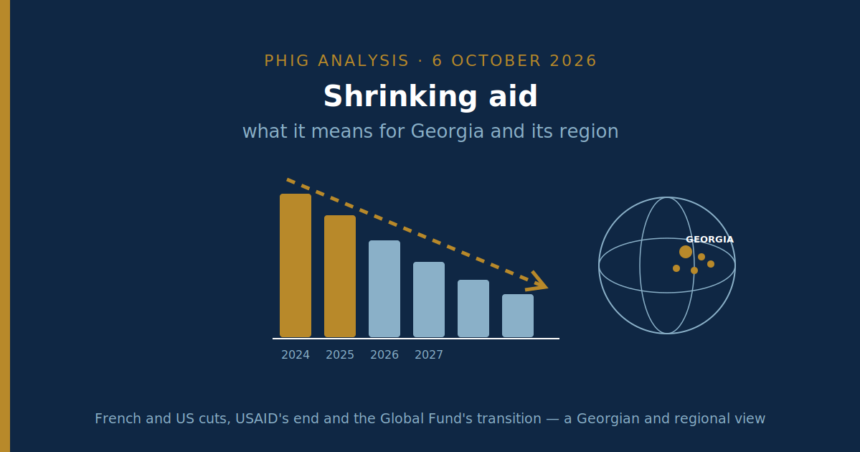
6 October 2026. The Public Health Institute of Georgia (PHIG) has published an analysis of this week’s global health financing news — France’s proposed further cut to development aid, the US State Department’s last-minute obligation of more than $4 billion in foreign aid alongside funds reserved for closing USAID, and the Global Fund’s decision to direct more of its resources to lower-income, high-burden countries as it chooses a new executive director — and what it means for Georgia and its neighbours.
PHIG argues that Georgia and most countries of the South Caucasus and Moldova are precisely the middle-income countries now receiving final Global Fund allocations, that USAID’s closure has removed the region’s most visible health partner, and that the European Union becomes the anchor donor by default, with governance and transparency conditions attached.
“The lesson of this week is that the region can no longer plan around donors,” said Prof. Giorgi Pkhakadze, PHIG’s Chair, calling for a public transition register of donor-funded services, parliamentary disclosure of every health financing agreement before signature, and a joint regional position on transition and on EU access.
Read the full PHIG analysis: https://publichealth.ge/shrinking-aid-what-the-french-and-us-cuts-and-the-global-funds-turn-to-the-poorest-countries-mean-for-georgia-and-its-region/

Source: PHIG analysis, 6 October 2026, drawing on Devex reporting of the same date. GMJ News is a platform of the Public Health Institute of Georgia; the analysis is quoted from the primary source on publichealth.ge.
Was this article helpful?
Disclaimer. This article is health journalism intended for general information and education. It is not medical advice and is not a substitute for professional diagnosis or treatment. Always consult a qualified healthcare provider about your individual circumstances. Full disclaimer →
Related Coverage


Editorial standards. This article was produced under the GMJ News editorial process, with oversight by the GMJ Editorial Board. Our editorial process. Spotted an error? Contact the editorial team.