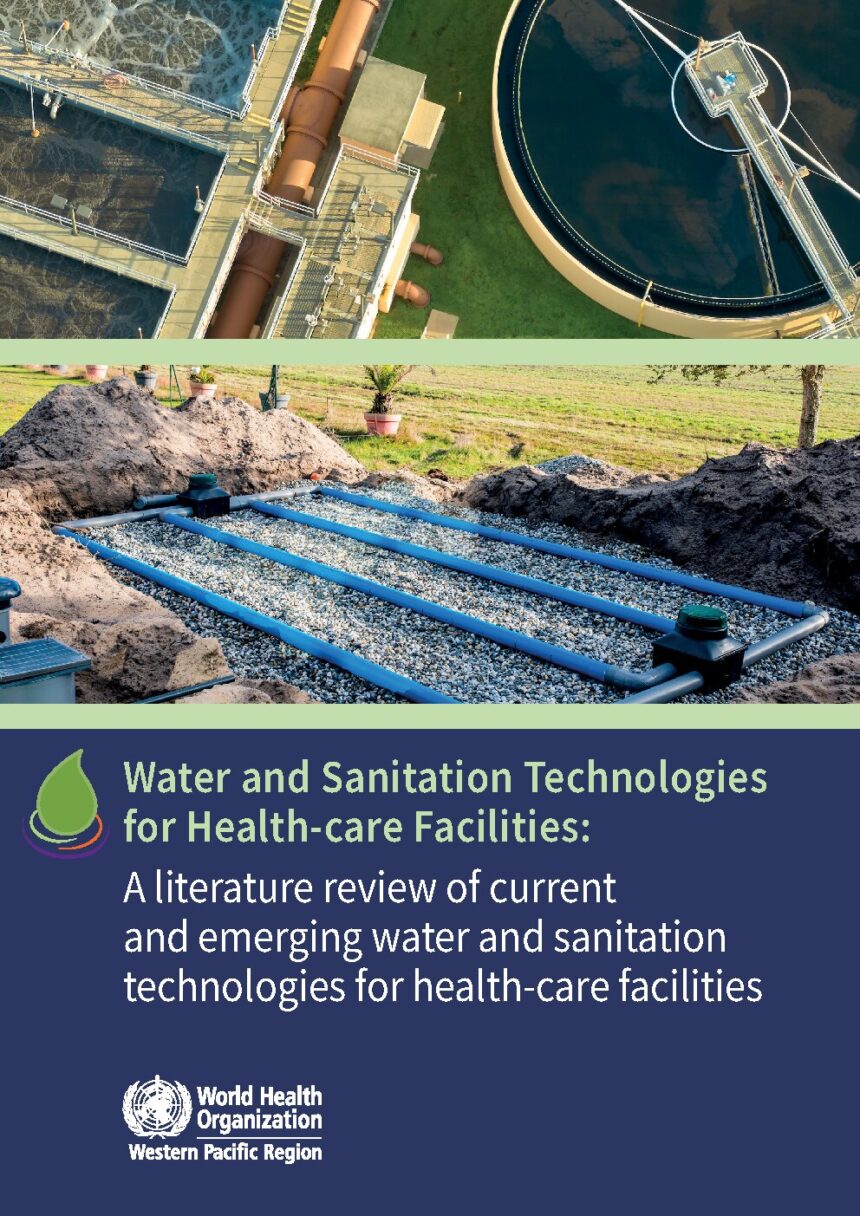
World Health Organization · 1st edition, 2024 · 30 pages
A literature review of current and emerging water and sanitation technologies for health-care facilities in LMICs.
- Issuer
- World Health Organization
- Edition
- 1st edition, 2024
- Audience
- Stakeholders and professionals responsible for managing water and sanitation in health-care facilities in low- and middle-income countries, particularly in the WHO Western Pacific Region.
- Evidence
- Literature review of academic and grey literature; descriptive guidance, not graded recommendations.
- Reviewed
- 16 Oct 2026 · GMJ
What this guideline says
GMJ summary
This WHO literature review identifies water supply and wastewater treatment technologies suitable for health-care facilities (HCFs), particularly in low- and middle-income countries (LMICs) in the Western Pacific Region. HCFs have unique requirements: they need consistent, reliable, high-quality water supply, and must remove hazardous compounds—including antibiotic-resistant bacteria (ARB) and pharmaceuticals (PhCs)—from wastewater before environmental disposal.
For water supply, the review covers adaptations to centralized piped systems (storage tanks and disinfection to address intermittency), on-site supply using groundwater, surface water, or rainwater (with filtration and disinfection), point-of-use treatment for sterile or ultra-pure water (distillation, reverse osmosis, UV, boiling, filters ≤0.45 µm), and non-conventional sources like desalination and recycled water. For wastewater, simplified systems (pit latrines, septic tanks, anaerobic baffled reactors) provide basic treatment but do not remove ARB or PhCs. Advanced technologies include physicochemical treatments (activated carbon, zeolites, chemical disinfection), biological systems (activated sludge, membrane bioreactors, constructed wetlands), and advanced oxidation processes (ozonation, Fenton, photo-Fenton, photocatalytic, electrochemical AOP) which achieve >90% removal of PhCs and significant ARB reduction. The review emphasizes that HCF effluents are 5–15 times more toxic than domestic wastewater; co-treatment at municipal plants is suboptimal, and on-site advanced treatment—though resource-intensive—is preferred where feasible.
The document serves as a resource for stakeholders to understand diverse water and sanitation technologies in the context of HCF requirements, acknowledging that technology choice must balance efficacy, cost, scale, operation and maintenance capacity, and local context. Where resources are scarce, basic containment and simplified treatment are preferable to direct environmental disposal, but larger HCFs and hospitals require more advanced solutions to protect public health and the environment.
Key points
For clinicians — doses and thresholds as stated in the guideline
- HCF water supply requires backup storage and disinfection; chlorine residuals should be maintained in distribution networks and dosing applied at key points to mitigate cross-contamination from intermittent piped supply.
- Point-of-use filters for sterilization at taps should have maximum porosity of 0.45 µm (practitioners recommend ≤0.2 µm) to control ARB outbreaks from internal plumbing; filters require regular maintenance and replacement based on volume filtered.
- Boiling water at >77 °C kills most pathogens in HCFs; solar disinfection (SODIS) requires a few hours of sunlight exposure; UV LED filters are emerging technologies for on-demand sterilization.
- Groundwater treatment typically combines softening, aeration, and disinfection; chlorine dispensers can be used as emergency treatment in resource-limited settings without electricity or moving parts.
- HCF wastewater is 5–15 times more toxic than domestic wastewater; conventional municipal treatment plants achieve only 10–90% removal of pharmaceuticals and are inadequate for ARB.
- Co-treatment using chlorine can be cost-effective for disinfection but incorrect dosing may increase ARB; ozonation, Fenton, and photo-Fenton processes improve biodegradability and avoid disinfection by-products but require precise process control.
- Advanced oxidation processes (AOPs) achieve removal rates >90% for pharmaceuticals and higher ARB removal than conventional systems; however, AOPs may generate by-products more challenging to remove than original pollutants.
- Membrane bioreactors show 30–50% higher removal rates than activated sludge for several pharmaceuticals, with effective pathogen removal, but ARB removal remains limited and polishing with physicochemical or AOP treatment is recommended.
From the guideline
Verbatim
“Hospital urine is often found to contain higher concentrations of ARB compared to effluent from the general population, and elevated levels of ARB are likewise to be expected in wastewater from HCFs.”
Editor’s perspective
Why this matters for Georgia and the region
Prof. Giorgi Pkhakadze, MD, MPH, PhD
Editor-in-Chief, Georgian Medical Journal · Chair, Public Health Institute of Georgia · WHO consultant, health and migration
As Editor-in-Chief of the Georgian Medical Journal and WHO consultant, I see this review as essential for Georgia's health infrastructure modernization. Our country has made impressive strides—hepatitis C elimination since 2015, universal health coverage since 2013, rotavirus vaccine introduction in 2013—but water and sanitation in district hospitals remain weak points, particularly in rural areas with intermittent supply. I would stress to Georgian clinicians the immediate implementation of point-of-use filtration (≤0.45 µm) at taps in high-risk departments to prevent ARB outbreaks, which is a low-cost intervention with high impact. The realistic caveat is that advanced wastewater treatment technologies—while scientifically sound—require sustained investment in skilled personnel, maintenance, and specialized materials (membranes, activated carbon, zeolites) that may not be locally available. For Georgia, a phased approach is prudent: prioritize basic water reliability and sterilization now, pilot advanced treatment at one or two tertiary centres (Tbilisi, Batumi, Kutaisi) to build regional expertise, and establish national procurement frameworks for specialized materials through regional cooperation in the South Caucasus.
ORCID 0000-0001-7609-4515 · Perspective written for the GMJ Guidelines Library, 16 Oct 2026
Applicability
Georgia and the South Caucasus
Georgia’s health-care system, like many in Eastern Europe and the South Caucasus, faces challenges with intermittent water supply in some regions and aging infrastructure. This review is directly relevant for upgrading water and sanitation in Georgian HCFs, particularly district hospitals and rural health centres. National programmes should prioritize ensuring basic water supply reliability (storage, disinfection) and point-of-use sterilization (filters ≤0.45 µm) to prevent nosocomial infections. For wastewater, Georgia should consider on-site treatment solutions for larger hospitals generating effluents with elevated pharmaceuticals and ARB, especially given the country’s hepatitis C elimination programme (since 2015) and antimicrobial resistance surveillance initiatives. Investment in advanced treatment (activated carbon, AOPs) may be feasible for major tertiary centres, while smaller facilities should implement at minimum sealed containment and simplified biological treatment rather than direct disposal. Regional cooperation in the Caucasus could support procurement of specialized materials (membranes, activated carbon, zeolites) and training for skilled operation of advanced systems.
Questions this guideline answers
Quick answers
What is the minimum water quality standard for HCFs when piped supply is unreliable?
Storage tanks with disinfection (chlorine, UV, or boiling) immediately after transition from water mains are recommended. Chlorine residuals should be maintained in distribution networks. Point-of-use filters (≤0.45 µm, preferably ≤0.2 µm) at taps prevent ARB transmission. National standards should apply; if absent, use WHO drinking-water guidelines (2022). Higher standards are needed for surgical procedures and newborn delivery versus non-potable uses like garden watering.
Can HCF wastewater be treated together with municipal sewage?
Not optimally. HCF effluents are 5–15 times more toxic than domestic wastewater, with higher concentrations of ARB and pharmaceuticals. Municipal plants achieve only 10–90% removal of pharmaceuticals and are not designed for ARB. Co-treatment requires pre-treatment at the HCF (e.g., ozonation, Fenton processes) before discharge to sewers, but on-site or near-on-site advanced treatment is preferred where feasible to comprehensively remove emerging contaminants.
What treatment is needed for HCFs without access to sewerage in resource-limited settings?
Where resources are scarce, install at minimum pit latrines, septic tanks, or anaerobic baffled reactors to provide basic containment and reduce public health risks versus direct disposal. These simplified systems perform primary and secondary treatment but do not remove ARB, pharmaceuticals, or most pathogens. They are not adequate for larger HCFs or hospitals, which require additional physicochemical or biological treatment stages. Faecal sludge must be safely treated and disposed in controlled facilities.
Which wastewater treatment technology is most effective for removing pharmaceuticals and ARB from HCF effluents?
Advanced oxidation processes (AOPs)—ozonation, Fenton, photo-Fenton, photocatalytic, and electrochemical AOP—show the most promising results, achieving >90% removal of pharmaceuticals and higher ARB removal than conventional systems. However, AOPs are emerging technologies requiring skilled personnel, precise process control, and may generate challenging by-products. Combination approaches are recommended: biological treatment (activated sludge, membrane bioreactors, constructed wetlands) plus AOP or physicochemical polishing (activated carbon, zeolites) for comprehensive removal.
Related on GMJ
Interconnected resources
GMJ News coverage
Quality & accreditation
- ASF Hospital — Standard 18 — Sustainable Care
- ASF Hospital — Standard 5 — Safety & Emergency Preparedness
- ASF Medical Transport — Standard 5 — Infection Prevention & Control
- ASF Laboratory — Standard 7 — Examination: Process & Safety
- ASF Hospital — Standard 7 — Governance & Management
- ASF Hospital — Standard 4 — Care & Treatment
Other guidelines on this topic
- International Code of Conduct on Pesticide Management: Guidance note on addressing illegal trade of pesticides
- Measuring the progress and impact of the UN Decade of Healthy Ageing (2021–2030): framework and indicators recommended by WHO Technical Advisory Group
- International Code of Conduct on Pesticide Management: Guidance on options for reducing risk when phasing out pesticides
- Social and behaviour change interventions for contraception and family planning
- Labour Care Guide: Implementation Resource Package
- Issuer
- World Health Organization
- Type
- Guidance (normative)
- Edition
- 1st edition, 2024
- Status
- Current
- Published
- 2025-05-08
- Languages
- English
- Scope
- Water supply and wastewater treatment technologies for health-care facilities; does not cover health-care waste disposal or environmental cleaning.
- Audience
- Stakeholders and professionals responsible for managing water and sanitation in health-care facilities in low- and middle-income countries, particularly in the WHO Western Pacific Region.
- Pages
- 30
- Licence
- CC BY-NC-SA 3.0 IGO
- ISBN
- 9789290620631
- Evidence
- Literature review of academic and grey literature; descriptive guidance, not graded recommendations.
- Record history
- Created 16 Oct 2026 · updated 16 Oct 2026 · next check Apr 2027
Water and sanitation technologies for health-care facilities: a literature review of current and emerging water and sanitation technologies for health-care facilities. Manila: World Health Organization Regional Office for the Western Pacific; 2024. Licence: CC BY-NC-SA 3.0 IGO.GMJ Guidelines Library records are original summaries written by the GMJ editorial team from the issuer’s published document and reviewed by a physician. They do not replace the full guideline. The document is the copyright of its issuer and is linked, not hosted. Spotted an error or a newer edition? Tell the Guidelines Desk.
Was this article helpful?