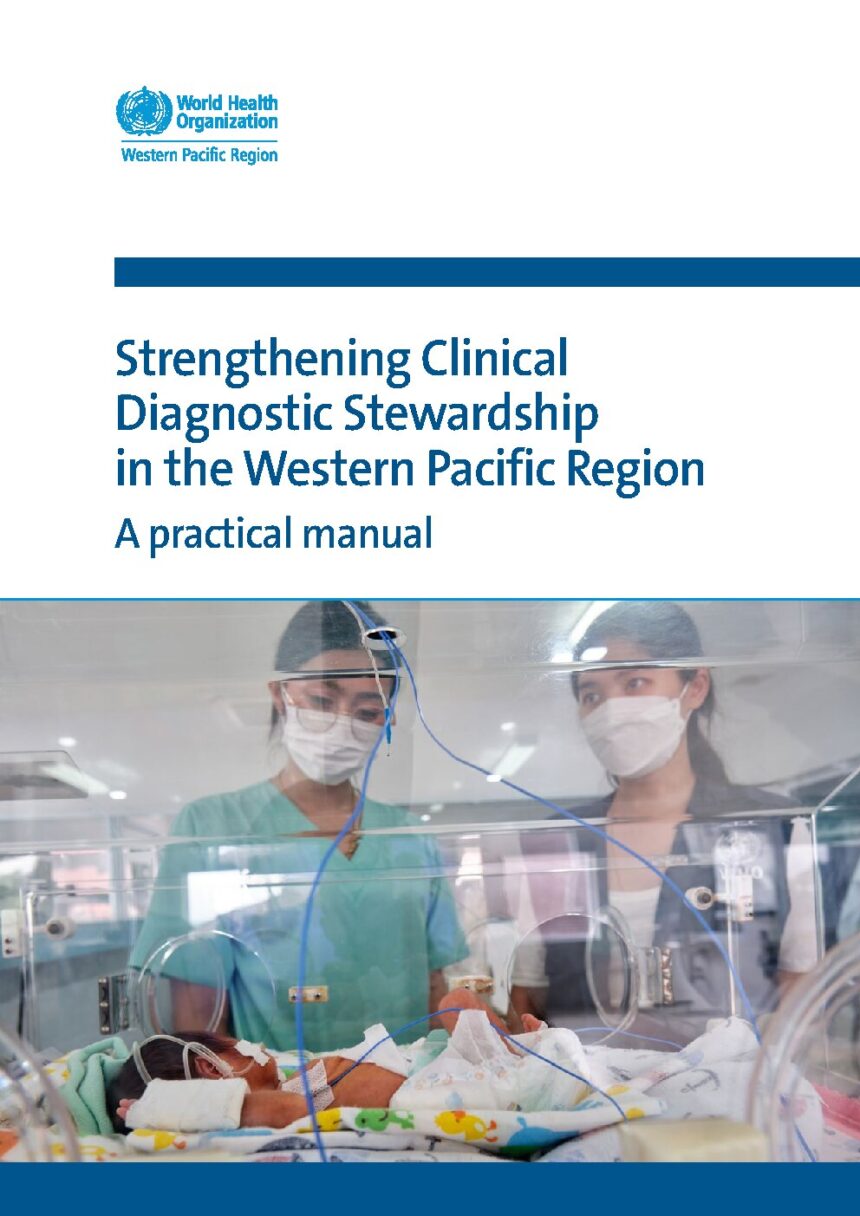
World Health Organization · 1st edition, 2026 · 47 pages
A practical guide for clinicians and health-care professionals on appropriate microbiological testing to improve patient outcomes and reduce antimicrobial resistance.
- Issuer
- World Health Organization
- Edition
- 1st edition, 2026
- Audience
- Clinicians, frontline health-care professionals, hospital epidemiologists, surveillance officers, infection control nurses, microbiology laboratory staff, pharmacists, hospital administrators, policy-makers, educators
- Evidence
- Expert consensus with case-study illustrations; aligned with WHO Global Antimicrobial Resistance and Use Surveillance System (GLASS) and AWaRe antibiotic classification
- Reviewed
- 17 Oct 2026 · GMJ
What this guideline says
GMJ summary
This practical manual provides comprehensive guidance on clinical diagnostic stewardship—ensuring the right diagnostic test is taken from the right patient at the right time using proper techniques, with results interpreted and acted upon appropriately. The manual emphasizes that pre-analytical errors (inappropriate test requests, poor specimen collection, contamination) account for 60–70% of all laboratory errors and directly compromise patient care quality.
The document presents a six-step diagnostic stewardship pathway covering clinical assessment, specimen collection, laboratory processing, and result interpretation. It addresses common problems including over-testing (routine wound swabs from chronic ulcers without infection signs, catheter urine samples from asymptomatic patients), under-testing (missing blood cultures in sepsis), and misinterpretation of results (treating colonization rather than infection). Case studies demonstrate practical applications in adult and paediatric settings.
Clinical diagnostic stewardship is positioned as integral to antimicrobial stewardship (AMS) and infection prevention and control (IPC), with accurate microbiological diagnosis enabling appropriate antibiotic selection, de-escalation from broad-spectrum to narrow-spectrum agents, and early detection of antimicrobial resistance patterns. The manual emphasizes that implementation requires sustained leadership commitment, adequate financing, staff training, and regular monitoring with feedback mechanisms.
Key points
For clinicians — doses and thresholds as stated in the guideline
- Blood cultures should be taken from all patients with suspected sepsis before starting antibiotics (without delaying treatment); two sets (four bottles total) are recommended where resources allow
- Blood culture contamination rates >3% indicate need for intervention; coagulase-negative staphylococci in a single blood culture bottle typically represent contamination rather than infection
- Urine cultures are indicated only for symptomatic patients with suspected upper-urinary-tract infection or lower-tract infection with risk factors; routine testing of asymptomatic catheterized patients is not recommended
- Wound swabs from chronic ulcers without clinical signs of infection (cellulitis, fever) should not be sent, as results represent colonization and drive unnecessary antibiotic use
- Sputum samples cannot be obtained from children under 10 years and have limited value in mild respiratory infections; objective quality assessment (polymorphs to epithelial cell ratio) should guide culture decisions
- Routine culture of central venous catheter tips upon removal is not recommended unless clinical signs suggest bloodstream infection or exit site infection is present
- Respiratory viral PCR can detect recent past infection (not just active disease); 'Detected' results must be interpreted with clinical symptoms and timing
- White blood cell counts >1000 × 10⁶/L in urine support but do not confirm urinary tract infection; clinical features and specimen collection method must be considered
Indicators to consider for monitoring clinical diagnostic stewardship activities
Table extracted from the guideline
| Step of pathway | Examples of possible indicators |
|---|---|
| Step 1: Clinical assessment and ordering tests | Percentage of patients with suspected sepsis who had blood cultures taken |
| Step 2: Collecting specimens | Proportion of patients with suspected sepsis who had blood cultures taken before starting antimicrobials; blood culture contamination rates; blood culture positivity rates; number of specimens with illegible/missing labelling |
| Step 6: Interpreting and acting on results | Time to reporting Gram stain from blood culture flagging positive; percentage of patients who received appropriate antimicrobial therapy after critical results reported (e.g. Staphylococcus aureus bacteraemia) |
Source: World Health Organization, Strengthening clinical diagnostic stewardship in the Western Pacific Region: a practical manual. Reproduced in summary form.
From the guideline
Verbatim
“The pre-analytic phase is the leading source of error in laboratory diagnostics, responsible for an estimated 60–70% of all laboratory errors.”
Editor’s perspective
Why this matters for Georgia and the region
Prof. Giorgi Pkhakadze, MD, MPH, PhD
Editor-in-Chief, Georgian Medical Journal · Chair, Public Health Institute of Georgia · WHO consultant, health and migration
As we strengthen Georgia's antimicrobial resistance surveillance under our National Action Plan, this WHO manual provides the missing operational link between laboratory capacity and clinical practice. Our experience implementing the Global Antimicrobial Resistance and Use Surveillance System since 2017 has shown that data quality depends fundamentally on appropriate specimen selection and collection—the pre-analytical errors highlighted here explain much of the contamination and colonization we see in reported isolates. I would emphasize to Georgian clinicians the specific guidance on blood culture contamination rates (target <3%) and the practical algorithms for distinguishing infection from colonization in chronic wounds and catheterized patients, both common scenarios in our tertiary centres. The realistic caveat is financing: while the manual correctly identifies health financing structures and procurement systems as essential enablers, Georgia's mixed public-private laboratory landscape and variable insurance coverage for microbiological testing will require phased implementation, likely starting with sentinel sites already participating in AMR surveillance before scaling to regional hospitals.
ORCID 0000-0001-7609-4515 · Perspective written for the GMJ Guidelines Library, 17 Oct 2026
Applicability
Georgia and the South Caucasus
For Georgia and the South Caucasus, this manual addresses critical gaps in diagnostic stewardship practices that directly impact antimicrobial resistance control and patient safety. The Western Pacific Region projections of 5.2 million deaths and US$ 148 billion in excess costs from drug-resistant infections (2020–2030) underscore risks relevant to all middle-income countries implementing antimicrobial resistance surveillance. Georgian national programmes should consider adaptation of the clinical decision tools and standard operating procedures to local contexts, integration with existing antimicrobial stewardship initiatives under the National Action Plan on AMR, and alignment with essential diagnostics lists to support sustainable procurement. The emphasis on reducing low-value testing is particularly relevant for health systems balancing universal health coverage expansion with resource constraints, while the quality-assurance indicators can strengthen laboratory accreditation processes already underway in the region.
Questions this guideline answers
Quick answers
When should blood cultures be taken and how many?
Blood cultures should be taken from patients with suspected sepsis before starting antibiotics, without delaying treatment. Where resources allow, two sets (one set = two bottles: aerobic and anaerobic) should be taken from two different peripheral sites close together in time. For patients with suspected meningitis, blood cultures are important even when cerebrospinal fluid is negative and are usually quicker and easier to perform than lumbar puncture.
How do you distinguish between infection, colonization, and contamination?
Interpretation requires clinical context: blood should be sterile, so any growth is significant unless common skin commensals (coagulase-negative staphylococci, Cutibacterium acnes, Corynebacterium, Bacillus species, Micrococcus) appear in only one of multiple bottles. For non-sterile sites (urine, wounds, sputum), consider clinical symptoms, white cell counts, specimen quality, and collection method. Chronic ulcers and endotracheal tubes are almost universally colonized; growth without clinical infection signs does not require treatment.
What urine specimens should not be sent for culture?
Do not send: (1) urine from perineal collection bags in children (high contamination risk; use catheterization or clean-catch instead); (2) catheter urine from asymptomatic patients (colonization is universal); (3) samples from otherwise-well premenopausal women with lower-urinary-tract symptoms alone (empiric treatment is appropriate). Do send urine for culture if the patient has upper-tract symptoms (fever, flank pain), recurrent UTI, immunosuppression, pregnancy, uncertain diagnosis, or failure of empiric therapy.
Should routine sputum or catheter tip cultures be performed?
No. Sputum should only be sent if there is clinical suspicion of infection and the sample quality is adequate (mucopurulent, not salivary; high white-cell-to-epithelial-cell ratio). Sputum cannot be obtained from children under 10 years unless intubated. Central venous catheter tips should only be cultured if there are symptoms of line infection (fever, rigors, hypotension without other source) or exit site infection (erythema, pus); routine culture upon removal consumes resources and drives unnecessary treatment.
Related on GMJ
Interconnected resources
Dictionary of Public Health
Drugs A–Z
Conditions A–Z
GMJ News coverage
- Sepsis AI Algorithms Fail When Trained on Future Data, Study Reveals Critical FlawsJul 2026
- New antibiotic combinations show promise against resistant urinary tract infectionsMay 2026
- Cambridge researchers identify three distinct severe pneumonia subtypes, opening path to personalised treatmentSep 2026
- Machine Learning Model Predicts Child Pneumonia Hospitalisation Risk in Malawi Primary CareJun 2026
Quality & accreditation
- ASF Laboratory — Standard 1 — Governance & Document Control
- ASF Laboratory — Standard 6 — Pre-Examination: Specimen Pathway
- ASF Laboratory — Standard 7 — Examination: Process & Safety
- ASF Laboratory — Standard 8 — Post-Examination: Reporting & Critical Values
- ASF Hospital — Standard 5 — Safety & Emergency Preparedness
- ASF Medical Transport — Standard 5 — Infection Prevention & Control
Other guidelines on this topic
- Minimum operational standards and typology for rapid response mobile laboratories
- Water and Sanitation Technologies for Health-care Facilities: Selecting Options for Adoption and Scale-up in the Western Pacific Region
- Water and Sanitation Technologies for Health-care Facilities
- Anthrax: implementation guidance for clinicians
- Emergency ready primary health care framework
- Issuer
- World Health Organization
- Type
- Manual
- Edition
- 1st edition, 2026
- Status
- Current
- Published
- 2026-06-09
- Languages
- English
- Scope
- Clinical diagnostic stewardship focusing on bacteriological testing (microscopy, pathogen identification, antimicrobial susceptibility testing) for infectious disease diagnosis
- Audience
- Clinicians, frontline health-care professionals, hospital epidemiologists, surveillance officers, infection control nurses, microbiology laboratory staff, pharmacists, hospital administrators, policy-makers, educators
- Pages
- 47
- Licence
- CC BY-NC-SA 3.0 IGO
- ISBN
- 978-92-9-062136-2
- Evidence
- Expert consensus with case-study illustrations; aligned with WHO Global Antimicrobial Resistance and Use Surveillance System (GLASS) and AWaRe antibiotic classification
- Record history
- Created 17 Oct 2026 · updated 17 Oct 2026 · next check Apr 2027
Strengthening clinical diagnostic stewardship in the Western Pacific Region: a practical manual. Manila: WHO Regional Office for the Western Pacific; 2026. Licence: CC BY-NC-SA 3.0 IGO.GMJ Guidelines Library records are original summaries written by the GMJ editorial team from the issuer’s published document and reviewed by a physician. They do not replace the full guideline. The document is the copyright of its issuer and is linked, not hosted. Spotted an error or a newer edition? Tell the Guidelines Desk.
Was this article helpful?