World Health Organization · 1st edition, 2025 · 66 pages
Step-by-step guide for national and subnational authorities to implement IPC programmes across preparedness, readiness and response phases
- Issuer
- World Health Organization
- Edition
- 1st edition, 2025
- Audience
- National and subnational IPC focal points, outbreak response focal points, public health institutions, disaster management agencies, safety and quality leads, regulatory bodies, NGOs involved in IPC and emergency response
- Evidence
- Implementation science principles, multimodal strategy framework, country case studies and expert consensus
- Reviewed
- 17 Oct 2026 · GMJ
What this guideline says
GMJ summary
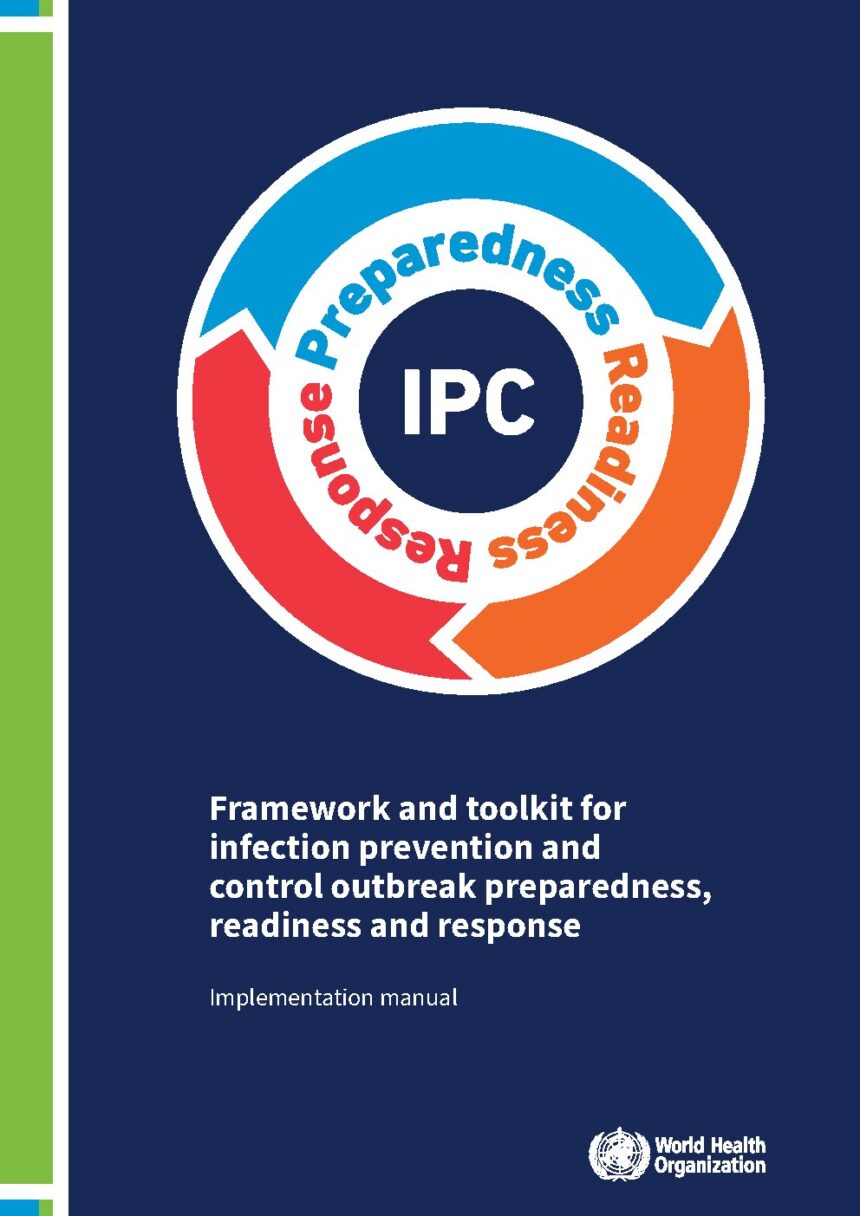
This implementation manual accompanies the WHO Framework and Toolkit for IPC outbreak preparedness, readiness and response (IPC-OFT). It provides a structured, phase-based approach for national and subnational authorities to strengthen infection prevention and control capacities before, during, and after outbreaks. The manual translates the IPC-OFT framework into actionable steps using a multimodal strategy that includes system change, training, monitoring, culture change, and communications.
The manual organizes IPC actions into three emergency management phases: preparedness (building foundational IPC capacity over 6 months to 2 years), readiness (adapting plans for a specific imminent threat over approximately 6 months), and response (activating plans during an actual outbreak). Within each phase, actions are prioritized as immediate (operationalizing key activities), early (engaging personnel and partners), or advanced (auditing and testing systems).
Health facilities with limited IPC capacity can amplify infectious disease transmission within facilities, communities, and across borders. The manual emphasizes that evidence-based IPC measures are critical for preventing and containing outbreaks while ensuring ongoing delivery of safe, effective health care. It provides templates, checklists, assessment tools and country examples to support implementation adapted to local contexts.
Key points
For clinicians — doses and thresholds as stated in the guideline
- Three emergency phases guide IPC actions: preparedness (no evident threat), readiness (imminent risk from neighbouring outbreak or global alert), and response (facing actual outbreak with greater-than-expected incidence)
- Immediate preparedness priorities include evaluating IPC capacity using IPCAT-2 and SPAR tools, developing national IPC outbreak management plans, creating training programmes, and establishing surge capacity plans
- Readiness phase requires adapting existing plans to the specific threat, reviewing PPE stockpiles using burn rate calculators, activating training coordination teams using training-of-trainers strategies, and establishing IPC outbreak task forces
- Response phase activates IPC task forces, distributes essential supplies to priority facilities, leverages on-the-job training (2-3 hours for up to 15 workers), activates surveillance systems, and implements communication strategies
- Multimodal strategy includes five elements: Build it (system change), Teach it (training), Check it (monitoring), Live it (culture change), and Sell it (communications)
- IPC outbreak task force should be multidisciplinary, meet regularly with documented minutes, establish clear command lines, and coordinate with incident management systems
- Surveillance priorities include monitoring infections among health workers, tracking trained personnel percentages, ensuring availability of IPC supplies, and establishing regular reporting mechanisms
- Advanced priorities in all phases include conducting simulation exercises, tabletop drills, after-action reviews, and systematic assessments using the IPC outbreak preparedness-readiness-response checklist
Summary of phases, priorities and key actions for infection prevention and control in emergencies at national level
Table extracted from the guideline
| Emergency phase | Priority | Key actions | Multimodal element |
|---|---|---|---|
| Preparedness | Immediate | Evaluate IPC capacity | Check it |
| Preparedness | Immediate | Develop national IPC preparedness and response plan | Build it |
| Preparedness | Immediate | Develop national IPC outbreak guidelines | Build it |
| Preparedness | Immediate | Develop national IPC outbreak training programme | Teach it |
| Preparedness | Immediate | Coordinate with national surveillance and reporting programme | Check it |
| Preparedness | Immediate | Develop national or subnational IPC communication strategy | Sell it |
| Preparedness | Immediate | Develop surge capacity plans for IPC resources | Build it |
| Preparedness | Early | Establish IPC outbreak taskforce | Build it |
| Preparedness | Early | Establish IPC partner mapping and networking | Live it |
| Preparedness | Advanced | Assess IPC outbreak preparedness | Check it |
| Readiness | Immediate | Establish IPC outbreak taskforce | Build it |
| Readiness | Immediate | Ready the national IPC outbreak response plan | Build it |
| Readiness | Immediate | Adapt surge capacity plans for IPC resources | Build it |
| Readiness | Immediate | Adapt national IPC outbreak training programme | Teach it |
| Readiness | Immediate | Coordinate with national surveillance and reporting programme | Check it |
| Readiness | Immediate | Adapt national or subnational IPC communication strategy | Sell it |
| Readiness | Early | Prepare IPC partners | Live it |
| Readiness | Early | Prepare IPC stakeholder networks | Live it |
| Readiness | Advanced | Assess IPC outbreak readiness | Check it |
| Response | Immediate | Activate IPC outbreak task force | Build it |
| Response | Immediate | Activate national IPC outbreak response plan | Build it |
| Response | Immediate | Activate surge capacity plans for IPC resources | Build it |
| Response | Immediate | Leverage national IPC outbreak training programme | Teach it |
| Response | Immediate | Activate national surveillance and reporting programme | Check it |
| Response | Immediate | Activate national or subnational IPC communication strategy | Sell it |
| Response | Early | Monitor for resurgence of cases | Check it |
| Response | Advanced | Assess IPC outbreak response | Check it |
Source: World Health Organization, Framework and toolkit for infection prevention and control outbreak preparedness, readiness and response: implementation manual. Reproduced in summary form.
From the guideline
Verbatim
“Health facilities with limited or no infection prevention and control capacities can amplify infectious disease transmission within the facilities themselves, within communities and possibly across borders.”
Editor’s perspective
Why this matters for Georgia and the region
Prof. Giorgi Pkhakadze, MD, MPH, PhD
Editor-in-Chief, Georgian Medical Journal · Chair, Public Health Institute of Georgia · WHO consultant, health and migration
As Chair of Georgia's Public Health Institute, I recognize this manual addresses critical gaps in our outbreak preparedness revealed during the COVID-19 pandemic. Georgian health facilities must prioritize the immediate preparedness actions: conducting baseline IPCAT-2 assessments, establishing dedicated IPC budgets, and creating functional IPC outbreak task forces with clear coordination mechanisms between the national programme and our regional public health centres. The manual's emphasis on Orange Networks—peer facility groups sharing resources and expertise—offers a practical model for Georgia's resource-constrained system where only 30-40% of facilities currently meet minimum IPC requirements. However, our most significant implementation challenge will be training sufficient IPC specialists; we currently lack the certified postgraduate IPC training programmes required by WHO core competencies, and developing accredited curricula within Georgian medical universities should be an urgent priority alongside the operational steps outlined here.
ORCID 0000-0001-7609-4515 · Perspective written for the GMJ Guidelines Library, 17 Oct 2026
Applicability
Georgia and the South Caucasus
Georgia’s health system would benefit significantly from this framework given ongoing regional infectious disease threats and the country’s role as a transit corridor between Europe and Asia. The Georgian Public Health Institute and national IPC programmes should prioritize baseline assessment using IPCAT-2 and SPAR IPC indicators (C9.1-C9.3) to identify gaps. Given limited resources, Georgia should focus on establishing Orange Networks of peer health facilities that share characteristics and can support each other, following Nigeria’s model. The country’s existing surveillance infrastructure for tuberculosis, hepatitis C, and vaccine-preventable diseases provides a foundation for integrating IPC outbreak surveillance. Implementation challenges will include securing dedicated IPC budgets at national and facility levels, training sufficient IPC specialists (requiring certified postgraduate IPC training courses), and coordinating across fragmented health governance structures. The manual’s emphasis on early coordination with WASH programmes aligns well with ongoing efforts to strengthen water and sanitation in Georgian health facilities.
Questions this guideline answers
Quick answers
How do I determine which emergency phase my country is in?
Answer two questions: (1) Are you facing an outbreak with greater-than-expected incidence, a single case of rare epidemic-prone disease, or increased highly transmissible disease cases? If yes, you are in Response phase. (2) If no to question 1, do you have a single case of epidemic-prone disease in a neighbouring area with links, increased cases in linked regions, or a global alert? If yes, you are in Readiness phase. If no to both, you are in Preparedness phase.
What are the essential IPC supplies that should be stockpiled?
Essential supplies include personal protective equipment (PPE) appropriate to transmission modes, hand hygiene resources, environmental cleaning and disinfection supplies, and waste management materials. Use the WHO disease commodity packages and technical specifications to define quantities based on number of health facilities, bed capacity, and transmission characteristics of potential outbreak pathogens. Calculate burn rates using the PPE burn rate calculator and plan for contingencies in case of shortages.
What training is required for IPC professionals?
IPC professionals require completion of a certified postgraduate IPC training course or nationally/internationally recognized postgraduate course including IPC as core curriculum with practical and clinical training, following WHO core competencies. During outbreaks, use training-of-trainers strategies with 2-3 hour on-the-job training sessions for up to 15 health workers. Essential content includes hand hygiene, standard precautions, use of PPE, rapid identification and isolation procedures, and contact tracing. Maintain a database of trained personnel.
How should an IPC outbreak task force be structured?
The task force should be multidisciplinary with clear terms of reference defining roles, responsibilities, and command lines. It can be derivative of an existing national IPC committee but with different outbreak-specific functions. Establish regular meeting schedules with documented minutes, create communication cascades from national to facility level, coordinate with the incident management system's Health Operations pillar, and include partners from surveillance, laboratory, risk communication, and clinical management teams. Update stakeholder mapping at least every six months.
Related on GMJ
Interconnected resources
Dictionary of Public Health
GMJ News coverage
- Sir Jeremy Farrar's Retirement from WHO Is a Warning — Not About WHO, but About How the World Funds Global HealthAug 2026
- UK flu and COVID-19 surveillance data to May 2027 shows continued monitoring amid seasonal trendsOct 2026
- Community Health Workers Boost COVID-19 Testing Among Formerly Incarcerated PeopleAug 2026
- Hospital-Acquired Infections Rising in UK: Latest Surveillance Data Shows Increases in Dangerous PathogensAug 2026
Quality & accreditation
- ASF Hospital — Standard 5 — Safety & Emergency Preparedness
- ASF Hospital — Standard 11 — Critical Care
- ASF Medical Transport — Standard 6 — Emergency Response During Transport
- ASF Medical Transport — Standard 5 — Infection Prevention & Control
- ASF Laboratory — Standard 7 — Examination: Process & Safety
Other guidelines on this topic
- Guidance on Indoor Environmental Quality in Health Care Facilities
- Respiratory Protection Program for Healthcare Workers
- Risk Communication and Community Engagement for Contact Tracing in the Context of COVID-19 in the Region of the Americas
- Guidance for Developing Status Profiles on Communicable Diseases to Further Progress toward Their Elimination in the Region of the Americas
- Manual for Stratifying Malaria Risk and the Elimination of Foci
- Issuer
- World Health Organization
- Type
- Handbook
- Edition
- 1st edition, 2025
- Status
- Current
- Published
- 2025-12-03
- Languages
- English
- Scope
- National and subnational infection prevention and control programmes; outbreak preparedness, readiness and response
- Audience
- National and subnational IPC focal points, outbreak response focal points, public health institutions, disaster management agencies, safety and quality leads, regulatory bodies, NGOs involved in IPC and emergency response
- Pages
- 66
- Licence
- CC BY-NC-SA 3.0 IGO
- ISBN
- 9789240105614
- Evidence
- Implementation science principles, multimodal strategy framework, country case studies and expert consensus
- Record history
- Created 17 Oct 2026 · updated 17 Oct 2026 · next check Apr 2027
World Health Organization. Framework and toolkit for infection prevention and control outbreak preparedness, readiness and response: implementation manual. Geneva: World Health Organization; 2025. Licence: CC BY-NC-SA 3.0 IGO.GMJ Guidelines Library records are original summaries written by the GMJ editorial team from the issuer’s published document and reviewed by a physician. They do not replace the full guideline. The document is the copyright of its issuer and is linked, not hosted. Spotted an error or a newer edition? Tell the Guidelines Desk.
Was this article helpful?