Pan American Health Organization · 1st edition, 2025 · 71 pages
Procedures for institutional, community, and laboratory case-finding to strengthen surveillance of vaccine-preventable diseases for public-health professionals.
- Issuer
- Pan American Health Organization
- Edition
- 1st edition, 2025
- Audience
- National and subnational epidemiologists, immunization programme managers, public-health professionals, laboratory staff, and rapid response teams responsible for vaccine-preventable disease surveillance.
- Evidence
- Expert consensus based on PAHO Member State field experience; procedures derived from WHO polio eradication and measles/rubella elimination verification frameworks.
- Reviewed
- 16 Oct 2026 · GMJ
What this guideline says
GMJ summary
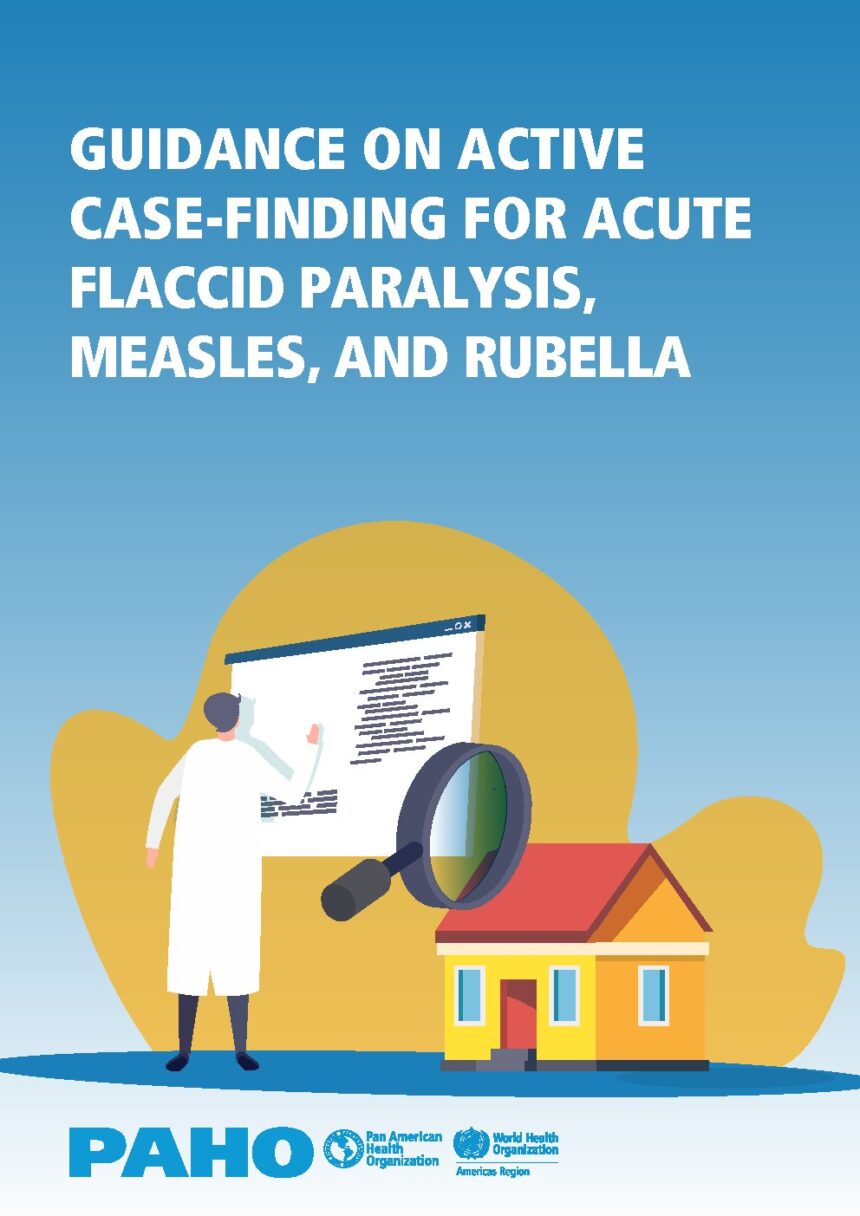
This 2025 PAHO technical guidance describes standardised procedures for active case-finding (ACF) of acute flaccid paralysis (AFP), measles, and rubella as a quality-control tool for routine epidemiological surveillance. Unlike passive surveillance, ACF involves health teams retrospectively visiting health facilities (active institutional case-finding, AIC), communities (active community case-finding, ACC), and laboratories (active laboratory case-finding, ALC) to identify unreported cases and document opportunities to improve system sensitivity.
The guidance recommends implementing AIC in selected high-risk municipalities at least every three months, reviewing medical records over defined periods: the preceding three months for AFP and 30 days for measles/rubella. ACC is conducted through household visits using community-adapted case definitions, targeting blocks around confirmed cases or in silent municipalities. All identified cases require field investigation, sample collection within specified time windows (stool samples within 14 days of AFP onset; serum within 30 days of rash onset), and classification by analysis units or external committees.
The methodology integrates selection criteria for municipalities (epidemiological silence, failure to meet reporting rates, migrant populations, border areas) and health facilities (highest user volume, rehabilitation centres for AFP, facilities with no VPD reporting in 12 months). Results are consolidated in structured reports quantifying the percentage of unreported cases; facilities where >50% of identified cases were unreported must develop improvement plans for their surveillance systems.
Key points
For clinicians — doses and thresholds as stated in the guideline
- Implement active institutional case-finding (AIC) at least every 3 months in prioritised municipalities classified as high-risk or epidemiologically silent.
- Review medical records retrospectively: preceding 3 months for AFP; preceding 30 days from rash onset for measles/rubella.
- Collect stool samples for AFP within 14 days of paralysis onset (extend to 60 days if needed); serum for measles/rubella within 30 days of rash onset (ideally within 7 days).
- Select municipalities based on: epidemiological silence, annual reporting rate <1 per 100,000 children <15 years (AFP) or <2 per 100,000 population (measles/rubella), migrant/displaced populations, border communities, or low vaccination coverage.
- Conduct active community case-finding (ACC) within a minimum 5-block perimeter around confirmed case households and along the case's travel path.
- If >50% of identified suspected/probable cases were not reported to routine surveillance, the health facility must develop a short- and medium-term improvement plan.
- Implement active laboratory case-finding (ALC) by testing dengue/arbovirus serum samples (collected within 30 days prior to processing) from prioritised municipalities for measles and rubella IgM.
- At outbreak end, perform ACF 12 weeks (3 months) after rash onset of the last confirmed measles/rubella case to document absence of additional cases before declaring closure.
Study of cases of acute flaccid paralysis found during active case-finding, according to the date of onset of paralysis
Table extracted from the guideline
| Onset of paralysis | Actions required |
|---|---|
| ≤14 days | Conduct investigation; collect stool samples; collect samples from AFP contacts; follow up at 60 days |
| >14 days and <60 days | Record in 'Unrecorded AFP cases'; conduct investigation; collect stool samples; follow up to assess sequelae |
| ≥60 days and ≤6 months | Record in 'Unrecorded AFP cases'; conduct investigation; do NOT collect stool samples; assess sequelae |
| >6 months | Record in 'Unrecorded AFP cases'; do NOT conduct investigation; do NOT collect stool samples |
Source: Pan American Health Organization, Guidance on active case-finding for acute flaccid paralysis, measles, and rubella. Reproduced in summary form.
From the guideline
Verbatim
“Active case-finding should ideally be conducted at least every three months to avoid an excessive backlog of medical records for review, and to identify possible weaknesses in timely detection and reporting of cases.”
Editor’s perspective
Why this matters for Georgia and the region
Prof. Giorgi Pkhakadze, MD, MPH, PhD
Editor-in-Chief, Georgian Medical Journal · Chair, Public Health Institute of Georgia · WHO consultant, health and migration
As WHO consultant on health and migration and Chair of Georgia's Public Health Institute, I recognise that active case-finding addresses a critical gap in our National Action Plan for Vaccine-Preventable Disease Elimination: systematic verification that our passive surveillance truly captures all AFP and measles/rubella cases, particularly in mountainous regions and among mobile populations crossing our borders with Turkey, Armenia, and Azerbaijan. The PAHO methodology's integration of institutional record review, community household visits, and laboratory testing of arbovirus sera mirrors the triangulation approach we applied successfully in Georgia's hepatitis C elimination programme since 2015. Georgian district epidemiologists should prioritise the quarterly AIC cycle in Racha-Lechkhumi, Samtskhe-Javakheti, and Kvemo Kartli (where both reporting rates historically lag and cross-border movement is high), and the 12-week post-outbreak ACF protocol is directly applicable to measles importation events documented in Adjara and Kvemo Kartli in recent surveillance years. The principal implementation challenge will be sustaining the 3-month AIC cycle with existing district epidemiologist workload—integration with routine immunisation supervisory visits (as the guidance suggests) and leveraging electronic medical records now deployed in Georgian polyclinics and hospitals can make this feasible without additional staffing, while mobile data-collection applications (Box 3) would reduce the paper burden that has historically limited our field surveillance quality.
ORCID 0000-0001-7609-4515 · Perspective written for the GMJ Guidelines Library, 16 Oct 2026
Applicability
Georgia and the South Caucasus
Georgia’s National Centre for Disease Control & Public Health operates active AFP surveillance (targeting ≥1 case per 100,000 children <15 years) and measles/rubella surveillance integrated with the WHO European Region verification framework. This PAHO guidance offers a systematic, multi-disease ACF approach that Georgian programmes could adapt: quarterly AIC in districts with reporting gaps (particularly mountainous regions, Adjara, and areas hosting displaced populations from occupied territories), ACC around imported measles cases (Georgia documented importations from endemic neighbours in recent years), and ALC using sera from the national arbovirus surveillance network established during West Nile virus monitoring. Implementation would require adapting the prioritisation criteria (migrant populations, cross-border traffic with Armenia/Azerbaijan/Turkey) and integrating ACF into existing supervisory visits by regional epidemiologists and the Lugar Centre reference laboratory workflows.
Questions this guideline answers
Quick answers
Why is active case-finding needed if routine surveillance already exists?
Active case-finding is a quality-control tool, not a replacement for routine surveillance. It identifies cases missed by the passive system (where health workers wait for cases to present), documents sensitivity gaps, and provides training opportunities. It does NOT guarantee timely reporting—its purpose is to improve the routine system by revealing weaknesses.
How often should active institutional case-finding be performed?
Ideally at least every 3 months to avoid excessive backlog of medical records and to identify weaknesses in timely detection and reporting. Countries may define shorter intervals (e.g. monthly). The 3-month period for AFP provides adequate opportunity to react and reduces memory bias; for measles/rubella, review the preceding 30 days from rash onset to allow adequate serum sampling.
What samples are needed and when must they be collected?
For AFP: two stool samples collected 24–48 hours apart, ideally within 14 days of paralysis onset (can extend to 60 days; after 60 days, do not collect). For measles/rubella: serum within 30 days of rash onset (ideally first 7 days); nasopharyngeal/nasal swabs within 14 days; urine within 10 days. Respiratory and urine samples allow virus isolation and genotyping, improving case classification when serology is inconclusive.
When is active case-finding performed at the end of an outbreak?
Active case-finding (institutional, community, and laboratory) must be implemented 12 weeks (3 months) after the date of rash onset of the last confirmed measles or rubella case. This 12-week period allows: (a) laboratory confirmation/exclusion of additional cases identified through contact-tracing, and (b) investigation and classification of any suspected cases identified during ACF, thus documenting absence of ongoing transmission before declaring the outbreak closed.
Related on GMJ
Interconnected resources
Dictionary of Public Health
GMJ News coverage
- Nigeria's Polio Campaign Reaches 33,000 Settlements, Vaccinating 1.2 Million Children in May 2026Aug 2026
- One child dies daily in Gaza despite ceasefire, UNICEF warns of humanitarian collapseSep 2026
- The Pennsylvania Measles Deaths Are a Failure of Will, Not EpidemiologyOct 2026
- Bangladesh's Measles Crisis: How a Vaccination Success Turned Into 120,000 CasesOct 2026
Quality & accreditation
- ASF PHC — Standard 4 — Acute & Same-Day Care · Primary Health Clinic
- ASF PHC — Standard 7 — Governance & Staffing · Primary Health Clinic
- ASF Hospital — Standard 5 — Safety & Emergency Preparedness
- ASF Hospital — Standard 11 — Critical Care
- ASF Medical Transport — Standard 6 — Emergency Response During Transport
Other guidelines on this topic
- Protocol for the Use of the Performance Monitoring Tool for the National Expanded Program on Immunization
- Control of diphtheria and pertussis: Field guide
- Technical guide on the use of maternal vaccine and long-acting monoclonal antibodies against respiratory syncytial virus to protect infants
- Guidelines for surveillance of congenital rubella syndrome in the Region of the Americas
- Technical guidance for an integrated approach to routine surveillance of respiratory viruses in the Americas
- Issuer
- Pan American Health Organization
- Type
- Procedures, manuals, guidelines
- Edition
- 1st edition, 2025
- Status
- Current
- Published
- 2025-02-11
- Languages
- English, Spanish
- Scope
- Active case-finding procedures for acute flaccid paralysis, measles, and rubella in institutional, community, and laboratory settings; includes adaptable instruments for diphtheria, tetanus, neonatal tetanus, and whooping cough.
- Audience
- National and subnational epidemiologists, immunization programme managers, public-health professionals, laboratory staff, and rapid response teams responsible for vaccine-preventable disease surveillance.
- Pages
- 71
- Licence
- CC BY-NC-SA 3.0 IGO
- ISBN
- 978-92-75-12890-9 (PDF)
- Evidence
- Expert consensus based on PAHO Member State field experience; procedures derived from WHO polio eradication and measles/rubella elimination verification frameworks.
- Record history
- Created 16 Oct 2026 · updated 16 Oct 2026 · next check Apr 2027
Pan American Health Organization. Guidance on active case-finding for acute flaccid paralysis, measles, and rubella. Washington, D.C.: PAHO; 2025. Available from: https://doi.org/10.37774/9789275128909GMJ Guidelines Library records are original summaries written by the GMJ editorial team from the issuer’s published document and reviewed by a physician. They do not replace the full guideline. The document is the copyright of its issuer and is linked, not hosted. Spotted an error or a newer edition? Tell the Guidelines Desk.
Was this article helpful?